OHS benefits of motion sensors and contemporary anthropometry

Several years ago, at a workshop over the development of the next Australian National Strategy for occupational health and safety (OHS), participants were asked to forecast an issue that would appear or be useful in the next decade.  I suggested sub-dermal implants that would record or transmit real-time health data.  My suggestion was received with laughter and a little bit of horror.

The sub-dermal implants for OHS monitoring are yet to occur but the electronic collation of important health data has progressed to a high level of relevance. This not only involves measuring body stresses but the bodies themselves. Continue reading “OHS benefits of motion sensors and contemporary anthropometry”
New workplace bullying report raises awareness in UK

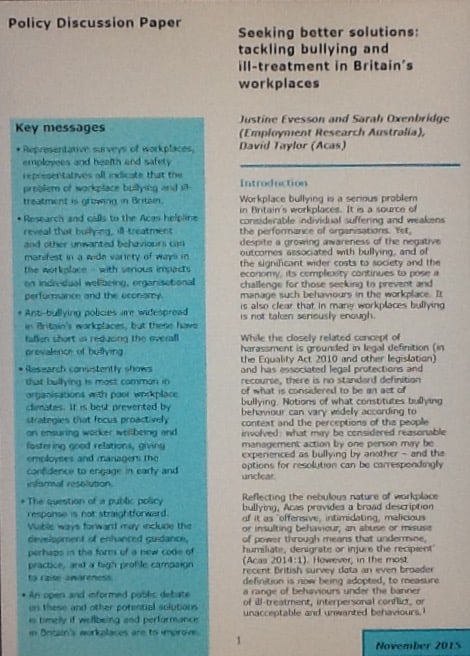
imageRecently workplace bullying gained increased attention in the United Kingdom due to media report about a discussion paper released by Advisory, Conciliation and Arbitration Service (Acas).

The report called “Seeking better solutions: tackling bullying and ill-treatment in Britain’s workplaces” is a very good summary of thinking on workplace bullying that acknowledges the Australian experience but seems to indicate that Britain remains in the early stages of tacking the workplace bullying situation after a series of false starts on the issue.

SafetyAtWorkBlog posed some questions about this paper to Dr 

Subscribe to SafetyAtWorkBlog to continue reading.
Subscribe Help
Already a member? Log in here

Time to reassess our approaches to machinery safety

9781472450777.PPC_alternative mobilitesTalking about workplace safety and machine manufacturing is unfashionable, perhaps because Australia’s manufacturing capacity is in strong decline. And occupational health and safety (OHS) seems preoccupied at the moment with psychosocial hazards and wellness.  But one Australian researcher, Elizabeth Bluff, has undertaken an empirical study of safety attitudes, motivations and practice in the manufacturing and OHS regulatory sectors and produced a remarkable book that needs to be read by everyone involved with workplace health and safety.

Bluff writes

“In illuminating the mechanisms underlying manufacturers’ responses for machinery safety the research also makes wider conceptual and theoretical contributions.  It provides insights into knowledge and motivational factors as principal elements shaping firm performance for social and regulatory goals, and advances understanding of how these elements are constituted in the everyday operations of firms and their interactions with external actors.” (page 3)

Continue reading “Time to reassess our approaches to machinery safety”

OHS Professionals get, or want, global attention

Pages from INSHPO_2015-OHS_Professional_Capability_FrameworkThe International Network of Safety & Health Practitioner Organisations (INSHPO) has launched the “The OHS Professional
Capability Framework – A Global Framework for Practice“.  The document reflects many of the issues raised in recently published research on occupational health and safety (OHS) professionalism, accreditation and certification.  However there are a couple of useful issues to note, from a very brief review, that indicate a major step forward.

Professional, Practitioner, Generalist

Australian OHS professionals have felt insulted over the last few years by the use of the title “OHS Generalist”.  The proponents of this concept failed to understand that the term was divisive (and insulting to some) and this failure indicates a persistent problem in communicating change to the OHS profession in a manner that fosters cooperation.  The INSHPO document seems to drop the Generalist category so beloved by the Australian OHS Education Accreditation Board. Continue reading “OHS Professionals get, or want, global attention”

Bridging Health and Safety, a matter of urgency as well as good business sense?

Susan Fleming, Managing Director of Acting Consulting Training Australia attended a breakfast seminar on November 10 2015 and has provided this guest post .

“We have been shouting about safety for some time and in contrast whispering about well-being and health in the workplace. We need to address this as a matter of urgency”

Perth breakfast seminar 101115Judith Hackitt, Chair of the UK Health and Safety Executive addressed the issue of University of Western Australia Centre For Safety (UWA Centre for Safety) breakfast on 10 November 2015.
In a prudent and well-programmed session, the UWA Centre for Safety inspired good debate about the business impact the well-being of employees is having on the workplace.

Subscribe to SafetyAtWorkBlog to continue reading.
Subscribe Help
Already a member? Log in here

“Old” documents improve the context of modern OHS initiatives

cover of Professional Development Needs of Generalist OHS PractitionersSeveral long and involved phone conversations resulted from last week’s articles on Australia’s Occupational Health and Safety (OHS) Body of Knowledge (BoK) and its role in accreditation of tertiary OHS courses.  It is worth looking at the origins of some of the issues behind the research on these safety initiatives.

One important document was published by the National OHS Commission (NOHSC, a forerunner of Safe Work Australia) in 1999 – “Professional Development Needs of Generalist OHS Practitioners“* .  This NOHSC document continues to be referenced in the continuing debates listed above and illustrates the need to understand our recent OHS past. Continue reading ““Old” documents improve the context of modern OHS initiatives”

OHS formally enters professional sports

On November 9 2015, WorkSafe Victoria charged the Essendon Football Club with breaches of the occupational health and safety (OHS) law over its controversial supplements program. This blog has watched how the Australian Football League (AFL), in particular, has acknowledged its OHS obligations and duties.  This interest has been shared by Dr Eric Windholz who wrote about the charges today.

Windholz acknowledges that WorkSafe Victoria has established a formal presence in professional sports with its decision to prosecute.  

Subscribe to SafetyAtWorkBlog to continue reading.
Subscribe Help
Already a member? Log in here
Concatenate Web Development
© Designed and developed by Concatenate Aust Pty Ltd