
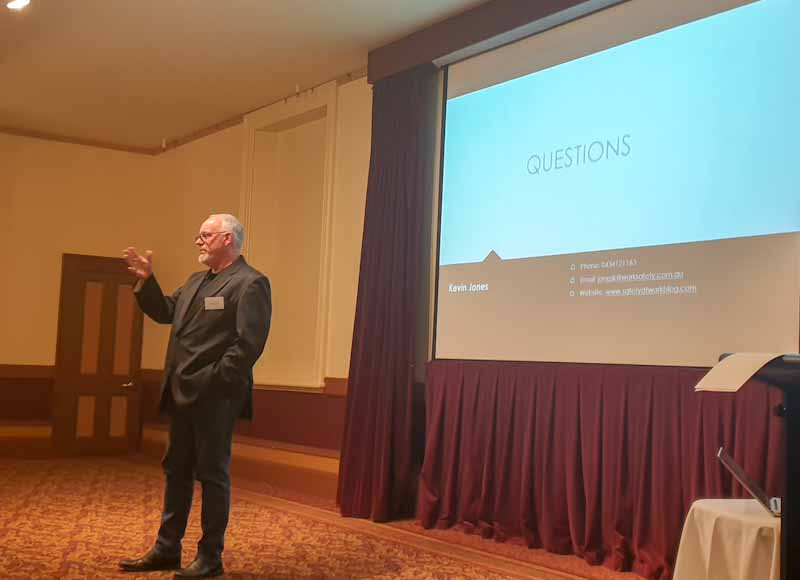
Seminars on workplace mental health must always offer solutions and not only (always) the solution that the host wants to promote. Occupational health and safety (OHS) needs to be more altruistic (Yes, it may be hypocrisy from a subscription blog). Recently I spoke on the issue of psychosocial hazards at work and offered this slide on “What can be done?” [Note: This article discusses suicide]
Continue reading “What to do about workplace mental health? Talk, Listen, Examine”Category: accountability

When an increase of 0.5 percentage points is described as an outrageous 43% increase
This week the Victorian Government flagged changes to the workers’ compensation premiums and eligibility. This has generated outrage from business lobby groups and the trade unions, and as he is being criticised by both political extremes, Premier Dan Andrews believes his decision, i.e. being hated by everyone, is a winner.
The Age newspaper was one of the first to report (paywalled) on the announcement of these changes on May 19, 2023. Significantly it included a quote from Dr Mary Wyatt on the economic and social importance of injury prevention. Hers has been one of the few mentions of the role of good occupational health and safety (OHS) management.
Tip-Off Line
Remember, if you have some OHS information that you want SafetyAtWorkBlog to investigate or that would be of interest to SafetyAtWorkBlog readers, please contact us on the anonymous-if-you-want tip-off line

OHS and the weekend newspapers – 1
This is the first of, hopefully, many articles about what some of the weekend newspapers and media say about issues related to occupy national health and safety (OHS). It will not be comprehensive but short takes on what I see in the newspapers.
[Note, the article below mentions suicide and workplace bullying]
Workload and Suicide
It has been a year since an employee of the Victorian Building Authority, Rob Karkut, died by suicide. According to The Age (May 13, 2023, [paywalled] his suicide occurred:
“…amid intense pressure from the authority’s managers to meet ambitious inspection targets. A litany of failings within the organisation have been exposed since his death.”
Ballarat ups the OHS best practice in procurement
Six months ago, trade unions and occupational health and safety (OHS) advocates protested outside the Ballarat Council offices over the awarding of a construction contract to Pipecon, a company that was prosecuted over the deaths of two workers in a trench collapse several years earlier. Last week, the council decided to upgrade its procurement practices to provide further weight to the OHS performance of tenderers. In effect, it established a new level of “best practice” by local councils in Victoria.
The continuation of engineered stone can no longer be supported
The Housing Industry Association (HIA) is an effective government lobbyist for its members who can be relied on to make a submission to whatever opportunity the governments offer. The HIA does not provide details of membership numbers or names, but it does list its sponsors and partners. Recently HIA made a submission on “the prohibition on the use of engineered stone”. Its position held few surprises.
Perhaps also unsurprising is Kate Cole’s justification for a ban on engineered stone.

Stress reenters the research vocabulary and we are all better for it
Work is making people sicker, according to a recently published research report from the University of Melbourne. The “2023 State of the Future Work – A Work Futures Hallmark Research Initiative Report” said:
“Critically, we find almost three-quarters of people with a chronic illness (73 percent) say that their health condition was caused or worsened by the stress associated with their job.”
page 15
It is good to see the various incarnations of work-related mental health conditions being brought back to the collective and specific term of Stress.

The well-being and psychosocial “wild west”
With the new Psych Health and Safety regs/codes of practice, it seems many corporate ‘wellness’ providers are now branching out into the now topical, psychosocial risk management domain. As someone who supports several national/multinational organisations, I am seeing a big gap between the academic research, provider capability, corporate understanding, and real-world activity. I am also seeing some very questionable tools/approaches/programs and activities emerging in the race to sate the increasing corporate psych risk appetite.
[Guest post by David Burroughs]
Continue reading “The well-being and psychosocial “wild west””