
Who would buy asbestos?

A busy mum, two little kids playing on the carpet in the corridor.  She is busy pulling out an old gas heater from the cavity in the wall.  Dust everywhere.  She wants to recreate the old fashioned open fireplace that was there.  The job will take a few days, she’s not in a hurry.    Then the neighbour asks her gently, “Have you checked, we had asbestos behind our fireplace?”  Mum’s blood goes cold.  She looks at the kids.

‘Who in their right mind would buy asbestos?’  you may ask.  After all the publicity, the growing numbers of tragic mesothelioma sufferers in Australia, the lung cancers, the famous court cases, the Hardies’ debacle.

There are three main ways you can still buy asbestos in Australia.  First, a small number of components used in industry and the defence forces still contain asbestos in sealed conditions.  For example, a shock absorber in the front wheel assembly of an aeroplane may contain an asbestos gasket.  Certain specialised gaskets used in segments of the chemical industry may contain asbestos.  The risk to workers and the general public is very small.

Then you can buy asbestos when you purchase gravel made from crushed masonry from demolished buildings that contained asbestos.  Some 10 million tonnes of such bricks and concrete are recycled every year in Australia.  Continue reading “Who would buy asbestos?”
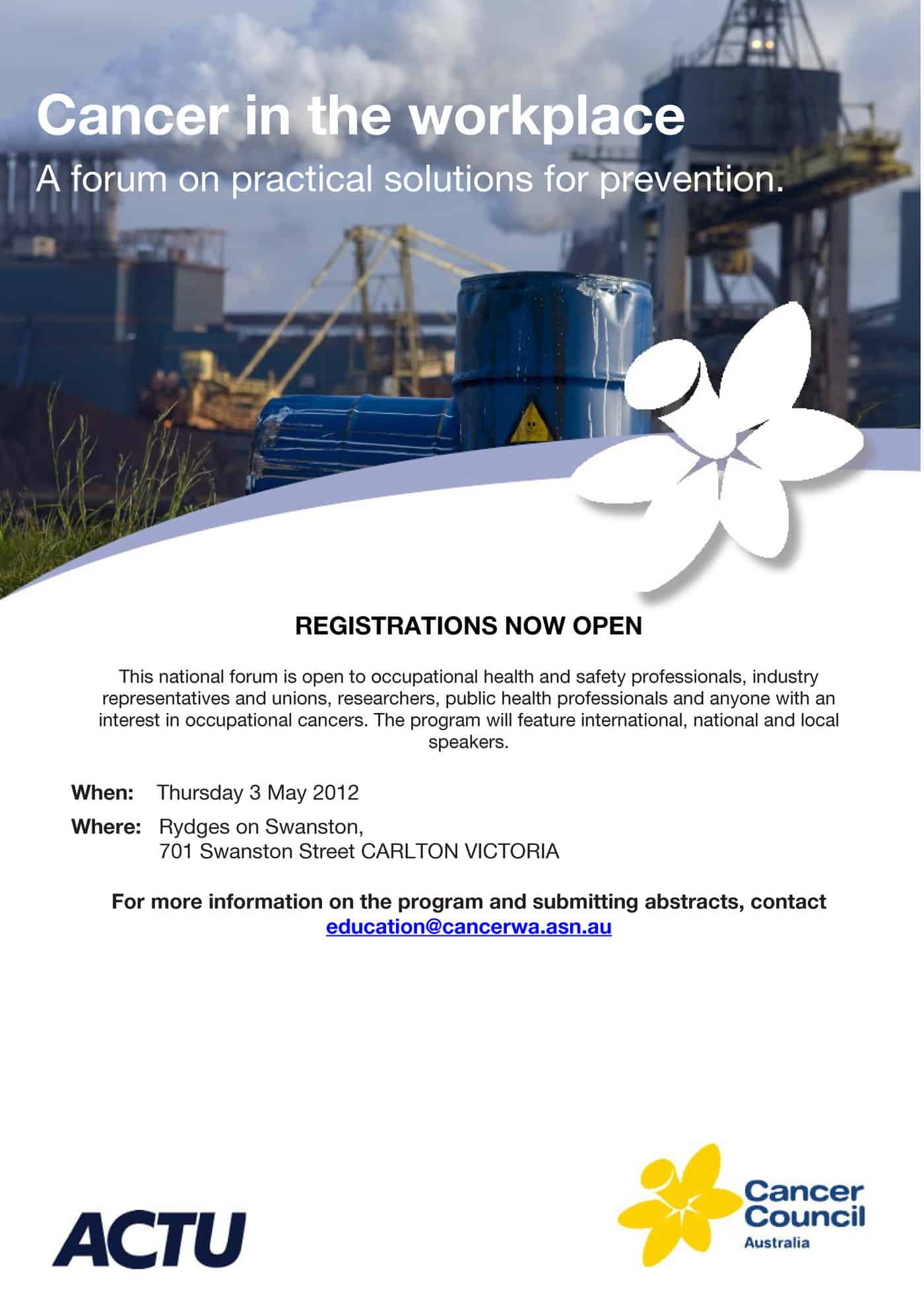
Upcoming cancer in the workplace seminar

In November 2010 Geoff Fary left his role with the Australian Council of Trade Unions (ACTU) to chair the Asbestos Management Review. On May 3 2012 Geoff Fary will join other keynote speakers in a full day seminar in Melbourne called “Cancer in the workplace – a forum on practical solutions for prevention“.  This event has been jointly organised by the ACTU and the Cancer Council of Australia.

Australia’s trade union movement has a good record in asbestos- and cancer-related seminars but rarely do they gain much traction outside of their sector.  The cooperation with the Cancer Council will broaden the appeal of the seminar into more general workplace health consideration, particularly with a speaker from the United States, Lucille Servidio of Capaccio Environmental Engineering.  Local speakers are not overlooked with, probably, Associate Professor Tim Driscoll being the most recognisable participant to OHS professionals.

With the increasing attention to workplace health, concern over cancer clusters and breast cancer risks in nightshift workers, these very affordable seminars often give terrific value – not something that one always gets from the seminars that cost of $A2000 a day.

Kevin Jones

Accuracy on OHS laws, services and products is essential

The following article illustrates how important it is for companies to maintain accuracy when writing a media release about safety laws.  The internet allows for inaccuracies to become widely distributed and for these to gain some legitimacy through the re-publication on various OHS, magazine and news websites.

Asbestos Audits International issued a media release in early April 2012 stating the following:

“On January 1st, 2012, new Australian Model Health and Safety legislation came into effect dictating workplace buildings constructed before 2004 must have an asbestos audit. The legislation outlines building owners, building managers and property managers are responsible for these audits. Continue reading “Accuracy on OHS laws, services and products is essential”

Tread carefully when speaking with the media

One of the most important professional lessons is to only talk about what you know.  I found this out personally after a disastrous pre-conference workshop many years ago where I did not understand what the workshop participants expected until I began seeing blank and quizzical expressions from the, thankfully, small audience.

On Australian radio on 14 December 2011, a geologist became embroiled in an interview on asbestos and cancer.

Ian Plimer is a well-known Australian geologist and is a professor of mining geology at the University of Adelaide.  Plimer is a controversial and outspoken critic of climate change.  The climate change debate is a fringe consideration in occupational health and safety but today,  Professor Plimer entered the debate on asbestos, a carcinogen that is responsible for hundreds and thousands of work and non-work related deaths.

On ABC Radio, prominent Australian journalist and writer on asbestos industry issues, Matt Peacock, took Ian Plimer to task about Plimer’s 2008 claim that chrysotile, or white asbestos, is not carcinogenic.   Continue reading “Tread carefully when speaking with the media”

Free October 2001 safetyATWORK magazine

SafetyAtWorkBlog evolved out of an online publication, safetyATWORK.  In 2001, safetyATWORK published a special edition of the magazine focussing on the OHS issues related to the collapse of the World Trade Centre (WTC) in September 2011.  That special edition is now available as a free download through the cover image on the right.

The magazine contains:

  • an article by Lee Clarke on planning for the worst-case scenarios;
  • an interview with Peter Sandman,
  • an article by me, Kevin Jones,

and other articles concerning

Australia to ratify ILO OHS Convention, says Senator

The Australian Financial Review (AFR) reported on 14 June 2011 (not freely available online) that Senator Jacinta Collins has publicly stated that an International Labour Organisation (ILO) occupational health and safety convention will be signed by the current Government in conjunction with other conventions on maritime labour, asbestos and part-time work.  The announcement that “Australia will ratify four ILO Conventions this year” was made at the recent International Labour Conference.

Most of the AFR article focussed on the labour relations impacts of the conventions but RMIT’s Professor of Law, Breen Creighton noted that

“Ratifying a convention has no effect in Australian law unless the Australian parliaments legislate to give effect to the international obligations.”

Senator Collins’ speech identifies the OHS protocol as the “Optional Protocol of 2002 to the Occupational Health and Safety Convention”.

A brief discussion on this protocol occurred on this blog in late April 2011 when the ratification was mentioned during the World Day for Safety and Health at Work.

Kevin Jones

Australian IR Minister mentions international OHS conventions action

Chris Evans, the Australian Minister for Workplace Relations issued a media statement on 28 April 2011 concerning the World Day for Safety and Health at Work.  As well as some generalities about OHS harmonisation and government commitment, he said

“The Australian Government is also in the process of ratifying the ILO Asbestos Convention 1986 (convention 162) and the ILO Protocol of 2002 to the Occupational Health and Safety Convention 1981 (Protocol 155).

These ILO instruments will give Australians a world class OHS regime, by entrenching best practice in protecting our community from the harmful effects of asbestos and enhancing data collection and publication to support policy making and research.

“Australia has long been a member and supporter of the ILO in its efforts to promote safe work environments and raise the quality of labour and social standards throughout the world,” said Senator Evans.” [links added]

This seems a positive move but it is significant that no deadline for ratification is identified by Minister Evans.  There are also a couple of obvious limitations or problems with these conventions and protocols. Continue reading “Australian IR Minister mentions international OHS conventions action”

Concatenate Web Development
© Designed and developed by Concatenate Aust Pty Ltd