Workplace Bullying Beat-Up

Over the last few weeks the Australian print media has published several articles based on the expressions of concern by some business and employer associations about  Safe Work Australia’s code of practice on workplace bullying.  The latest article was in the Sunday Herald-Sun on 28 October 2012, “Bullying blueprint attacked” (not available in its original form online), which opens with the inflammatory paragraph:

“Workers in cushy jobs will be able to claim compo for being left idle, under national laws drawn up to combat bullying.”

The later online version of the article, by the same writer, Natasha Bita, has a much less aggressive title, “Plan to ban work pranks”, and a revised text.  The “new” opening paragraph says:

“Workers will be able to claim compensation if their boss does not provide them with enough work and office pranks would be banned under national laws to combat bullying.”

This has not stopped Senator Eric Abetz releasing a media statement which states that the workplace bullying code reads

“like something out of the socialist playbook whereby personal  responsibility is thrown out the window and everyone is bound in bubble wrap.”

Senator Abetz is known for these types of colourful statements but the question that should be asked is, why raise these concerns now? Continue reading “Workplace Bullying Beat-Up”

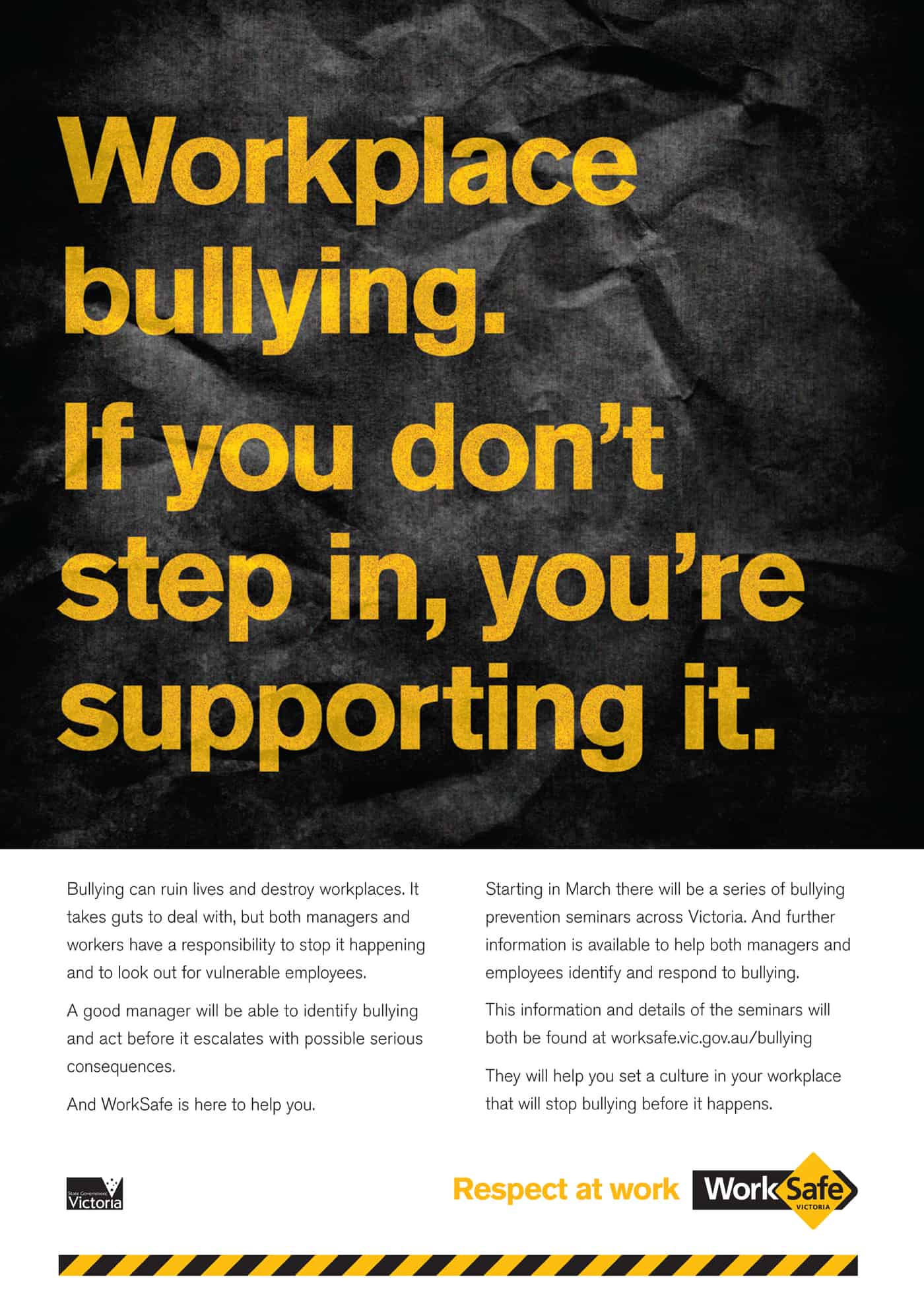
WorkSafe tries a new promotional approach

The increasing prevalence of pictorial social media has generated a surge in organisations generating “infographics” from workplace health and safety statistics Almost always these images are a technique for generating internet traffic through established websites, blogs and other online services. Fundamentally it is stealth advertising for the unwary online user. However, such images have much greater legitimacy when offered by OHS regulators.

In the week prior to its WorkSafe Week 2012, WorkSafe Victoria issued two online infographics as part of a media statement. Both are attractive by their simplicity but the simplicity can also be a problem.

The cost comparison infographic is super general but clearly illustrates that the cost to prevent harm is much less than any fine that may come from prosecution. However, the risk of being prosecuted in Victoria and receiving a monetary penalty seems to be declining as non-pecuniary penalties, such as enforceable undertakings and others, are made available to the Courts.

Fines are only one of the potential costs. An inescapable cost is the cost to the injured worker, the disruption to that worker’s family life, the disruption to the worker’s employer. Continue reading “WorkSafe tries a new promotional approach”

Momentum increases for tangible action on workplace bullying

According to the Canberra Times, a company board has been served with an improvement notice over inadequate attention to workplace bullying claims in a retirement home.  The ABC television program, 7.30, has followed up workplace bullying claims aired earlier this month with a further case on 25 September 2012 with savage criticism of WorkSafe Victoria’s actions in the case.

The Australian Government has completed the public hearings of its Parliamentary Inquiry into workplace bullying.  Bullying is everywhere but little seems to be happening to address the various elements and deficiencies of the regulatory system.

On 21 September 2012 the WorkSafe ACT Commissioner warned about inaction on workplace bullying:

“If bullying has not occurred, then a properly conducted investigation should find that… If, on the other hand, an independent investigation substantiates the allegations, then the employer will be in a position to act to protect their workers from any ongoing threat to their health and safety.” Continue reading “Momentum increases for tangible action on workplace bullying”

Law reform does not prevent harm, only compensates for it

Josh Bornstein is a media-savvy lawyer with Maurice Blackburn who has gained some prominence on the matter of workplace bullying.  A week ago Bornstein spoke at a Legalwise seminar in Melbourne Australia and he has yet to stop running on his topic of discussion – “Disproving the seven myths about workplace bullying”.  Today he released a video of his presentation on the Maurice Blackburn YouTube channel.  The speech from the seminar is HERE.

Lawyers advise that words and statements are very important.  Documents and presentations are deconstructed for nuance and alternate interpretations.  Context is also vitally important to determine why something was said when it was said and why it was said.  These tools are equally useful for Bornstein’s presentation.

Continue reading “Law reform does not prevent harm, only compensates for it”

South Australian WHS laws get closer

Australian OHS discussion forums have been buzzing with the passing of the model Work Health and Safety (WHS) bill through the South Australian Parliament. SafetyAtWorkBlog has been advised that the WHS Bill has yet to go to Committee stage which then requires a third reading.  Some engaged in South Australian politics still believe the WHS Bill will fail to become law.

However the focus should not only be on the WHS Bill as there were other OHS matters discussed in Parliament on 6 September, such as workplace bullying.

Second Reading

The Second Reading Speech (page 2069) by Russell Wortley on 6 September 2012 includes some comments of note. Below are a couple of extracts:

“There has been a lot of fearmongering about the effects of these laws. I want to assure honourable members that these fears are misguided and, sadly, often based on misinformation from lobby groups with a particular self-interest in seeing this legislation defeated.”

“…if we do not modernise our laws now, the scope of legal workplace safety protections will continue to be limited by the employer/employee relationship and existing ambiguities will remain. Honourable members need to understand that if the bill is not passed, a South Australia worker will have lower standards of safety than other workers in other states and territories across Australia.”

Of particular note is that Wortley tables (pages 2077-2079) the Housing Industry Association‘s table of increased costs from the new WHS laws. Continue reading “South Australian WHS laws get closer”

CCH and Freehills produce a curate’s egg of an OHS book

CCH Australia has a long history as a prominent publisher on occupational health and safety issues but its latest book is a “curate’s egg”.

Australian law firm, Freehills, has always been very involved with CCH’s “Master occupational, or work, health and safety  guides but the 2012 edition of the Australian Master Work Health and Safety Guide is a more obvious marketing tool for Freehills than previous editions.  The books have long had a back page advertisement.  This year’s back page is devoted entirely to Freehills. The early pages of this edition include ten of photos of Freehills authors contributors with another eight of other non-Freehills authors before any useful text appears.  It is difficult to see the need for such prominence when names alone have been sufficient in books for decades.

The book is also much more graphical and pictorial than previous editions but CCH’s decision to keep the book’s contents in black and white is less than impressive.  Some of the monochrome photos in the Manual Tasks chapter are indistinct. Previous OHS books like CCH’s 2003 Australian Master OHS and Environment Guide had no graphics so colour was not missed.  The lack of colour was a poor decision for this book.

The chapters on the model Work Health and Safety laws are less interesting than those sections dealing specifically with hazards.  This book is a good introduction to many of the OHS issues that safety professionals will deal with or need to be aware.  One recently graduated work colleague found the chapter on Plant Safety particularly good but basic.  The information on the WHS laws seems familiar, and similar information is likely to be available from a much cheaper source or from reputable online sources.

Continue reading “CCH and Freehills produce a curate’s egg of an OHS book”

Where do workers and managers learn about respect?

The origins of workplace bullying behaviour seem many.  One of the issues to, hopefully, emerge from Australia’s inquiry into workplace bullying is how to prevent and minimise bullying, but to do so, one will need to identify the causes.  And these causes need to be more than an amorphous, unhelpful concept like “workplace culture”.

David Yamadamake this comment in his blog, “Minding the Workplace“, about a recent article in a New York Times blog (gosh, social media feeds social media.  What’s a newspaper, Daddy?):

“Doctors and lawyers in training may have no idea how to conduct themselves as practitioners, other than being influenced by a lot of unfortunate “role models” on television. If we want to prevent workplace bullying, the training schools for these professions are the first and perhaps best places to start.”

This point links thematically to several recent SafetyAtWorkBlog articles about defining a safety profession, moving from a practice to a profession, workplace culture and workplace bullying. Continue reading “Where do workers and managers learn about respect?”

Concatenate Web Development
© Designed and developed by Concatenate Aust Pty Ltd