Why isn’t workplace health and safety improving?

On Wednesday June 24 2020 at 1.30pm (AEST) I will be presenting my conference paper on the topic above. This is the first Australian Institute of Health and Safety conference to be conducted virtually and I am proud to be part of this year’s conference. As it is virtual, there is no limit on tickets so if you could not attend previous AIHS conferences, get to this one. Below is an extract from my paper:

The workplace fatality rates have been falling consistently for decades.  Occupational health and safety (OHS) professionals seem to be busier than ever.  So, the world must be safer than it has been in the past?  Maybe.  But this may not be the reality if we think a little deeper about the causes of harm and about the actions the OHS profession has applied.

Here is a typical graph showing the rate of workplace fatalities since 1985, when the modern OHS legislation was enacted in Victoria.

Subscribe to SafetyAtWorkBlog to continue reading.
Subscribe Help
Already a member? Log in here

How logical is safety? Here’s a fresh perspective

This week I found a research paper in my inbox called “How logical is safety? An institutional logics perspective on safety at work”. The Background and Objective were, respectively:

“Occupational incidents and accidents are still commonplace in the contemporary workplace, despite increased understandings of safety.”

“This article aims to yield new insights into safety-related thinking, decisions and behaviours through the application of an institutional logics perspective.”

As most readers do, I read something and try to link it with ideas, concepts and conversations we have been involved with in the past. My brain tried to fit the use of “institutional logics” with safety culture and then with organisational culture but it did not seem to fit, and I wondered whether I should bother with institutional logics.

Subscribe to SafetyAtWorkBlog to continue reading.
Subscribe Help
Already a member? Log in here

Tooma on Mental Health – Review

Michael Tooma is probably the most prominent occupational health and safety (OHS) lawyer in Australia. His latest book is, a little pretentiously, called “Michael Tooma on Mental Health“, but it fits with the series of OHS-related publications he has written for Wolters Kluwer. Unusually for a lawyer, there are only two chapters that specifically discuss legislative obligations, and, in many ways, these are the least interesting.


Positive Mental Health

In the Introduction, Tooma goes out of his way to stress the positive benefits of work. He is critical of the current OHS approach to workplace stress writing that we seek a “Goldilocks” application of perfection when this is really subjectively determined by each worker. Tooma challenges this in a major way through the 2012 study by Keller and others:

Subscribe to SafetyAtWorkBlog to continue reading.
Subscribe Help
Already a member? Log in here

If staff are “going to hit the wall”, redesign the wall

On May 11 2020, the Australian Financial Review’s back page ran an article (paywalled)about how “corporates” are becoming aware of mental health risks due to the COVID19 disruption. It is a good article but also one that reveals the dominant misunderstanding about mental health at work and how to prevent it.

Subscribe to SafetyAtWorkBlog to continue reading.
Subscribe Help
Already a member? Log in here

Is it OK to lie to your employer while working from home?

[Guest Post] By Simon Longstaff (reproduced with permission from Crikey)

Each week, The Ethics Centre’s executive director Dr Simon Longstaff will be answering your ethics questions [in Crikey]. This week:

“ My employer sent me a questionnaire designed to test if my home working environment meets basic standards. If I’d answered truthfully I would have ‘failed’ the test. But what’s the point in telling the truth when I have to work at home in any case? Was it wrong to lie on the form?”

Although this ethical issue seems to fall on you — as the person receiving the survey — it actually starts with your employer’s decision to request this information in the first place.

Subscribe to SafetyAtWorkBlog to continue reading.
Subscribe Help
Already a member? Log in here

OHS, organisational culture, sex abuse and the Catholic Church

The discussion of “organisational culture” has tried to remain apolitical or amoral, but it always relies of case studies to illustrate the academic and ephemeral. Largely these studies involve major disasters, but few people work in heavy industry, chemical plants, or offshore oil rigs. Better examples could be sought by looking at other industries, such as the Catholic Church. (I really hope someone is examining this relationship in a PhD)

Subscribe to SafetyAtWorkBlog to continue reading.
Subscribe Help
Already a member? Log in here

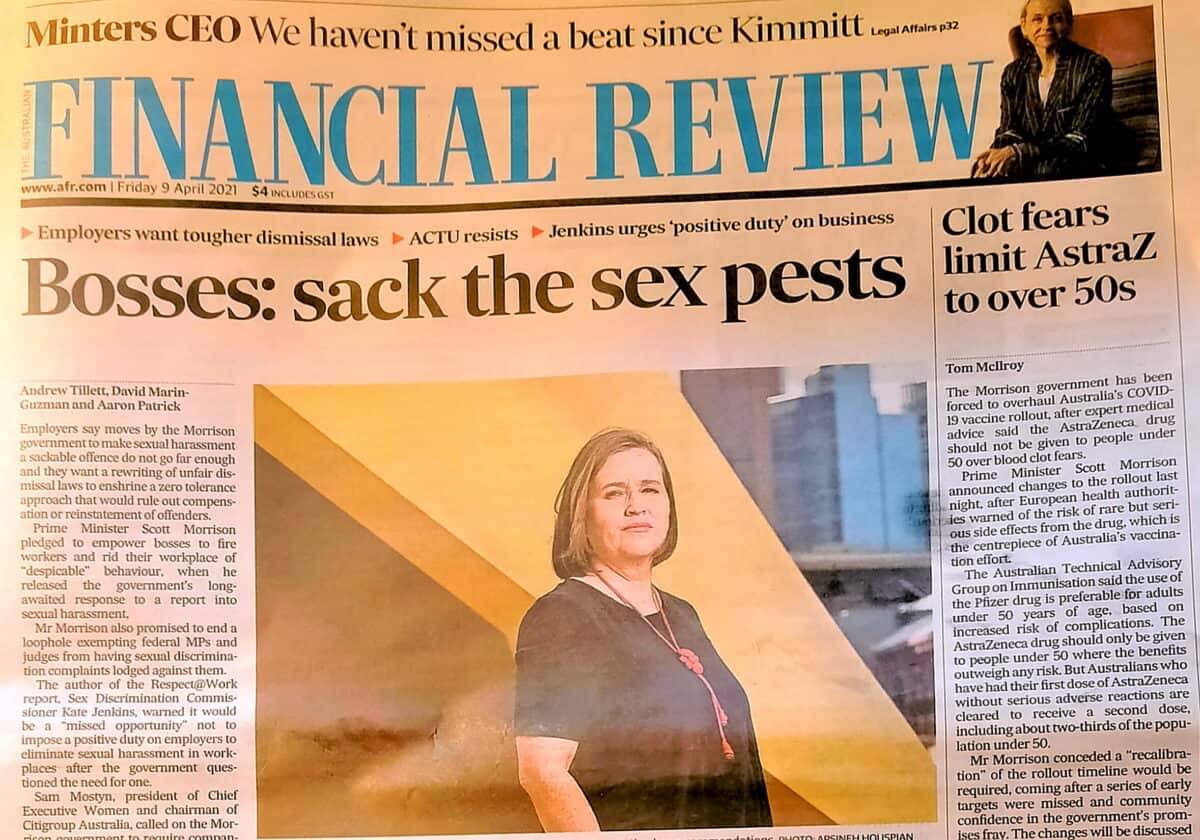
New gendered-violence guide is good on the What but thin on the How

Australia’s trade union movement has been at the forefront of many of the occupational health and safety (OHS) changes, especially workplace stress and bullying. Other than Industrial Manslaughter laws, its most recent campaign targeted to a workplace hazard has revolved around work-related gendered violence. Last week WorkSafe Victoria released a guide to employers on “work-related gendered violence including sexual harassment”. The advice in this guide is good but does not go far enough and is less helpful than it could have been.

Subscribe to SafetyAtWorkBlog to continue reading.
Subscribe Help
Already a member? Log in here
Concatenate Web Development
© Designed and developed by Concatenate Aust Pty Ltd