Sexual misconduct research – Interview with Professor Marie Bismark

A lot of recent attention has been given to incidents of sexual harassment in Australian legal and finance corporations, in particular, and how these are being (mis)managed. COVID19 has thrown a big focus on the working conditions of health care workers. Last month, Australian research on sexual misconduct was released that is, essentially, a Venn diagram of the issues of sexual harassment and misconduct with health practitioners.

The lead author of the study, Associate Professor Marie Bismark, professor of Public Law at the Melbourne School of Population and Global Health, spoke exclusively with SafetyAtWorkBlog about the research findings.

Subscribe to SafetyAtWorkBlog to continue reading.
Subscribe Help
Already a member? Log in here

Liability, COVID19, Manslaughter and Working from Home – Welcome to the new OHS

Last week WorkSafe Victoria followed some of the other Australian States by requiring employers to report positive COVID19 cases as “notifiable incidents”. (If they can do this fro COVID19, shouldn’t it be possible to do the same for mental health disorders?) Expanding the pool of notifiable incidents is of little practical consequence but it is indicative of how occupational health and safety (OHS) management is changing, and how Industrial Manslaughter is becoming a pervasive threat.

Managing Liability

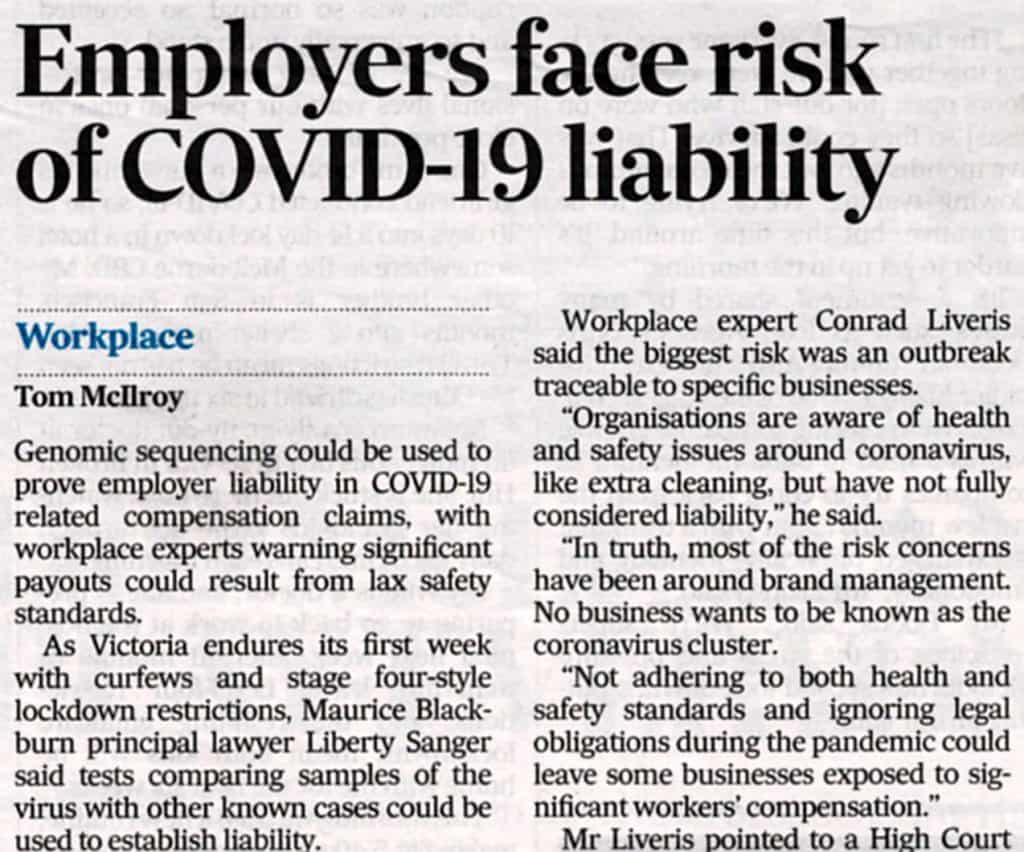
In the Australian Financial Review (AFR) on August 4 2020, employer liability for COVID19 incidents was discussed. Liberty Sanger of union-associated law firm, Maurice Blackburn, spoke of the importance of genomic testing to better identify the origin of the infection, ie. was it caught at work or at home.

Subscribe to SafetyAtWorkBlog to continue reading.
Subscribe Help
Already a member? Log in here

Australians become impatient for change on sexual harassment

Victoria, perhaps, has the best chance of applying occupational health and safety (OHS) principles to the prevention of sexual harassment and the psychological harm that harassment can generate. In the wake of the sexual harassment allegations against former Justice Dyson Heydon, several reviews into the legal profession have been announced.

Sexual harassment at work remains on the national agenda with the Federal Government yet to respond to the Australian Human Rights Commission’s (AHRC) Respect@Work Report which has been sitting with the government since March 2020.

Subscribe to SafetyAtWorkBlog to continue reading.
Subscribe Help
Already a member? Log in here

“Justice Tempered” – ethics and abuse

Recently the Finance Sector Union (FSU) released a small study on ethics and capitalism. The report illustrates how poor corporate ethics and greed created a disregard for the mental health of the finance industry’s workers as well as the financial and mental health of its customers.

The report – “Justice Tempered – How the finance sector’s captivity to capitalist ethics violates workers’ ethical integrity and silences their claims for justice” – was written by John Bottomley, Brendan Byrne and John Flett. Although it is based on detailed interviews with only eight finance sector workers, the authors use these conversations as a catalyst for broader discussions of ethics with extensive cross referencing of relevant, books, publications and, especially, the findings and report of the Royal Commission into Misconduct in the Banking, Superannuation and Financial Services Industry.

Subscribe to SafetyAtWorkBlog to continue reading.
Subscribe Help
Already a member? Log in here

Call for change on sexual harassment could use support from OHS

Discussion on the sexual harassment allegations against former High Court judge Dyson Heydon continue even though some Australian States’ media have returned to COVID19 clusters and football. On July 6, 2020, five hundred women in the legal profession published an open letter calling for

“… wider reforms to address the high incidence of sexual harassment, assault and misconduct in the legal profession”

The signatories call for an independent complaints body for the Australian judiciary and changes to the appointment of judges. What is missing is Prevention.

Subscribe to SafetyAtWorkBlog to continue reading.
Subscribe Help
Already a member? Log in here

Two steps forward, one backward

The latest media release from the Australian Institute of Health and Safety (AIHS) shows a remarkable maturity and a newfound ability to be inclusive and topical.

The AIHS, in conjunction with several other occupational health and safety (OHS) related organisations, developed and released an important guidance on respiratory protection masks for the work environment. Not only is this super topical but the effort has the support of the Australian Council of Trade Unions (ACTU), an organisation that, historically, has been reluctant to support OHS initiatives from outside trade union resources.

The primary purpose of the media release is to push the Federal Government for “the urgent establishment of a register for approved respirators (aka face masks)”, but this may be too simplistic and too narrow a focus especially when the issue of face masks is a critical part of the Governments’ plans to “reopen” the economy.

Subscribe to SafetyAtWorkBlog to continue reading.
Subscribe Help
Already a member? Log in here

Exclusive Interview with Dr Tom Doig

SafetyAtWorkBlog had the chance to put some questions to Dr Tom Doig in early 2019 prior to the book’s release. Below is that exclusive interview.

SAWB: “Hazelwood” is predominantly a book that describes the social and environmental impacts of the Hazelwood. What, if any, overlap did workplace health and safety (WHS) and WorkSafe Victoria have in the fire’s aftermath?

TD: In the aftermath of the mine fire, a number of WHS issues have come to the fore. Firstly, in the 2014 Hazelwood Mine Fire Inquiry, a number of criticisms were made of Hazelwood’s regulatory framework, with a suggestion that there was a ‘regulatory gap’, as expressed by Mr Leonard Neist, Executive Director of the Health and Safety Unit at the Victorian Workcover Authority (VWA), at that time:

‘If I identify that gap as, who is responsible for regulating for the protection of public safety, regardless of what the source of the hazard or the risk is, who’s responsible for public safety, that’s where the gap probably is and I can’t—if you were to ask me right now, I can’t tell you who is responsible for regulating public safety. I’m responsible for regulating workplace safety and responsible for public safety as a result of the conduct of that undertaking, but I couldn’t tell you who is directly responsible.’

In this case, while VWA focuses on the health and safety of mine employees, they aren’t explicitly concerned with the health and safety of the general public, if a hazard – like a 45-day plume of toxic smoke – is dispersed beyond a specific workplace.

Continue reading “Exclusive Interview with Dr Tom Doig”
Concatenate Web Development
© Designed and developed by Concatenate Aust Pty Ltd