Treatment of workers from Transocean oil rig

More information is coming to light about the treatment of survivors of the explosion on the Transocean oil rig.  According to an article (and podcast) on National Public Radio on 6 May 2010, company lawyers for Transocean had survivors sign waivers within hours of the disaster.

The article says:

“The form that they made them sign had, ‘I was here when it happened, I didn’t see anything.’ Or ‘I saw this and I was or was not hurt,’ ” says Steven Gordon, a Houston attorney who represents some of the survivors…. Continue reading “Treatment of workers from Transocean oil rig”
How revolutionary could the Work Health and Safety Act be?

In April 2010, the Australian Government is busy negotiating a new health reform package.  It is likely that the next stage of the reforms will be in the Australian Senate which brings Nick Xenophon into the negotiations.  On 21 April 2010,  The Australian reported Xenophon saying:

“…he had “an open mind” on the deal brokered by the Prime Minister yesterday but wanted to ensure it had a strong emphasis on preventative health, which was the ultimate “test of the health system”.”

Senator, Nick Xenophon, provides a good example of how personal ideals cross social boundaries and professional disciplines.  His focus on the prevention of harm covers public safety and workplace safety illustrates the interconnection that an ethical stance can bring social issues that are governed under different laws and expectations. Continue reading “How revolutionary could the Work Health and Safety Act be?”

A discussion on ethics and OHS decision making

In 2004, I was asked to make an OHS-themed presentation to a group of paramedic students on ethics and from a small business perspective.  Some of the information may have dated slightly but I post this to stimulate discussion.  Below is an edited version of that 2004 oral presentation:

Quite often, when we have an ethical dilemma, “should I do this or should I do that?” we often go away somewhere to think.  In the short term, you “sleep on it” and when you wake you may have a solution or, at least, a different perspective on the problem.  Often we try to clarify our perspective.  I don’t know many people whose job it is to develop ethical statements or programs who sit at a table and talk about ethics.  More often, we go away and think about the issue and then come back and discuss, compare and refine our problem.  We frequently do this with our colleagues and by using our social network.

For an example, recently a colleague asked for me to sign off on a safety manual for some Australian contractors who are installing equipment for an American company in Australia.  It is one thing to deal with companies in your native country but dealing with overseas companies is very different.  With local companies you can solve problems by meeting with the Manager or CEO but when it is an American company, from such a litigious society, how should a small business proceed?  Should I accept the contract?  Is the risk worth the money?  I am not sure. Continue reading “A discussion on ethics and OHS decision making”

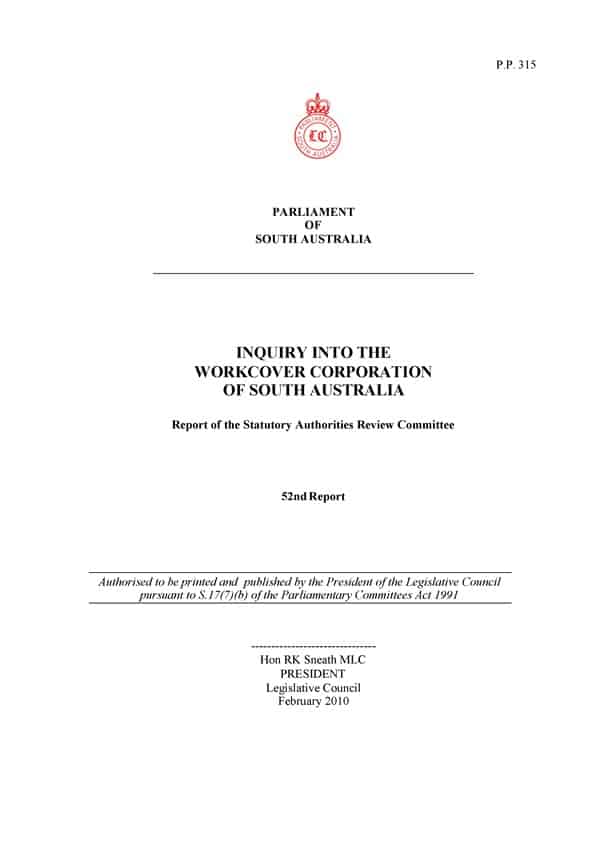
Workers’ Compensation becomes an election issue in South Australia

On 12 February 2010, the Greens parliamentarian, Mark Parnell, accused WorkCover Corporation of failing injured workers in South Australia.  In response to the release of the Parliament’s Statutory Authorities Review Committee (SARC) inquiry into WorkCover, he said

“The Greens have been saying for a number of years now that the outsourcing of WorkCover’s claims management is a failed experiment, and must be reversed….. Until WorkCover fixes up the poor management of injured workers, it will never get out of its financial mess.” Continue reading “Workers’ Compensation becomes an election issue in South Australia”

Asbestos Awareness Week – journalist conversation

On 25 November 2009, the Victorian Trades Hall hosted a conversation on asbestos and corporate management between two well-respected Australian journalists and writers, Matt Peacock and Gideon Haigh.  Over the last few years both have produced excellent books focusing on the role of James Hardie Industries in the asbestos industry in Australia.

The books, Killer Company and Asbestos House, respectively, provide different perspectives on the conduct of James Hardie Industries, the various board members and the support provided to the company over many decades by various Australian and State governments.

While SafetyAtWorkBlog is producing articles about the event, below is a one minute video sample of the event where Matt Peacock is talking about the PR mastery of James Hardie Industries.

Kevin Jones

Senator calls for Senate hearing on the safety of posties

Senator Steve Fielding is the head of the Family First Party, the smallest political party in Australia’s Parliament at the moment.  Fielding is one of the handful of senators who hold the balance of power in the parliament and therefore has more political influence than a party of the size of Family First usually has.

On 19 October 2009, as a result of evidence given at a Senate inquiry by a representative of Australia Post, Senator Fielding said, in a media statement:

“There are serious allegations staff have been forced back to work simply to sit in a room to watch television so managers can get their bonus for having lower lost injury time figures,” Senator Fielding said.  “This is outrageous and puts the health of workers at risk because of some greedy managers.

“No wonder Australia Post won an award last month for its rehabilitation of injured workers if it’s fudging the numbers.  There’s an obvious conflict of interest between InjuryNET, which looks after the doctors that Australia Post sends its workers too, and Australia Post itself.

“Dr David Milecki, who is a consultant to Australia Post’s return-to-work program, also runs InjuryNET.

“Australia Post even admitted that this contract did not go through an independent process – there was not even a tender process.

“We need a senate inquiry urgently to make sure Australia Post employees are being looked after and that they’re aren’t being taken advantage of by dodgy managers who are more interested in their bonuses.”

SafetyAtWorkBlog contacted Australia Post to gauge some reaction.  A spokesperson says that Australia Post will be cooperating fully with any Senate inquiry.

Every country has its fair share of eccentric politicians.  The current feeling is that Steve Fielding is Australia’s.  But regardless of character or competence, the Senator has authority and a responsibility to investigate the concerns listed above.

This is a developing story but one that may relate a little to issues raised in the recent SafetyAtWorkBlog about awards nights.

Kevin Jones

An Ombudsman for the safety profession

WorkSafe Victoria is very keen for the safety advice and management discipline to become professional.  It is providing considerable technical and financial support to the Safety Institute of Australia and other members of the Health and Safety Professionals Alliance (HaSPA).  The current status of HaSPA in Australia has been discussed in other SafetyAtWorkBlog articles.

HaSPA likes to compare itself to other managerial professions such as accounting, medicine and the law, and is trying to establish a contemporary profession.  One of the professions mentioned, law, an established profession for hundreds of years, is seriously considering the introduction of an ombudsman, a concept that should have been established already for the safety sector.

According to a media report in The Australian on 4 September 2009:

A taskforce of federal and state officials is working on a plan to create a national legal ombudsman with unprecedented power over the nation’s lawyers.

If the plan goes ahead, the ombudsman would be able to set standards for all lawyers, oversee the handling of all complaints from consumers and intervene with the profession’s state-based regulators.

One option being considered would establish the office of the legal ombudsman as a new national institution drawing authority from a network of uniform state laws.

This would unify the regulation of lawyers and give state governments a role in confirming prospective candidates for the new national office.

Lawyers, rather than taxpayers, could be asked to pay for the cost of establishing their new regulator.

The taskforce, which has been appointed by federal Attorney-General Robert McClelland, is examining the possibility of establishing the new office as the centrepiece for the promised regulatory overhaul of the legal profession.

OHS law in Australia is undergoing its most major national review in decades.  Shouldn’t the safety profession also develop the “Office of the Safety Ombudsman”?  The legal profession is doing all the work on a model.

Australia has a tradition of effective industry-based ombudsmen.  A list is available online but the most publicly well-known would be the Telecommunications Industry Ombudsman.

[In the last couple of years the safety profession has heard from the Victorian Health Services Commissioner, Beth Wilson, on the purpose and role of the commission and how the safety profession can learn from her support, adjudication and  advocacy.  The commissioner is not an ombudsman but there may be a role for a safety commissioner to address WorkSafe’s concerns over the quality of safety advice being provided by safety professioanls to business.  A video of Beth Wilson briefly discussing the role is available on YouTube.]

The application of an Ombudsman model in the safety profession should be discussed but similar objections will be raised to those of the legal profession in the article quoted above.  Underpinning the objections is that an established profession is resistant to change and suspicious of relinquishing the power it has established over its lifetime.

If the safety advocates are truly committed to establishing a contemporary profession, the concept of a safety ombudsman must be discussed or else  the system of self-regulation will continue and so will the lack of independence, the lack of accountability, the limited communication and the lack of faith by the general community that safety professionals can be trusted to do a good job.

Kevin Jones

Concatenate Web Development
© Designed and developed by Concatenate Aust Pty Ltd