Building a resilient society

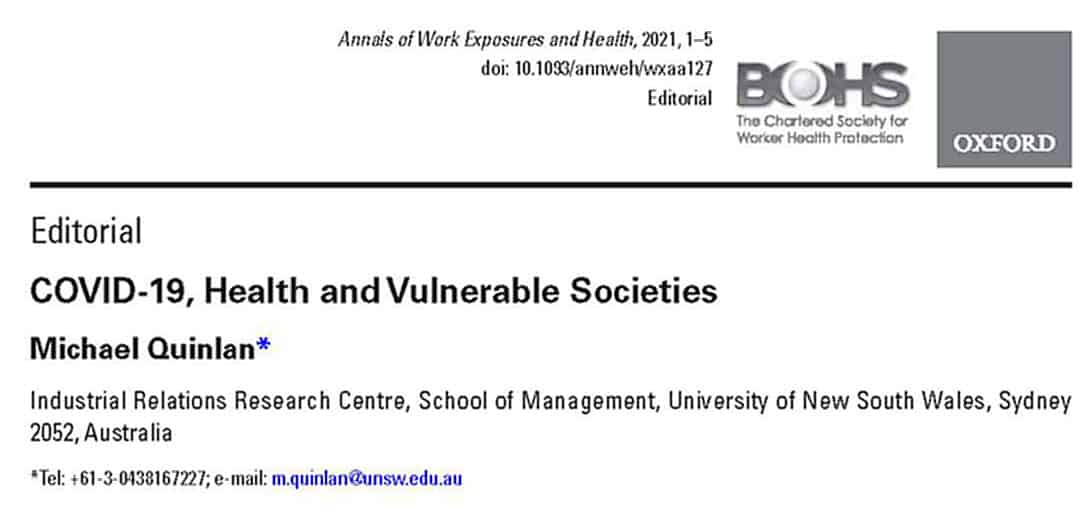
In the middle of a pandemic, it is easy to be locked into small issues, especially if they directly relate to you, such as lockdowns or sick relatives but it is important to be reminded of the broader social context. Professor Michael Quinlan recently wrote an editorial for the Annals of Work Exposures and Health, entitled “COVID-19, Health and Vulnerable Societies”.

Subscribe to SafetyAtWorkBlog to continue reading.
Subscribe Help
Already a member? Log in here

“safety theft” in the gig economy

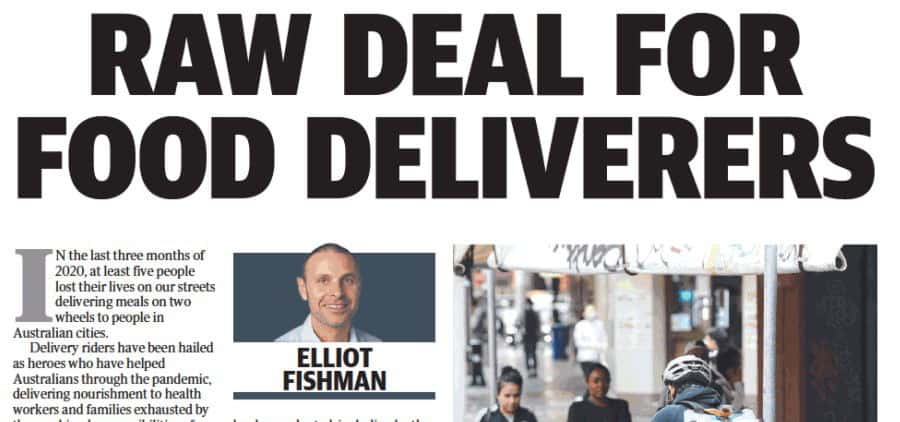
An opinion piece by Dr Elliot Fishman, of the Institute for Sensible Transport published in the HeraldSun newspaper on January 3, 2021 mentions Industrial Manslaughter in relation to food delivery drivers. (The article appears to be unavailable online) The link is tenuous and seems outside of Dr Fishman’s main area of expertise, but that seems to be the nature of Industrial Manslaughter penalties, they pop up in all sorts of discussions, many unrelated to the point being made.

The point Dr Fishman seems to be making is that the delivery of food on two-wheeled vehicles is dangerous, as shown by recent deaths of several riders in Victoria and New South Wales, and he poses several questions and suggestions to improve the situation:

Subscribe to SafetyAtWorkBlog to continue reading.
Subscribe Help
Already a member? Log in here

OHS and the Four Day Week

Recently the BBC’s Business Daily had a short discussion about the introduction of the 4 Day Week. This workplace reform has knocked about for a few years now and seems to have some mental health and job satisfaction benefits. This is enough for it to interest occupational health and safety (OHS), especially as it is one of the few examples of a structural and organisational change rather than an intervention aimed at each individual worker.

The BBC discussion indicates the difference (it may be a schism) between a new way of thinking about work and the old traditional way. The opponent to the 4 Day Week emphasises the individual over the organisational and compares service industries to those that produce goods.

The episode, now a podcast, is a good introduction to the for and against of the 4 Day Week but careful listening shows the challenge ahead.

Continue reading “OHS and the Four Day Week”

Federal leadership misses State action

Australia’s Industrial Relations Minister and Attorney-General, Christian Porter, has popped up on occupational health and safety (OHS) issues several times in the last few weeks. It is fair to say that each time he has not really shone, partly due to political ideology and partly due to constitutional structures. Some of these barriers, the Minister can address.

As mentioned recently, several food delivery drivers have died. Minister Porter was asked specifically about one of these deaths, that of Chow Khai Shien, in Parliament by the Australian Labor Party’s Josh Burns. Porter said that he had talked to representatives of the Transport Workers Union about this type of work, but:

“One of the things that we discussed in that meeting was the fact—that is acknowledged, I think, inside the union—that occupational health and safety for those drivers is, not just predominantly, but essentially, a state based responsibility.”

Subscribe to SafetyAtWorkBlog to continue reading.
Subscribe Help
Already a member? Log in here

Gig work changes that could save lives

The New South Wales government is conducting an inquiry into the gig economy, modern versions of precarious work. There has been five deaths of food delivery workers over the last few months and this has increased media attention on the Inquiry and the issues raised.

On November 28 2020, Joellen Riley Munton, Professor of Law at the University of Technology, Sydney spoke on the Australian Broadcasting Corporations’ AM Program. Out of all the recent media discussions on gig work, Munton’s seemed the most targeted on occupational health and safety (OHS).

Subscribe to SafetyAtWorkBlog to continue reading.
Subscribe Help
Already a member? Log in here

Getting distracted from safety

Seven years ago, the Australian Capital Territory (ACT) suffered a spike of workplace deaths in the construction sector. The then WorkSafe Commissioner produced a report, supported by at least one conference and extensive consultation, which proposed substantial changes. All of the recommendations from the 2012 Getting Home Safely report were accepted by the government and construction had no deaths for several years after but recent deaths have resurrected tensions between the ACT Government and the Master Builders Association (MBA).

Subscribe to SafetyAtWorkBlog to continue reading.
Subscribe Help
Already a member? Log in here

Will IR reform again ignore OHS?

Government policies that directly affect occupational health and safety (OHS) have been determined on a tripartite structure for many decades. This model comprises of representatives from business groups and trade unions in a consultation usually led by the government representatives. SafetyAtWorkBlog believes that this structure excludes important voices and is outdated, especially in a time when technology and the internet allows for a much broader consultation.

The limitations of the tripartite structure were on display recently when the Australian Government released the names of the organisations involved in the review of the industrial relations system. It is worth reading the list for you to understand who will be deciding your working future. It is also worth considering whether the negative OHS impacts of job and employment structures will be given the attention they deserve.

Subscribe to SafetyAtWorkBlog to continue reading.
Subscribe Help
Already a member? Log in here
Concatenate Web Development
© Designed and developed by Concatenate Aust Pty Ltd