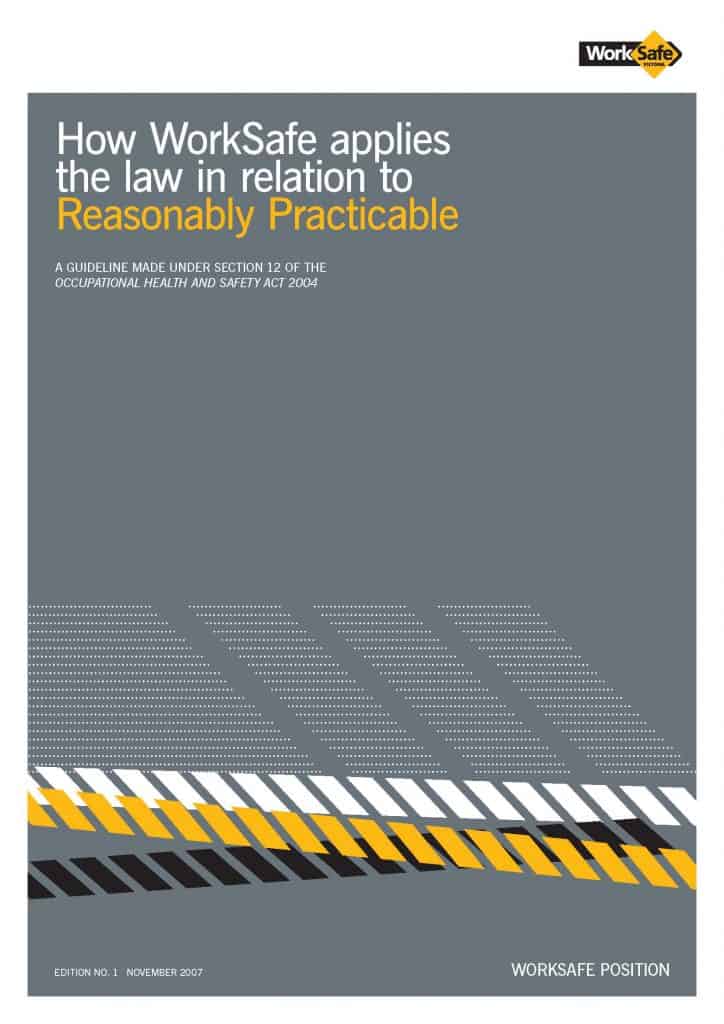
“So far as is reasonably practicable” is often used by scoundrels

On May 4, 2006, John Della Bosca advised the New South Wales Parliament:

“The Government will clarify that the general duties and obligations under the Act apply so far as is reasonably practicable. Ensuring the health and safety of employees will mean eliminating risks to health and safety so far as is reasonably practicable. Where it is not reasonable to eliminate a risk, employers will be required to reduce the risks to the lowest level reasonably practicable. Practical risk management does not require employers to go to extraordinary, unrealistic lengths, and never has. Rather, it requires the management of risks that are likely to affect health and safety over which the duty holder has a level of control. This is what the Government has always said, and it has always been Government policy. This is what it intends to enshrine in legislation to give greater certainty to both employers and employees.”

Della Bosca paints “so far as is reasonably practicable” (ASFAIRP) as an integral part of eliminating risks to health and Safety, and it is an integral part of OHS laws, but it is also a limitation, a condition and a concession in achieving safe and healthy workplaces and one that is drastically in need of a thorough independent review.

Subscribe to SafetyAtWorkBlog to continue reading.
Subscribe Help
Already a member? Log in here

OHS, sexual harassment, HR and the pursuit of prevention

HRDaily unlocked an article concerning workplace sexual harassment on March 6 2020. The article was written by lawyer Fay Calderone and SafetyAtWorkBlog sought clarification from her on a number of points.

Some of the issues raised in the original article and Calderone’s responses will be discussed in a secondary article.

Subscribe to SafetyAtWorkBlog to continue reading.
Subscribe Help
Already a member? Log in here

The next gig job must be safer and healthier

A man in different kind of occupations. Credit:
bowie15

A lot of focus is currently on casual workers as their jobs disappear due to the responses to the COVID19 coronavirus. Australia has around 2.6 million of them and there are many more workers who may be classified as Part Time but operate on uncertain rosters and are, in reality, as precarious as casual employees. Occupational health and safety (OHS) is struggling to address the hazards presented by modern variations of precarious work, such as gig economy workers, because it, and government economic and employment policy more generally, is structured on the assumption of Full Time Employment (FTE) with work occurring mainly from nine to five, on weekdays with weekends off.

Consideration of precarious worker OHS may seem a lesser priority at the moment as many of us are quarantined or quarantine by choice but at some point, hopefully, within the next twelve months, business will resume. However, that business model and structure is unlikely to be the same. Indeed, it should not be same as the risk profile for all businesses and the community generally has changed. So, let’s have a look at some of the recent thinking about precarious work and the OHS risks so that we can build a better, safer model.

Subscribe to SafetyAtWorkBlog to continue reading.
Subscribe Help
Already a member? Log in here

There but for the Grace of God ….. Dreamworld

The nature of news/media reporting is that any story must be topical, but the nature of occupational health and safety (OHS) is that topicality is stretched over years of investigation or it stutters over time when a new bit of information is available. This has been the case with the aftermath of the deaths of four people at the Dreamworld theme park in Queensland and there is a strong likelihood that other topical news, such as the possible pandemic of COVID-19, will mask the important management issues of Dreamworld.

Subscribe to SafetyAtWorkBlog to continue reading.
Subscribe Help
Already a member? Log in here

Can poor safety management = negligence?

L to R: Catherine Dunlop and Dale McQualter

In relation to the release, last week, of the Brady Review SafetyAtWorkBlog wondered:

“It is worth asking whether a reliance on Administrative Controls could be interpreted as a level of negligence that could spark an Industrial Manslaughter prosecution.”

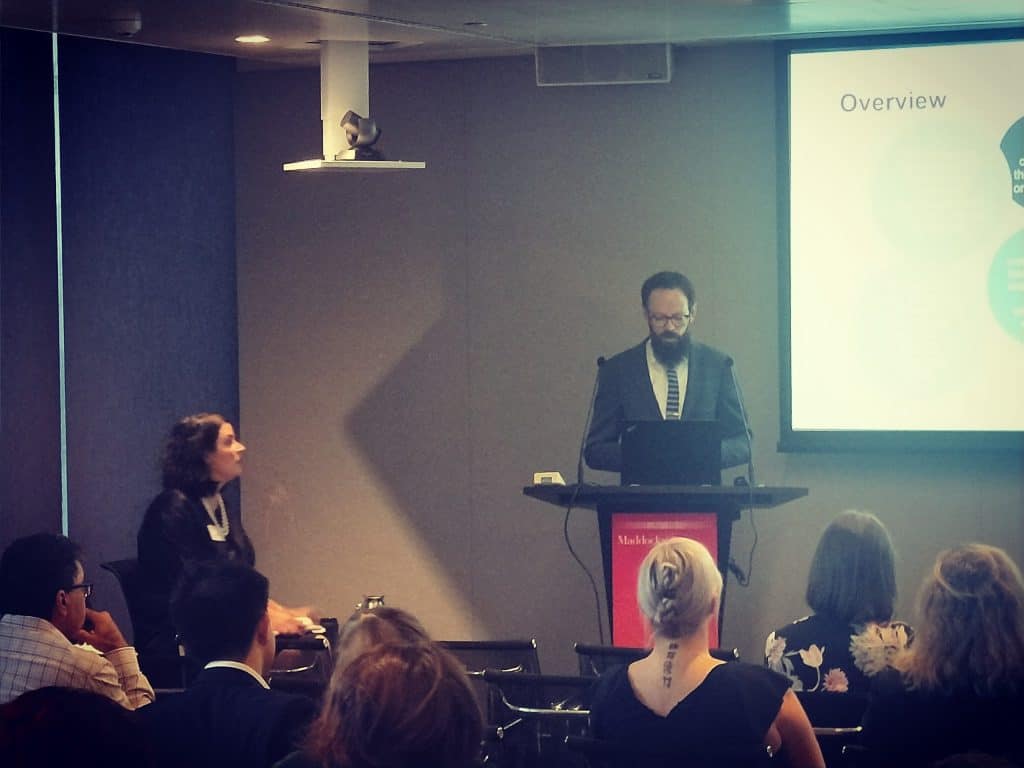
A seminar hosted by law firm Maddocks this week offered an opportunity to pose this as a question.

Subscribe to SafetyAtWorkBlog to continue reading.
Subscribe Help
Already a member? Log in here

Industrial Manslaughter – politics, suicide and misrepresentation

The 2020 business year has started with a bunch of occupational health and safety (OHS) seminars. Given last year’s moves towards Industrial Manslaughter laws in several Australian States, a discussion of these laws is inevitable and there are some voices calling out the politics of the issue. Herbert Smith Freehills’ Steve Bell is one of them.

Subscribe to SafetyAtWorkBlog to continue reading.
Subscribe Help
Already a member? Log in here

Take a good hard look at your business and do something about it

The Medical Journal of Australia (MJA) published an opinion piece on January 20, 2020 concerning working hours in the medical profession and the risk of mental health and suicide from working excessive hours. It uses the Japanese problem of “karoshi” to illustrate the severity of the workplace risks but it misses a couple of points.

It references the amendments to Victoria’s Occupational Health and Safety (OHS) legislation that introduced an offence of Industrial Manslaughter but implies that this amendment changes the duty of care expected of employers and changes a worker’s right to a safe and healthy workplace.

Subscribe to SafetyAtWorkBlog to continue reading.
Subscribe Help
Already a member? Log in here
Concatenate Web Development
© Designed and developed by Concatenate Aust Pty Ltd