
The NSCA Foundation has distributed an opinion piece on the occupational health and safety (OHS) duties of officers. The language in the article is anomalous in the context of contemporary OHS thinking and trends.

The NSCA Foundation has distributed an opinion piece on the occupational health and safety (OHS) duties of officers. The language in the article is anomalous in the context of contemporary OHS thinking and trends.
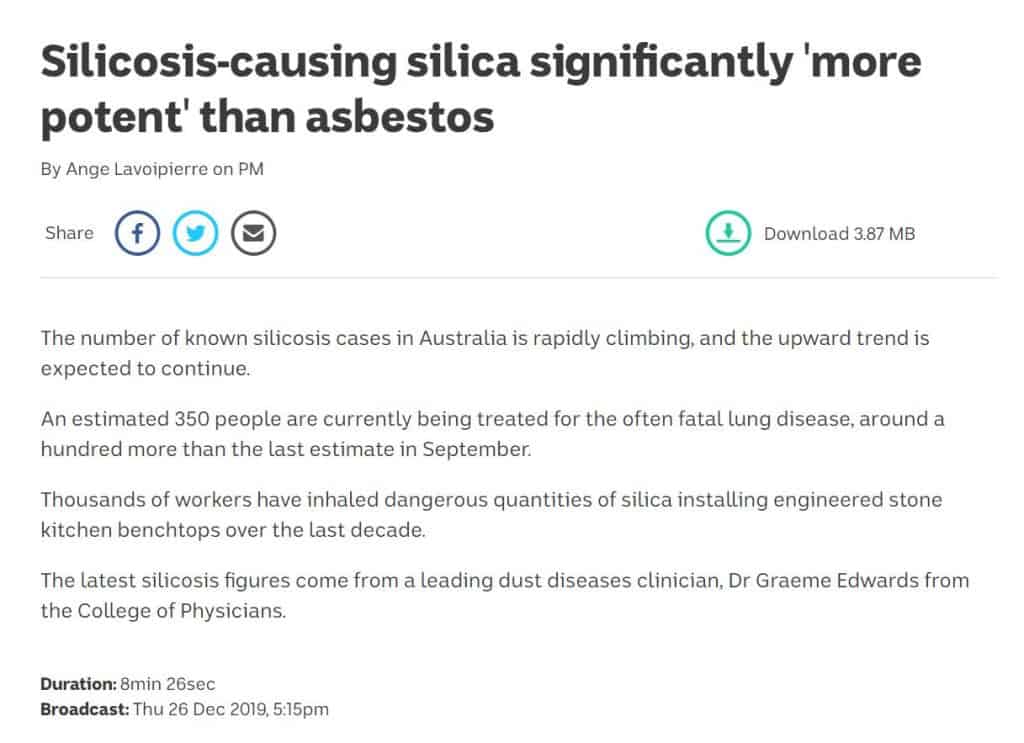
In late December 2019, Dr Graeme Edwards provided an update on Australia’s silicosis situation to the Australian Broadcasting Corporation’s PM program in which he mentions the movement of businesses to avoid occupational health (OHS) and safety obligations and duties.
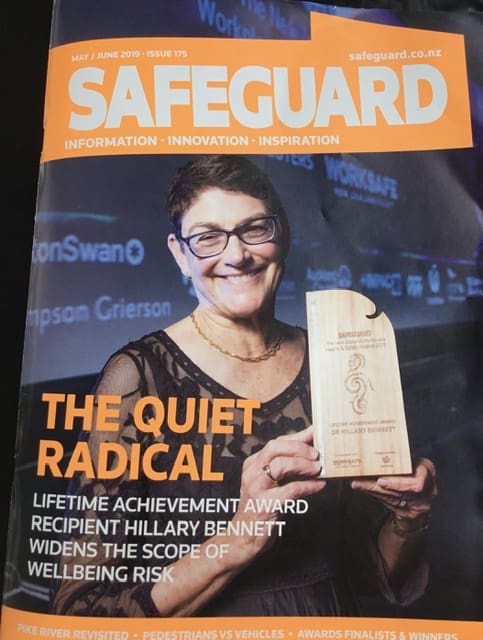
There seems to be a spate of intelligent and knowledgeable people talking about the structural changes required by businesses to reduce and prevent psychological harm. Two Australian voices are Lucinda Brogden and Dr Rebecca Michalak. New Zealand has Dr Hillary Bennett who recently received a Lifetime Achievement Award at the New Zealand Workplace Health and Safety Awards. Bennett’s interview with SafeGuard magazine should be obligatory reading.
Bennett is asked about the Human Resource (HR) profession and nails a critical difference in the HR approach to the occupational health and safety (OHS) one:

Any assessment of ethics in relation to occupational health and safety (OHS) is worthwhile and so the release of a chapter on ethics by the Australian Institute of Health and Safety (AIHS) generated some excitement. That excitement diminished somewhat as this Chapter of the Body of Knowledge (BoK) dealt with ethics in a very narrow context – “Ethics and Professional Practice“.

One reader has asked about the occupational health and safety (OHS) impacts of Brexit. This article looks specifically at The Conservative and Unionist Party Manifesto to identify potential OHS-related actions and intentions. The relevance for Australian readers is that UK and Australian politics frequently feed off each other.
The United Kingdom’s OHS laws have been greatly affected during the country’s membership of the European Union (EU). This has been seen as a nuisance by some but some EU safety Directives, such as Seveso 1, 2 & 3, have assisted many countries in establishing or strengthening their own regulations on specific hazards. EU safety rules seem amazingly complex for someone who has no involvement with them but then any economic community of over two dozen countries can seem baffling to an OHS writer who operates from an island with a small population in the Southern Hemisphere.
What can be said is that the UK will need to accommodate the “best” of the EU OHS laws in their own legislative structure, if it has not already. It is unlikely the UK will remove OHS rules that serve a positive, i.e. harm prevention, purpose unless there is a very good reason. But sometimes it seems that good reasons are not required, only political reasons.

This past week most media have been reflecting on the last twelve months or the decade. There are two ways of applying this practice to the SafetyAtWorkBlog – statistics and most-read. Let’s look at statistics first.
This year the SafetyAtWorkBlog posted 225 articles, not including this one, with an average word count of 1,030 words – the equivalent of a 230,000 word book on occupational health and safety (OHS). For those Annual subscribers that equates to just over $1.00 per article which I think is a pretty good return.
Continue reading “Most-read OHS articles in 2019”
The France Telecom suicide saga has reached a conclusion with a French Court sending several of company’s former executives to jail as a result of “collective moral harassment”. This will have very little impact on the management of occupational health and safety (OHS) in Australia because of the timing and inadequate translation and context.
“Moral Harassment” is a term that is absent from the Australian OHS lexicon. One equivalent term is “mobbing” but this is also an uncommon term in Australia. Australia’s equivalent is “workplace bullying” as mentioned in research by Katherine Lippel of the University of Ottawa in 2011 (pages 1-2).