HR and Legal have failed to address sexual harassment. Could OHS do better?

2019 is likely to be the year when the deficiencies and advantages of the occupational health and safety (OHS) approach to the prevention and management of the psychological harm produced by work-related sexual harassment will contrast (clash?) with the approach used by the Human Resources (HR) profession.  For many, many years OHS has failed to implement the control measures that the available research and guidance recommended.  For the same length of time, HR has largely focused on addressing the organisational consequences of accusations of sexual harassment displaying a preference for legal action or to move the accuser out of the organisation.

These approaches persist but there is some hope that recognition of each others’ role and purpose can bridge the ideological demarcations.  Australia’s inquiries into work- and non-work-related harassment have the potential to change the way psychological harm is seen, managed and, maybe, prevented.

Subscribe to SafetyAtWorkBlog to continue reading.
Subscribe Help
Already a member? Log in here

The Shock of the New

The Australian Human Resources Institute (AHRI) has recently published an article about the significant Human Resources trends for 2019. The trends identified include

  •  “A Change of Government”
  •  “Gig Economy Classification”
  •  “Sexual Harassment”
  •  “Technology Trends”

SafetyAtWorkBlog will be more specific in its occupational health and safety (OHS) “trends” for 2019.

Subscribe to SafetyAtWorkBlog to continue reading.
Subscribe Help
Already a member? Log in here

Addressing the invisible causes of visible harm

The trade union movement was instrumental in showing that workplace bullying was a pervasive problem in Australian workplaces.  Many Codes of Practice and guidances for workplace bullying and occupational violence were written shortly after the action by the Australian Council of Trade Unions almost two decades ago.  But, for some reason, although sexual harassment was mentioned in those early documents, it never received the attention in occupational health and safety (OHS) circles that, in hindsight, it should have.

Perhaps a more sustainable and effective strategy would be to focus on the “harassment” rather than the “sexual”, or in

Subscribe to SafetyAtWorkBlog to continue reading.
Subscribe Help
Already a member? Log in here

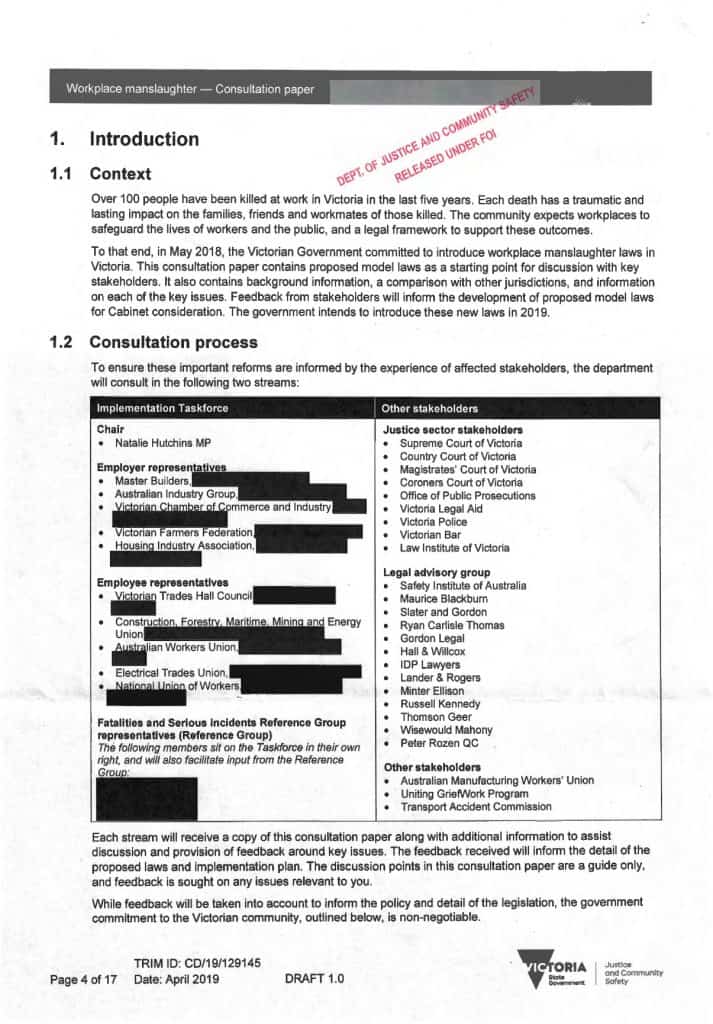
“Put them in jail!” – Industrial Manslaughter laws are not that simple

Christy Cain at ALP National Conference

Several people were surprised when Industrial Manslaughter laws popped up on the agenda on Day 3 of the National Conference of the Australian Labor Party (ALP) this week.  To ALP members from Western Australia and the Construction Forestry Mining Maritime and Energy Union, Christy Cain and Thomas French put a resolution on the issue to the Conference, which the delegates endorsed.

Most of the media who mentioned this resolution, and it was not many, focused on Cain’s urging of the delegates to

“Kill a worker, go to jail”.

Even though getting the audience to chant was colourful,  and the minute’s silence important, the discussion around Industrial Manslaughter laws was more nuanced.

Subscribe to SafetyAtWorkBlog to continue reading.
Subscribe Help
Already a member? Log in here

OHS is often about broken promises

Occupational health and safety (OHS) is often about promises.  Employees trust their bosses to provide them with a job and the employer promises to provide a workplace that is as safe as possible.  There are also contractual policies which formalise OHS relationships between client and contractor.  But OHS is more often about those more personal promises and expectations between the boss and the worker.

A

Subscribe to SafetyAtWorkBlog to continue reading.
Subscribe Help
Already a member? Log in here
Concatenate Web Development
© Designed and developed by Concatenate Aust Pty Ltd