
I once had to stop a potential fight on a construction site between a works supervisor and a safety professional. The verbal abuse and niggling occurred for several minutes before the men’s chests were inflated like roosters and it was at this point I stepped in to diffuse the situation by asking some questions as…
Category: law
Bullying, evidence, ethics and solutions
Safety people love evidence, particularly evidence of hazards because evidence can validate what we thought we saw. Perhaps of more importance is evidence about what types of interventions work. A recent study into the prevention of workplace bullying (abstract only) held the promise of solutions, even though it was a literature review and of some…
OHS and Marcus Cattani

Dr Marcus Cattani, is a Senior Lecturer in Occupational Health and Safety (OHS) within the School of Medical and Health Sciences at Edith Cowan University and a leading Australian OHS consultant. SafetyAtWorkBlog endeavoured to glimpse the person behind the qualifications by asking Dr Cattani some safety-related questions and he was kind enough to respond.
What attracted you to looking at workplace health and safety? Did you fall into it or always have an interest?
I was lucky enough to find out about WHS when I was around 20 years old, during my environmental science based college course. At that time, in the late 1980’s the trend for people finishing my course was to work in asbestos management or in Council environmental teams, neither of which really excited me!
Trump, Puzder and workplace safety
 Occupational health and safety (OHS) law in the United States has little impact on that of any countries outside of North America. But the response to those OHS laws by US and multinational companies indicates corporate approaches to workplace safety and this can spread round the world. The anticipated strategy to worker safety under the Presidency of Donald Trump is expected to be harsh, if he attends to it at all.
Brad Hammock, Attorney at US workplace law firm, Jackson Lewis P.C. (pictured right), told SafetyAtWorkBlog that
“There is a dominant view that there will be a weaker OSHA under the Trump presidency. This is driven largely by historical analyses of past Republican administrations and President Trump’s anti-regulatory rhetoric. I anticipate that OSHA will continue to be active, but will emphasis cooperative and voluntary programs over enforcement. In addition, I anticipate fewer large safety and health standards being issued under a Trump presidency. “
Outsourcing inductions may not support good safety management
 SafetyAtWorkBlog has been critical of the use and sale of generic Safe Work Method Statements (SWMS) for work tasks that can be managed through simpler and freely available job safety analyses (JSAs) and face-to-face communication. On 27 January 2017, the Chamber of Commerce and Industry of Western Australia (CCI) launched generic inductions.
The CCI asks and answers, in its media release:
“So why is it that so many workplaces don’t provide an induction? Our Members are telling us that they don’t really know what information they should be giving to a new starter.”
An internet search of the WorkSafeWA website would have led one to its “
Funding granted to UnionsACT for research
Pages 13-14 of the Australian Capital Territory’s Hansard for December 14 2016 contained a curious discussion on work health and safety (WHS) funding.
The discussion was primarily looking for details on government funding of trade union WHS services. Rachel Stephen-Smith of the ruling Labor Party and responsible for workplace safety stated that part of the financial grant given to UnionsACT is for “undertaking research into work health safety”. Alistair Coe, Liberal leader of the opposition sniffed a political opportunity and asked:
“…has any of the research which has been undertaken by UnionsACT actually been published?”
Inconsistent quad bike safety advice in WA
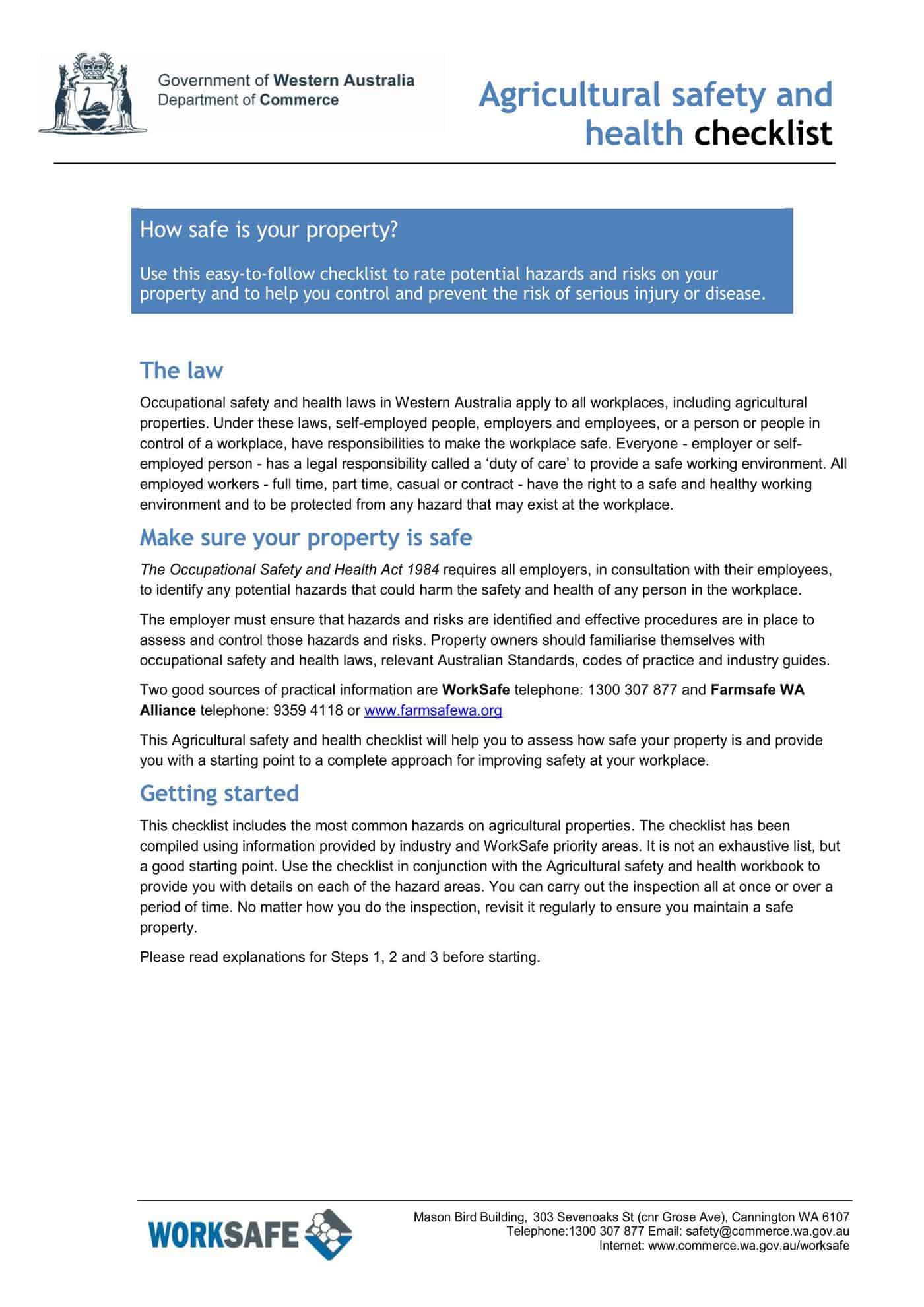 On 18 January 2017, WorkSafeWA released an agricultural safety checklist which includes some hazards associated with quad bike operations. West Australia’s occupational health and safety (OHS) regulator stresses the checklist only lists common hazards and refers to a handbook. The only agricultural handbook available on its website is from 2014 and the quad bike safety information seems outdated or, at least, inconsistent with the advice from South Australia and elsewhere. Continue reading “Inconsistent quad bike safety advice in WA”