The CFMEU should make a case for union OHS representatives

In late March 2014, the Construction Forestry Mining and Energy Union (CFMEU) was fined $A1.25 million over a violent dispute at the Emporium construction site that occurred in 2012.  In its media release about the fine, the CFMEU’s state secretary, John Setka, says:

“The protest at the Myer site in 2012 was about safety.”

Yes and no.  The dispute was about the representation of workers on safety matters, which is a different thing.  Setka goes on: Continue reading “The CFMEU should make a case for union OHS representatives”
CEO survey shows odd attitude to OHS

Cover of AiGroup CEO Survey 2014One has to be very careful with surveys, particularly those involving business confidence or surveys of an organisation’s membership base.  These are often surveys of perception which may not correlate with reality and can be used as an excuse to lobby government or set an agenda rather than determining a societal truth.  A recent example of this type of survey seems to have been produced by the Australian Industry Group entitled “Burden of Government Regulation“.  The AIGroup’s media release accompanying the report states that

“Over 83% of employers surveyed listed regulation related to industrial relations and occupational health and safety as a significant regulatory burden in 2014.”

Continue reading “CEO survey shows odd attitude to OHS”

Lessons from Royal Commission into Home Insulation Program

Australia’s Royal Commission into the Home Insulation Program (HIP) demands the attention of all occupational health and safety (OHS) professionals, primarily, because a job creation and economic stimulus program was so poorly planned at the highest level of government, that it seems to have established a culture that led to workplace deaths. However the Royal Commission is already revealing information that shows how OHS is misunderstood by decision-makers, a situation that still persists in many jurisdictions and will only change by watching the Royal Commission carefully and analysing this information through the perspective of workplace safety.

State of Knowledge

The Royal Commission has been investigating when the workplace deaths in New Zealand from using metal staples with foil insulation were known by the Australian Government.  In OHS-speak, it is trying to determine the state of knowledge on this workplace hazard in the decision-making process.  The deaths of four young Australian workers prove that the state of knowledge was inadequate however it is well established that Australia and New Zealand operate independently and that, although there are legislative similarities, it is rare for a death in one country to generate regulatory change in another.  (One could look to the quad bike safety issues for an additional example.)  The recent legislative changes in New Zealand may indicate that they listen to Australia more than vice versa.

Subscribe to SafetyAtWorkBlog to continue reading.
Subscribe Help
Already a member? Log in here

Senator Abetz oversteps on workplace bullying claim

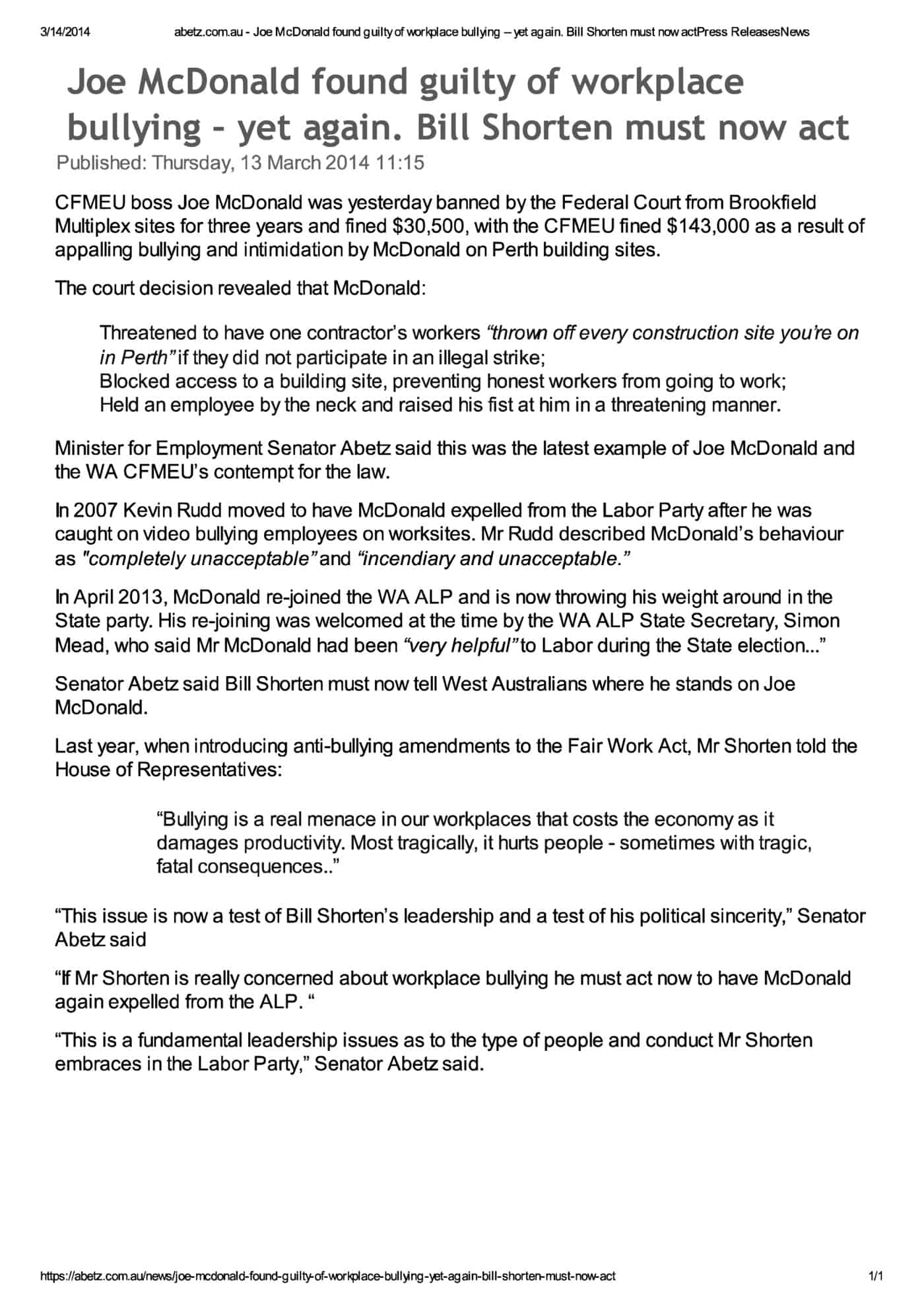
abetz.com.au - Joe McDonald 130314Anyone dealing with occupational health and safety (OHS), or in any profession, knows to be careful with one’s words in public.  This is particularly so when one is dealing with mental health issues or claims of workplace bullying.  This week Senator Eric Abetz, Australia’s Workplace Relations Minister, seems to have overstepped the mark by misrepresenting some Federal Court Orders as related to workplace bullying, when the Court made no such statement.  This could simply be dismissed as political hyperbole in the heat of the moment but this was no off-the-cuff remark.  He headlined his media release on 13 March 2014 as:

“Joe McDonald found guilty of workplace bullying – yet again. Bill Shorten must now act”.

According to Safe Work Australia, an organisation within Senator Abetz’s portfolio, workplace bullying is defined in the most recent national guide as

“repeated and unreasonable behaviour directed towards a worker or a group of workers that creates a risk to health and safety.” (page 2)

Nowhere in the Federal Court orders*  is workplace bullying, or any other bullying, mentioned and the Federal Court has not found Joe McDonald guilty of workplace bullying. The best that can be said is that Joe McDonald has a history of intimidation on construction sites and that this has created tense relations between the workforce and employers (perhaps a confused safety culture) and generated delays in construction.

Does this all matter? Yes

Subscribe to SafetyAtWorkBlog to continue reading.
Subscribe Help
Already a member? Log in here

New Zealand trumps Australia on workplace bullying advice

Cover of workplace-bullying NZWorkSafe NZ has released “best practice guidelines” on workplace bullying.  Best practice is a nonsense term but this guide is a major step above similar guides in Australia, in particular.

Definitions

Guides always begin with definitions and the definition New Zealand has applied is the same as that in the recently released Australian workplace bullying guide but with a couple of odd semantic differences.  These variations should not have any effect on organisational changes required to prevent bullying but the variations are curious. Australia describes “unreasonable behaviour” the actions that generate the bullying as:

“…  behaviour that a reasonable person, having considered the circumstances, would see as unreasonable, including behaviour that is victimising, humiliating, intimidating or threatening.”

New Zealand’s definition is:

“…. actions that a reasonable person in the same circumstances would see as unreasonable. It includes victimising,  humiliating, intimidating or threatening a person.”

Is there a difference between actions and behaviours?  

Subscribe to SafetyAtWorkBlog to continue reading.
Subscribe Help
Already a member? Log in here

New industrial relations book does service to OHS (for a change)

It is common for industrial relations to be written about without any mention or serious analysis of occupational health and safety (OHS). But a new textbook on Australian industrial relations includes a very good chapter of OHS that, significantly, cross-references other chapters in the book to provide a unified approach that reflects both the title and its intent. The book is called “Australian Workplace Relations” and the workplace health and safety chapter is written by Elsa Underhill.

Underhill has written on the OHS effects of precarious employment extensively and this issue is the basis of her chapter.  She sees this as major cause of many of the OHS issues, particularly the growth in psychosocial risks in modern society and provides copious amounts of Australian and international research in support. Continue reading “New industrial relations book does service to OHS (for a change)”

Concatenate Web Development
© Designed and developed by Concatenate Aust Pty Ltd