Serious questions raised over the role of Safe Work Method Statements

Any safety conference involving the Australian construction industry will have some discussion on Safe Work Method Statements (SWMS) and this weekend’s Building Safety conference was no different. During the presentation on Saturday by the Federal Safety Commissioners, SWMS was bubbling along underneath many of his words and statements. Sadly, the audience (now) seems to have been too polite to ask him questions about the elephant in the room. There was no such hesitation following the presentation by Brookfield-Multiplex’s Paul Breslin on the Sunday.

Several delegates stated their belief that the Office of the Federal Safety Commissioner (OFSC) is largely to blame for the over-emphasis on SWMS in the construction sector and for the bloating of SWMS into a document that does little to improve safety and is more related to meeting the audit criteria of the OFSC.

Continue reading “Serious questions raised over the role of Safe Work Method Statements”

Rita Donahy speaks at Australia’s Building Safety conference

Donahy 2013 01The first international speaker at this weekend’s Building Safety conference in Canberra, Australia was Rita Donahy, author of the One Death Is Too Many report into the UK’s construction industry safety performance, and a member of the House of Lords.

Donahy stressed that workplace safety is, and should be, a social issue and not treated as a special case.
Continue reading “Rita Donahy speaks at Australia’s Building Safety conference”

Supreme Court decision limits public knowledge of OHS offences

Woman CelebratingIn May 2013 Fiona Austin (@upfrontfi) a lawyer with the Australian law firm, Herbert Smith Freehills (HSF), tweeted:

“Great win in the Supreme Court! No more naming and shaming for health and safety offenders in Queensland”

The Supreme Court decision is an appalling situation over which OHS professionals and regulators should be outraged.

Austin and other HSF lawyers authored a longer article on the case and totally miss the point of why OHS offenders should be named.  Shaming of offenders is a different matter.

The article explains how a decision under the Penalties and Sentences Act 1992 (Qld) may stop the OHS regulator in Queensland, Work Health and Safety Queensland, from listing the names of offenders on its website. Continue reading “Supreme Court decision limits public knowledge of OHS offences”

New workplace bullying laws generate heated debate

Today Australia hosts a No2Bullying conference.  It is a timely conference as the debate on Australia’s changes to the Fair Work Act in relation to workplace bullying heats up.

Lawyer Josh Bornstein is particularly critical of the politicisation of the amendments and believes this increases the instability or remedies available to victims of workplace bullying by increasing pressure on under-resourced OHS regulators.

The amendments are unlikely to reduce the incidence of workplace bullying in Australia as they address post-incident circumstances.

As the new legislation is being passed through Parliament, the industrial relations, political and legal context will dominate the media, Continue reading “New workplace bullying laws generate heated debate”

New Zealand railways, red tape, politics and workplace deaths

cover of NZ RailOn 28 April 2013, New Zealand lawyer, Hazel Armstrong, published a 48-page book on how workplace fatalities and the management of the NZ rail industry has been related to politics and economics.

This is an ideological position more than anything else and the evidence is thin in much of this short book but there is considerable power in the description of the manipulation of occupational health and safety regulations and oversight during the political privatisation of the NZ rail sector.  Many countries have privatised previously nationalised, or government-owned, enterprises usually on the argument of productivity and efficiency increases.  Armstrong argues that these arguments were used to justify breaking the trade union dominance of the rail industry. Continue reading “New Zealand railways, red tape, politics and workplace deaths”

Short-sighted redefinition of worker

In May 2013, Workcover Queensland supported the government’s intention to change the definition of worker to match that of the Australian Taxation Office (ATO).  The definition re-emphasises the significance of the employer/employee relationship.  Workplace health and safety laws through most of Australia have recently changed to remove the reliance on the employer/employee relationship with the intention of clarifying the lines of responsibility for preventing harm.  The diversity between workers’ compensation and OHS definitions unnecessarily complicates the management of a worker’s health through the linear experience of employment.

The government believes such changes will reduce “red tape” but only in the narrow context of workers compensation.  The Work Health and Safety Act expands the definition of worker but another piece of legislation in the same State restricts it.  Inconsistencies of concepts are likely to lead to duplications, confusion and arguments that may generate as much unnecessary business and legal costs as the initiatives were intended to save. Continue reading “Short-sighted redefinition of worker”

Prevention of harm is lost in the debate over workplace bullying

This week in Australia the conservative Liberal Party released its much-anticipated industrial relations policy.  Most commentary is that the policy is thin but in terms of occupational health and safety, the Liberal Party is supportive of the changes made concerning workplace bullying.  Sadly, the commentary is often lazy.

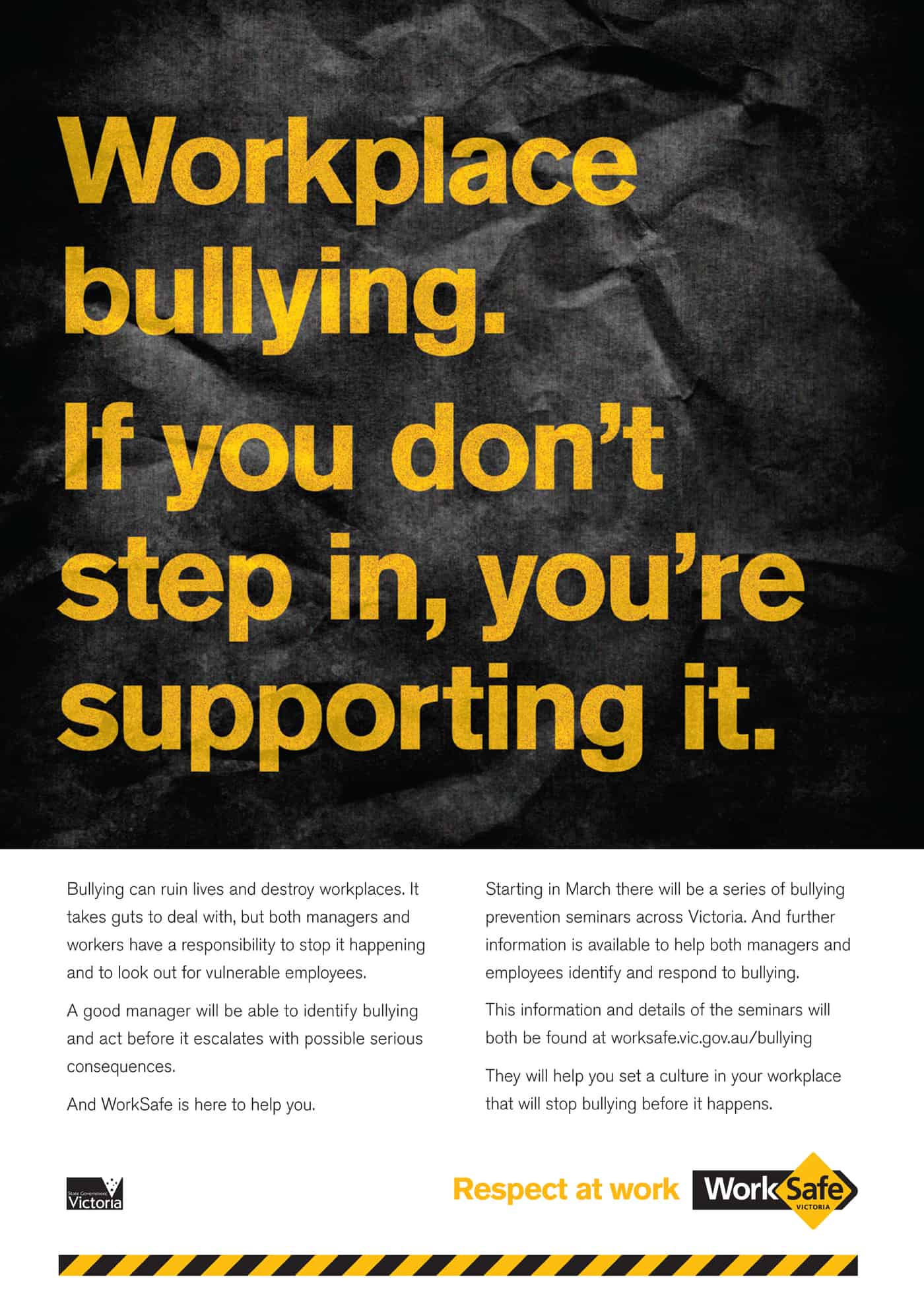
VWA+0518+28x5+Bullying+A3+PosterMedia Misunderstanding

One example of a careless  headline is in the Herald Sun newspaper for 11 May 2013, “$20 million Budget boost to stop workplace bullying“.  The Australian Government’s changes to the Fair Work Act do not prevent bullying, it only provides further options for remedy.  OHS is principally about preventing harm and the Fair Work Act changes do not help in this aim. Continue reading “Prevention of harm is lost in the debate over workplace bullying”

Concatenate Web Development
© Designed and developed by Concatenate Aust Pty Ltd