
HondaMPE sends lawyer’s letter to Australian manufacturer of safety devices

Just over a week after Australia’s national safety authority, Safe Work Australia, slammed the quad bike and all terrain vehicle manufacturers over shortsightedness on safety, Honda MPE has sent legal correspondence to an Australian manufacturer of crush protection devices (CPD), Quadbar Industries, over the wording of a sticker.

Norton Rose Letter to QuadbarIn the letter Peter Cash of Norton Rose Australia says that his client HondaMPE believes that a sticker on each Quadbar identified as a “compliance plate” may misled or deceive “members of the public and, in particular, prospective purchasers of your device”, and potential purchasers of Honda quad bikes.

The wording of the sticker is:

“COMPLIANCE PLATE

Certification/ fitment contact

Manufacturer 118 Industries

www.quadbar.com

7 Margaret St Clifton, Qld Aust. Continue reading “HondaMPE sends lawyer’s letter to Australian manufacturer of safety devices”

Melbourne Business School takes the high road on fall prevention

Below is a guest post from long time SafetyAtWorkBlog reader, Marian Macdonald.

Workplace Access & Safety height safety consultant Aaron Carratello on a walkway built for access to HVAC equipment at Mt Eliza Business School

It was when Simon Murray put himself in the witness box and imagined what a judge would say that investing in walkways and guardrails became a ‘no brainer’.

The property and facility manager of the Melbourne Business School was faced with an important decision: whether to install extra roof anchors and static lines or shift towards more passive forms of fall prevention.

Roof anchors were cheaper initially, while the walkways and guardrails offered a far lower lifetime cost but, in the end, price was not the issue.

“A judge would ask whether we had done what was ‘reasonably practicable’,” Mr Murray says, “and if we’d only installed roof anchors and static lines to reach our HVAC equipment, the answer would have been ‘no’.” Continue reading “Melbourne Business School takes the high road on fall prevention”

Is safety leadership the panacea for unsafe workplaces?

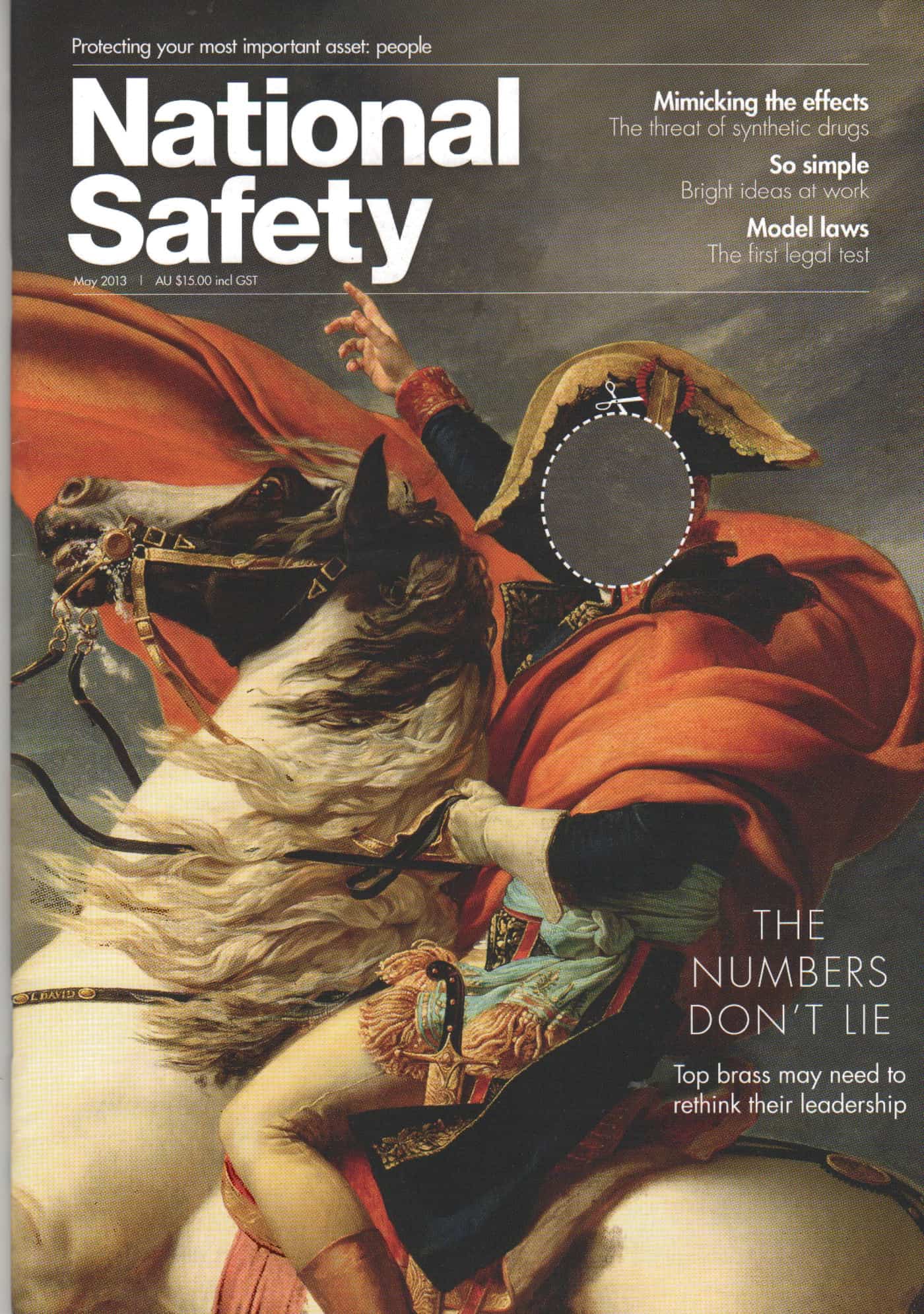
National Safety Cover May 2013The May 2013 National Safety magazine has an article on safety leadership by Australia lawyer, Michael Tooma.  It is a terrific article but it also highlights the lack of case studies of the practical reality of safety leadership in Australia and the great distance still required to improve safety. Tooma starts the article with

“It is widely recognised that strong safety leadership is integral to work, health and safety performance in any organisation.” [emphasis added]

Later he writes

“There is little doubt that safety leadership is a prerequisite to a positive safety culture in any organisation.”

These equivocations may indicate authorial caution on the part of Michael Tooma but  they could illustrate that the role of safety leadership still remains open to question. Continue reading “Is safety leadership the panacea for unsafe workplaces?”

Workers Memorial Day ceremony, industrial manslaughter and red tape

ACTU President Ged Kearney addresses the event. (image: VTHC)

The President of the Australian Council of Trade Unions (ACTU), Ged Kearney, spoke briefly at the Workers Memorial Day ceremony in Melbourne Victoria on 29 April 2013.  Kearney reiterated the call for industrial manslaughter laws in Australia echoing the statements by the ACTU’s Michael Borowick yesterday and the ACTU media release. Continue reading “Workers Memorial Day ceremony, industrial manslaughter and red tape”

National Workers Memorial opens

Yesterday Australia opened its National Workers Memorial in Canberra.  The Workplace Relations Minister  Bill Shorten, spoke at the ceremony with, largely, an edited and reduced version of the speech he presented in Brisbane earlier last week.  The Canberra speech dropped  all the ANZAC Day references and spoke about the importance of remembering.

“By erecting this monument, we tie the lives and memories and families of thousands of Australians to this place.  We stand here in this place as a mark of respect from a civilised community as an expression of failure and regret.  That’s what all memorials are, and this one is no different.  This is a symbol of the mourning for those lost too early from our tribe Australia.” Continue reading “National Workers Memorial opens”

Safety, business costs and regulation

On the 28 April edition of the ABC TV show, Insiders, Gerard Henderson displayed a common misunderstanding about the role and existence of regulations.  In discussing the childcare industry Henderson,  Executive Director of the Sydney Institute, said that regulations always increase business costs, as if regulations are the start of a process when regulations are almost always a reaction to a hazard, an abuse, an exploitation or a risk.

Business leaders seem to be incapable of understanding that they have the  power to reduce what they see as OHS red tape by changing their behaviours, perhaps by embracing and implementing safety leadership.

Many politicians and commentators have linked recent factory explosions and collapses around the World Day for Safety and Health at Work on 28 April.   Continue reading “Safety, business costs and regulation”

Safety change through rape?!

At many occupational health and safety seminars and conferences in Australia there is often an OHS professional in the audience who says that jail time is the only real and effective deterrent for those breaking safety laws, usually in the context of gross negligence, reckless endangerment or industrial manslaughter.  The threat of imprisonment is indeed a deterrent for some people.

But sometimes there is an OHS professional who colours their call for imprisonment by suggesting that, once in prison, offenders should be harmed or even raped.  An example appeared on an OHS discussion forum within the last week.  The comment, on an issue of fall prevention, included this phrase:

“Only need to send a few for a short holiday with “Bubba” and some soap on a rope, to get the message across to the masses.”

This person is suggesting that the deprivation of liberty is insufficient punishment for an OHS offence and that the offender should also be raped.  What does this say about the real values of a person whose profession is based on harm minimisation and the elimination of hazards?

If, as The Guardian newspaper says, the two main principles for jail are “in order to punish wrongdoers, and to remove the danger they would otherwise pose to the wider world”, where is the justification for abuse?

The “Bubba” comment above, and many similar comments I have heard over the years, may be an extension of the cynicism that many OHS professionals seem to acquire over their time in the profession.  But it is also offensive and shows an approach to humanity that I do not share and that I believe has no place in the OHS profession, or anywhere, for that matter.  It is lazy thinking, and these thoughts come from those who advise Australian businesses!  It is a shameful situation.

Kevin Jones

Concatenate Web Development
© Designed and developed by Concatenate Aust Pty Ltd