CSB pushes for a more effective discussion on fatigue management

Occupational health and safety has many examples of addressing small or short-term issues rather than  facing the difficult and hard, but more sustainable, control measures. I was reminded of this by a recent media statement from the United States Chemical Safety Board (CSB) in relation to fatigue management.

In 2007 the CSB recommended that, following the Texas City refinery fire,

“the American Petroleum Institute (API) and the United Steelworkers International Union (USW) jointly lead the development of an ANSI consensus standard with guidelines for fatigue prevention in the refinery and petrochemical industries.” [links added]

The progress of API and USW in developing the 2010 ANSI-approved Recommended Practice 755 (RP 755) has been reviewed by the CSB staff and they have found the following disturbing problems:

  • “The document was not the result of an effective consensus process, and therefore does not constitute a tool that multiple stakeholders in the industry can “own.” It was not balanced in terms of stakeholder interests and perspectives, and did not sufficiently incorporate or take into account the input of experts from other industry sectors that have addressed fatigue risks. Continue reading “CSB pushes for a more effective discussion on fatigue management”

First aid marketing exercise requires analysis

It is common to use a self-commissioned survey to market one’s services but sometimes the evidence does not support some of the marketing statements. The latest survey by St John Ambulance is a good example of this.

According to St John Ambulance’s media release on 13 March 2013:

“Only 13 per cent of Australian workplaces know how to keep their employees safe according to new research released … by … St John Ambulance Australia.”

Cover of First aid in the workplace - code 2012This is reworded in the report (page 2) as

“…only 13% of Australian businesses are compliant with the new [First Aid in the Workplace Code of Practice]’s requirements…”

The survey sample does not support the generalisations above. Continue reading “First aid marketing exercise requires analysis”

Where are the Codes for establishing a safety culture?

Recently a safety professional told me he was investigating an incident on a work site and asked his first question “What do you think caused the incident?” The response was “safety culture”. Of course the next question will always be “what do you mean by safety culture?” and in most cases at this point the investigation will stall.

iStock_000023283219XSmallAll workplaces have a safety culture, it is just that most are dysfunctional or immature. In many workplaces, incident causes are handballed to this poorly understood concept of which most take as the latest iteration of “an act of God” or an SEP – “someone else’s problem”.

Safety regulators need to break the use of safety culture as an excuse by developing codes of practice on how to introduce and build an effective safety culture in Australian workplaces.

Continue reading “Where are the Codes for establishing a safety culture?”

Need to focus on safety first and compliance later

Several years ago, a WorkSafe Victorian executive saw “reasonably practicable” as a major legal advantage in safety regulation. It is of legal benefit, but does it make workplaces safer? Does it make it easier to manage workplace safety? In this time of economic austerity and the pursuit of red tape reductions, can the “reasonably practicable” elements of Australia safety law be an impediment to safety management?

Cover of SAW News Oz 089 rawEmployers have always seen legislative compliance as the equivalent of being safe. This position seems sensible because if the safety police of the OHS regulator leave you alone after a site visit and say you are compliant, your workplace must be safe. The safety experts have visited and found nothing wrong, it is logical to then assume safety.

Here’s a radical thought – compliance ≠ safety. Never has and never will.

This will be a shock for many businesses, and even a shock for many OHS regulators, because so much workplace safety strategy is based a flawed logic that “if I comply with workplace safety laws, I am safe”. Regardless of OHS laws, there is a moral social duty to look after the safety and welfare of one’s workers and oneself. When values become codified in law, the law becomes the value, and the moral duty becomes historical.

Continue reading “Need to focus on safety first and compliance later”

Stargazing on harmonisation from 2003

Writing recent articles on workplace bullying and harmonisation reminded me of an interview I conducted in 2003 with the then head of the National OHS Commission, Robin Stewart-Compton.  NOHSC was a predecessor to Safe Work Australia.

The extract below reminds us that National Uniformity, a cousin to harmonisation, started over twenty years ago.

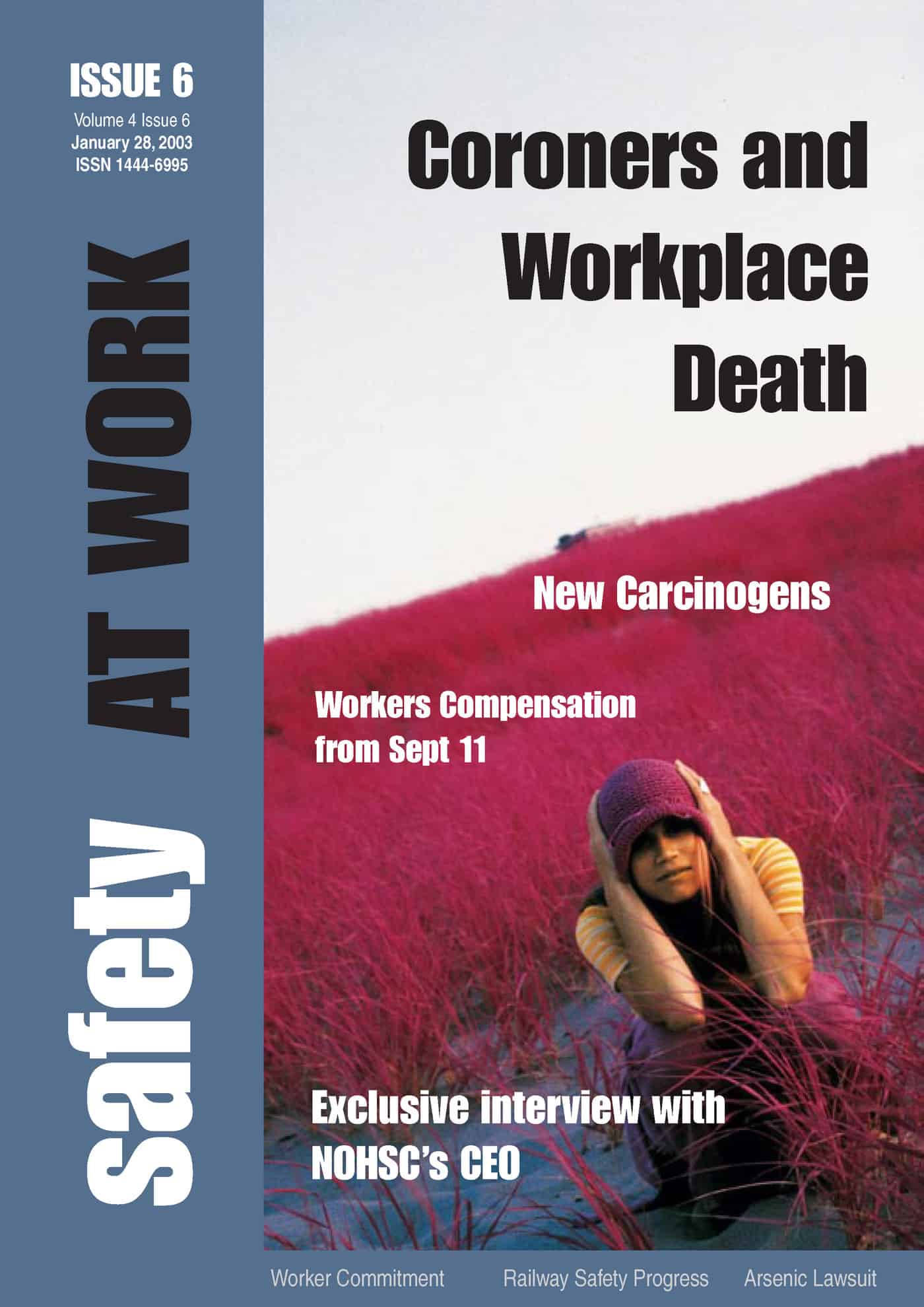
cover of 4i6 SAW: In the early 1990s there was a strong push for National Uniformity of OHS laws and a recent conference of the Royal Commission into the Building and Construction industry discussed this issue at length. Will the National Strategy achieve the aims of National Uniformity over 10 years ago?

RSC: The language has changed and you are more likely to hear of National Consistency than Uniformity but although this change has occurred there exists a paradox. Ten years ago we spoke commonly of the objective of National Uniformity and made very little progress toward achieving it. Continue reading “Stargazing on harmonisation from 2003”

Australian Government shifts workplace bullying into the industrial relations system

Politicians are sufficiently media-savvy to release policies and information to gain the maximum exposure in the media cycle.  For some reason, Australia’s Workplace Relations Minister, Bill Shorten, missed the opportunity to have his changes on workplace bullying in the newspapers for 12 February 2013.  The news cycle is also being dominated by the resignation of Pope Benedict.  However Shorten’s response to the Parliamentary Inquiry into Workplace Bullying deserves detailed analysis.

??????????????????????????????????Shorten is bringing the investigation of workplace bullying cases under the Fair Work Commission.  There are likely to be complex consequences of this decision, a decision that is clearly the Minister’s as the Parliamentary Inquiry made no clear recommendation on the location of the “new national service”.

“The Committee did not receive evidence on where such a service [“a single, national service to provide advice to employers and workers alike on how to prevent, and respond to workplace bullying” 5.51, page 136] should be located.  It might be best situated within an existing government agency or department such as Safe Work Australia, the Fair Work Ombudsman or the Department of Education, Employment and Workplace Relations.  It may also be considered appropriate for the service to be an independent body that is funded by the Commonwealth. Consequently, the Committee does not have a clear recommendation as to where the new national service may sit.” (Section 5.58, page 138)

Clearly Shorten’s announcement could easily have been “Minister rejects independent body on workplace bullying”.  The Minister should be asked about his reasons for not establishing an independent body into this important issue. Continue reading “Australian Government shifts workplace bullying into the industrial relations system”

How can one learn from OHS mistakes if those mistakes are hidden?

Occupational health and safety (OHS) regulatory agencies have existed for decades, originally with an enforcement role but increasingly aimed to prevention and education.  It is fair to say the “2nd generation” of OHS regulators in Australia appeared in the 1980s.  It is also fair to expect to be able to readily access the corporate memory and prosecutorial activity of the regulators, particularly since the growth in the Internet. Very recently WorkSafe Victoria reviewed its online database of OHS prosecutions excising prosecution summaries prior to 2012.  This decision is a major weakening of the “state of knowledge” about workplace safety in this State, a decision that some have described as outrageous.  How can one learn from mistakes if those mistakes are not made available?

Continue reading “How can one learn from OHS mistakes if those mistakes are hidden?”

Concatenate Web Development
© Designed and developed by Concatenate Aust Pty Ltd