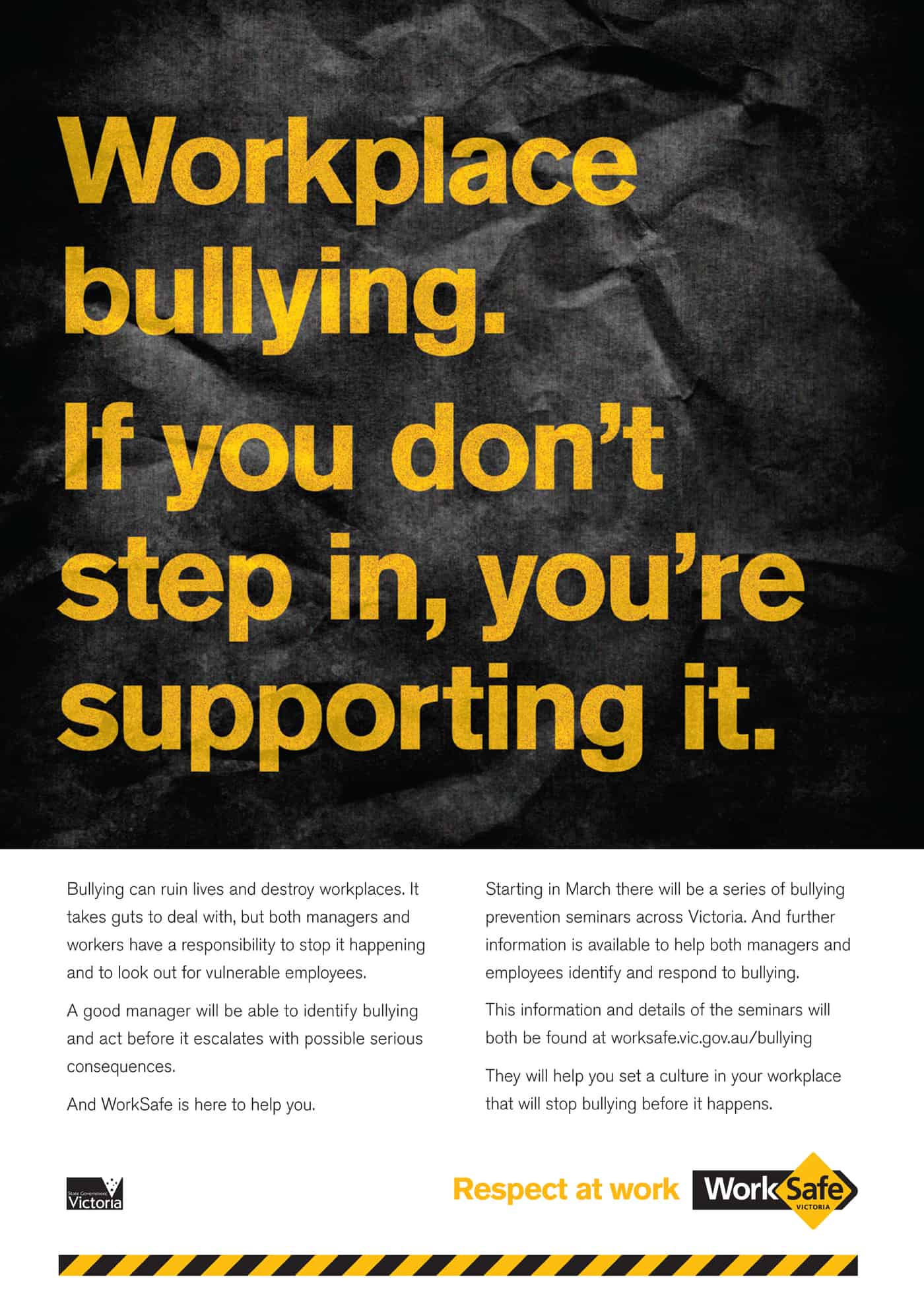
Why all the arguing over a workplace bullying definition?

There have been many calls in Australia for a national definition of workplace bullying.  Apparently the definition below that has applied in OHS legislation for over ten years in Victoria is insufficient:

“Repeated unreasonable behaviour directed toward a worker or group of workers that creates a risk to health and safety.”

The definition above was the one used in the first draft Code of Practice on Preventing and Responding to Workplace Bullying produced by Safe Work Australia in September 2011.

The definition was questioned by Moira Rayner, as a representative of the Law Institute of Victoria, at recent public hearings into workplace bullying.  Researchers said that a lack of a national definition is a major reason that research in workplace bullying has been so thin.

A quick survey of workplace bullying definitions in Australia is listed below:

“Unreasonable and inappropriate workplace behaviour includes bullying, which comprises behaviour which Continue reading “Why all the arguing over a workplace bullying definition?”

Australian Government moves on quad bike safety

Just before Christmas in 2009, Dr Yossi Berger speculated for an information network about the safety of quad bikes.  He called it QuadWatch.  Over two years later, on 13 July 2012, Australia’s Employment and Workplace Relations Minister Bill Shorten announced his own QuadWatch.

In the 2009 Croaky Blog, Dr Berger suggested

“a network could be called QuadWatch and it would become a clearing house for all needs related to quad bikes, particularly in relation to safety standards.  All training needs, advice about accessories, advice about the correct machine for a certain job or terrain could be handled by such regional cells.”

Shorten described the new QuadWatch as

“… a community based network bringing together farmers, community groups, emergency services and local government.

Shorten’s QuadWatch is broadly consultative but is a little different in its communication strategy.  Establishing websites in support of a political strategy have not had the greatest success in the last few years under the Federal Labor Government and QuadWatch is not the end point in the safety debate.

It is worth deconstructing the Minister’s media release a little.

Continue reading “Australian Government moves on quad bike safety”

Workplace bullying inquiry followed the script, mostly

The Melbourne public hearing in support of the Parliamentary Inquiry into Workplace Bullying has concluded after over an hour of personal impact statements that were confronting, saddening but, overall, defiant.

The hearing began more sedately and predictable. The employers’ association, ACCI, says that workplace bullying is a broad social issue that needs broad social control measure. In rough translation, “it’s not our problem”. The employers also see everything in terms of industrial relations so prevention of harm rarely features in recommendations.

The ACTU stressed that workplace bullying IS a workplace issue and therefore should be principally “managed” under occupational health and safety laws. Continue reading “Workplace bullying inquiry followed the script, mostly”

Lessons for everyone in the legal action against France Telecom executives over suicides

In 2009-10, SafetyAtWorkBlog followed the unfolding and tragic story of the spate of suicides at France Telecome that were directly related to the change of work practices and organisational policies instigated after privatisation.  SafetyAtWorkBlog stated that the suicides could be considered to be a case study of poor personnel management and, in more recent parlance, a failure of safety leadership.  This month French authorities have begun investigating France Telecom executives.

According to an AFP report in early July 2012:

“Louis-Pierre Wenes was placed under investigation on Thursday, a day after former France Telecom chief Didier Lombard, for workplace harassment, his lawyer Frederique Beaulieu said.”

At the time of the suicides Wenes was Deputy CEO and Lombard was CEO.

Interestingly and curiously, workplace bullying is not a term used in the France Telecome situation, although it may have met the criteria that Australia applies. Continue reading “Lessons for everyone in the legal action against France Telecom executives over suicides”

Public hearings into Workplace Bullying to commence in Australia

Next week Australia holds public hearings into the issue of workplace bullying. Currently the House Standing Committee on Education and Employment has not yet made any submissions publicly available which handicaps the value of the public hearings for observers but the Trade Unions have released their submissions.  Generally, the suggestions for control measures are progressive but the submissions also indicate the extent of the challenge in “controlling” workplace bullying and some of the challenges facing this inquiry.

The ACTU claims that workplace bullying was given national prominence following a survey of union members in 2000 but that survey is not representative of the broader Australian community and should be treated with caution.  The ACTU submission seeks support for its survey results from more authoritative sources such as Safe Work Australia and the Productivity Commission.  But neither of these sources indicates workplace bullying to be as big an issue as the ACTU claims.

Safe Work Australia’s figures, quoted by the ACTU , say that in

“In 2007/08, 26% of accepted workers compensation claims for mental stress in Australia resulted in 26 or more weeks off work.”

The significance in this quote is that bullying is not mentioned and if one accepts that bullying is a subset of mental stress and psychosocial hazards, bullying should be only a fraction of the 26% figure.  It is also the case that it is common for victims of bullying to eliminate the hazard through resignation rather than lodge workers’ compensation claims.  So one metric may indicate a low bullying rate but another indicates a “hidden” rate.  Accurate measurement, the accumulation of evidence, is a major problem in any study of workplace bullying and is a major challenge for this Parliamentary Inquiry. Continue reading “Public hearings into Workplace Bullying to commence in Australia”

WorkSafe Victoria tries humour in safety advertising

For the last few weeks WorkSafe Victoria has been running new injury prevention advertisements based on a game show theme of playing the odds on injuring a worker.  The curiosity of this campaign is that humour and a little bit of shame has been employed to communicate.

It is refreshing for an OHS regulator to use humour in the aim of improving workplace safety particularly as this attempt avoids the slapstick humour that has been tried in the past by several safety organisations.  Workplace injuries are not a laughing matter but a gentle humour can be used to prick the conscience of those who have safety obligations.

Conversations with OHS peers on these ads has shown a perplexity over these ads.  Those who have established a public face or a reputation in the safety field are unsure whether laughing or, at the least, being amused is appropriate.  There is a fine line between mockery and amusement so hesitation is understandable. Continue reading “WorkSafe Victoria tries humour in safety advertising”

Workplace bullying in the police force illustrates the challenges of change management

There are two newspaper reports in Australia on 21 June 2012 about the Victorian Police Force that illustrate a fractious safety culture and a major organisational and ideological impediment to reducing workplace bullying.

The Australian article ” OPI concedes failure against force’s culture” (only available to subscribers) states that:

‘The Office of Police Integrity has conceded it and other corruption fighting measures have failed to root out the entrenched culture of reprisals and mateship in pockets of the Victoria Police that seriously harms the force….”

“The OPI says current law fails to deal with why whistleblowers are targeted. ‘‘The legislated protections against retaliation do not address the root cause of reprisal — a workplace culture of misguided loyalty,’’ it argues.  “The protections are individualistic and short-term, tending to ‘look after’ victims and potential victims of reprisal rather than address why reprisal occurs.’’

“Despite the subsequent formation of the OPI and the beefing up of the Ombudsman’s powers, police still struggled to break free of the shackles of loyalty and the so-called brotherhood.’

The Age article, “A fifth of police bullied at work“, reports on a government survey circulated to 14,000 people.

‘The figures, provided to The Age, mean about 1250 of the 4200 police staff who completed the survey have seen bullying behaviour, while nearly 900 say they have been bullied.’ Continue reading “Workplace bullying in the police force illustrates the challenges of change management”

Concatenate Web Development
© Designed and developed by Concatenate Aust Pty Ltd