A return to the Forgotten Royal Commission

Ministerial accountability. Occupational health and safety (OHS). Leadership. Industrial Manslaughter. These issues have existed in various combinations in various jurisdictions and discussed by many people. At the moment in Australia, this combination has in relation to COVID19 but some of the discussion contains tenuous links and some is masking long held political agendas. Much of it harks back to arguments put to the Royal Commission into the Home Insulation Program.

The latest combination came to my attention from an August 19 article in The Australian newspaper (paywalled) written by business journalist Robert Gottliebsen.

Subscribe to SafetyAtWorkBlog to continue reading.
Subscribe Help
Already a member? Log in here

“This is how silly OH&S has become” Not really

Truck driving is one of the most contentious areas of occupational health and safety (OHS) in Australia. The transport industry has refined a reasonably practicable level of OHS to a high degree where levels of fatigue that would not be tolerated in other occupations are the norm. There also seems to be a negative attitude to OHS as an impediment to getting the job done rather than an investment in the health of drivers and the longevity of their careers.

These attitudes were on display recently in an inquiry into the “Importance of a viable, safe, sustainable and efficient road transport industry” undertaken by the Rural and Regional Affairs and Transport References Committee of the Australian Senate.

Subscribe to SafetyAtWorkBlog to continue reading.
Subscribe Help
Already a member? Log in here

Responsibility and its denial

Occupational health and safety (OHS) laws are intended to clarify who is responsible for workplace health and safety and to assist those responsible to fulfil their OHS duties. But responsibility is hardly ever discussed in reality except after an incident. A core question at that time is “Who was responsible?”, with the social subtext being “It wasn’t me.” OHS laws have already established broad OHS responsibilities which we accept when we have to, but deny when we don’t.

Clear, defined roles and responsibility are core to our understanding of workplace health and safety and the establishment of a safe and healthy workplace, and also of corporate integrity and productivity.

Subscribe to SafetyAtWorkBlog to continue reading.
Subscribe Help
Already a member? Log in here

Work-related elements for social change

It is almost impossible for occupational health and safety (OHS) people to stop looking at the world through the risk assessment parameters and hierarchies with which they work every day. The Hierarchy of Control could be applied to the COVID19 pandemic with the important lesson that the elimination of a hazard does not only come from the right purchase but could require months and months of a combination of Administrative Controls, Personal Protective Equipment, and perseverance. This impossibility should not be something that makes OHS professionals shy. It should be embraced and expanded, where possible, beyond the bounds of workplace organisations to societal design and change.

Michael Quinlan has recently written about a different investigative process that could be directly applied to the management of disasters, including COVID19. His research on Ten Pathways to Death and Disaster has been popping up in conferences, books and public speaking, including the OHS advocacy of Dr Gerry Ayers of the CFMEU, and has rarely been more timely.

Subscribe to SafetyAtWorkBlog to continue reading.
Subscribe Help
Already a member? Log in here

Liability, COVID19, Manslaughter and Working from Home – Welcome to the new OHS

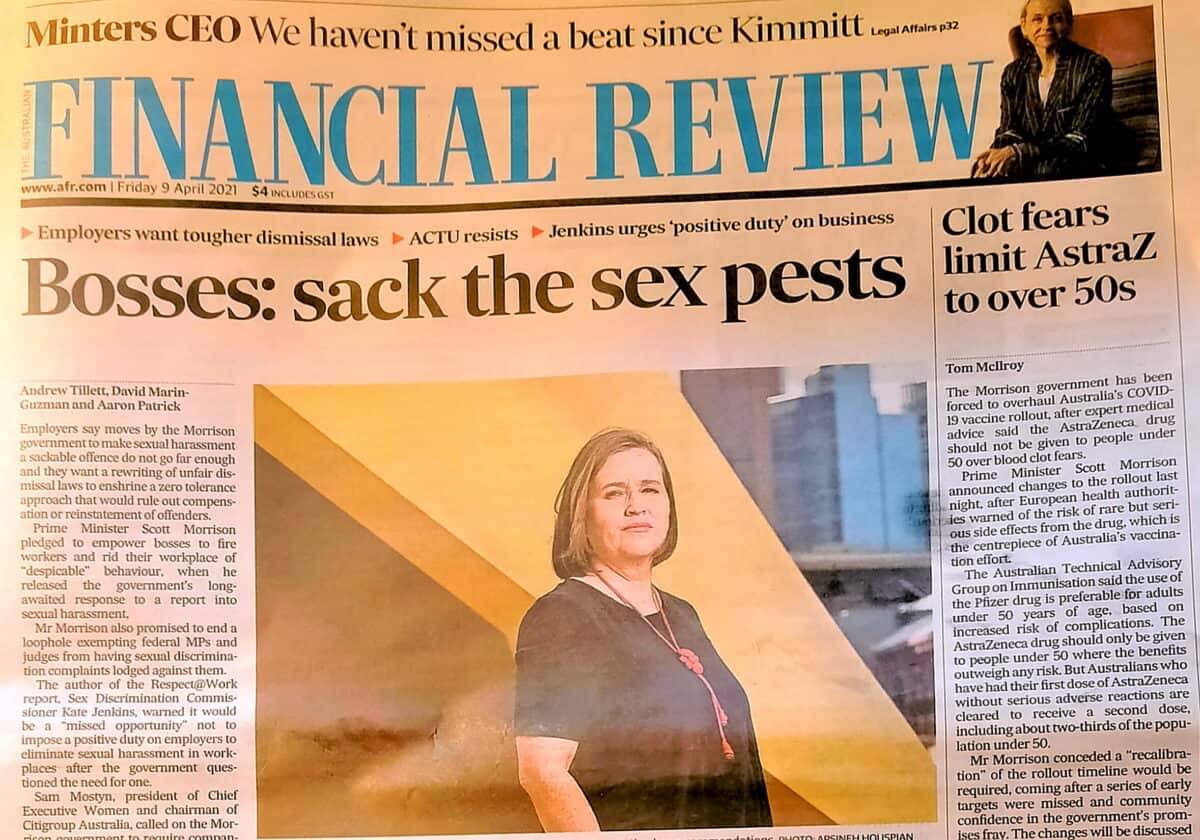
Last week WorkSafe Victoria followed some of the other Australian States by requiring employers to report positive COVID19 cases as “notifiable incidents”. (If they can do this fro COVID19, shouldn’t it be possible to do the same for mental health disorders?) Expanding the pool of notifiable incidents is of little practical consequence but it is indicative of how occupational health and safety (OHS) management is changing, and how Industrial Manslaughter is becoming a pervasive threat.

Managing Liability

In the Australian Financial Review (AFR) on August 4 2020, employer liability for COVID19 incidents was discussed. Liberty Sanger of union-associated law firm, Maurice Blackburn, spoke of the importance of genomic testing to better identify the origin of the infection, ie. was it caught at work or at home.

Subscribe to SafetyAtWorkBlog to continue reading.
Subscribe Help
Already a member? Log in here

Is it time for a Department of Safety?

The COVID19 pandemic is a public health challenge but what happens when workplaces are integral to the control and spread of the virus? This overlap between public health and occupational health is complicated and unlikely to be resolved in the short term, however, it can fixed in the longer term. The crisis in the Australian State of Victoria (where this author lives) offers an example of this complexity, but also an opportunity for positive change, perhaps even, a Department of Safety.

Subscribe to SafetyAtWorkBlog to continue reading.
Subscribe Help
Already a member? Log in here

A sliver of hope on the farm safety horizon

Australian farm safety received several boosts last week. FarmSafe Australia released new report on agricultural injury and fatality trends. The Victorian Government gave the Victorian Farmers Federation more money to fund farm safety inspectors, again. And the Agriculture Minister established a Farm Safety Council of the usual agricultural groups. It is hard not to take many of these farm safety activities as indications of insanity by doing the same thing but expecting different results.


Subscribe to SafetyAtWorkBlog to continue reading.
Subscribe Help
Already a member? Log in here
Concatenate Web Development
© Designed and developed by Concatenate Aust Pty Ltd