

Occupational health and safety (OHS) is rarely addressed in election campaigns, and the Victorian election in November is likely no exception. However, there are OHS issues that need to be discussed and addressed, and there may also be a political advantage.
Category: penalties

Agriculture Has the Injuries of a Regulated Industry, But Not the Regulation
Over the past few months, I have increasingly encountered the term “regulated industries” in the context of occupational health and safety (OHS) laws. In OHS in Australia, these industries seem predominantly to include:
- Construction
- Mining and
- Major Hazards.
I can identify no reason why farming should not also be a “regulated industry”.

Workplace Suicides Becoming Australia’s Next Regulatory Flashpoint
You should have heard by now that Safe Work Australia (SWA) has come through with guidance on having work-related suicides included in each jurisdiction’s occupational health and safety (OHS) legislation as incidents that will require notification to the local OHS regulator. If you haven’t, get a new OHS or Human Resources (HR) adviser because the future will be a bumpy, uncomfortable and challenging ride.
Warning: this article discusses suicide.
Deterrence Delayed, Lives at Risk—Will Victoria’s Leaders Respond?
The Victorian Government has yet to respond to a report on occupational health and safety (OHS) sentencing and penalties that it received over the Christmas period. The longer it takes to respond to the Sentencing Advisory Council recommendations, the more delayed the action required to improve the systems, which can deter employers from ignoring their OHS obligations and the longer unnecessary risks to work health and safety persist.
In 2018, before the introduction of Industrial Manslaughter laws, Dr Gerry Ayres of the CFMEU and I spoke about the importance of deterrence. In that interview, he pointed out that financial penalties fail as deterrents for several reasons:

Can I be convinced EUs are good?
In the realm of occupational health and safety (OHS), Enforceable Undertakings (EUs) have emerged as a significant alternative to prosecution for companies that breach safety legislation. Recently, I had the opportunity to catch up with Naomi Kemp to explore the concept of EUs, their implications for workplace safety, exceeding compliance, and the restoration of relationships following incidents.

Pyrrhic IR prosecution that ignores the OHS context
Recently, sentencing in a court case in Melbourne has generated much online chatter about excessive working hours and the exploitation of workers in a small law practice. One report of the $A50,000 fine against Erudite Legal says that the company:
“…forced a junior lawyer to work up to 24-hour days and watch an ice hockey movie at 1am so she could understand her boss’ philosophical position”.
Other media reports provide more details of the successful prosecution, but the occupational health and safety (OHS) context is mostly absent.
Whether it’s a book or a brick, it is invaluable
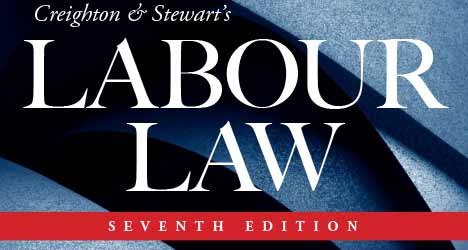
The latest edition of Creighton & Stewart’s Labour Law book (7th edition) has been released. I say “book”, but it is almost a brick, weighing in on my scales at 1.8 kilograms (see photo below). The book is excellent and probably authoritative, with the primary negative being its size and format. This article focuses on the 79-page occupational health and safety (OHS) chapter written by Richard Johnstone.