Should heartlessness be the status quo?

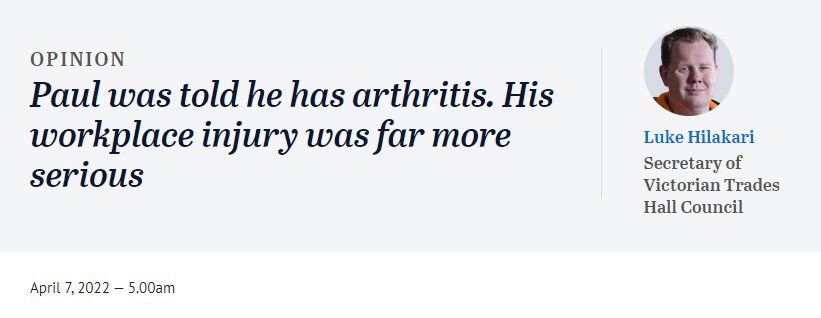
On April 7, 2022, prominent trade unionist Luke Hilakari had an opinion piece published in The Age newspaper titled “Paul was told he has arthritis. His workplace injury was far more serious”. Hilakari told a story, familiar to many, of one man’s journey from workplace injury to impecunious hardship.

The story is tough to read and full of injustices, but the political point of the article is lost. The Victorian Government has been provided with a report that could reduce the bureaucratic and surveillance challenges faced by Paul, but the system itself will not change.

Subscribe to SafetyAtWorkBlog to continue reading.
Subscribe Help
Already a member? Log in here

We need a revolution in how we think about working hours

If there was only one way available to improve the health and safety of workers in Australia, it would be to limit and enforce working hours to those in the official Awards and job descriptions.

This situation which would really be simply a case of working-to-rule, would need to be supported by other not unreasonable changes, in no particular order:

Subscribe to SafetyAtWorkBlog to continue reading.
Subscribe Help
Already a member? Log in here

What does the IPCC report on climate change say about work?

Global warming will affect the way we work.  This was acknowledged in the most recent report from the International Panel on Climate Change.  The 3,676-page report cited several research papers related to these changes.  Below is a list of those papers and comments on the abstracts, where available.

Vanos, J., D. J. Vecellio and T. Kjellstrom, 2019: Workplace heat exposure, health protection, and economic impacts: A case study in Canada. Am. J. Ind. Med., 62(12), 1024-1037, doi:10.1002/ajim.22966.  https://pubmed.ncbi.nlm.nih.gov/30912193/

This abstract recommends “Providing worksite heat metrics to the employees aids in appropriate decision making and health protection.” This research adds to one’s state of knowledge but may not help with which on-the-ground decisions need to be made.

Subscribe to SafetyAtWorkBlog to continue reading.
Subscribe Help
Already a member? Log in here

Work, not Sex, won the day

On February 10 2022, the Victorian Parliament passed laws to decriminalise sex work, supporting the (Labor) government position that sex work needs to be treated the same as any other type of work. The debate, the culmination of decades of work by many sex work supporters and advocates, was won by emphasising the role of Work over the concerns about Sex. This is a strategy that other workplace safety advocates may consider.

Subscribe to SafetyAtWorkBlog to continue reading.
Subscribe Help
Already a member? Log in here

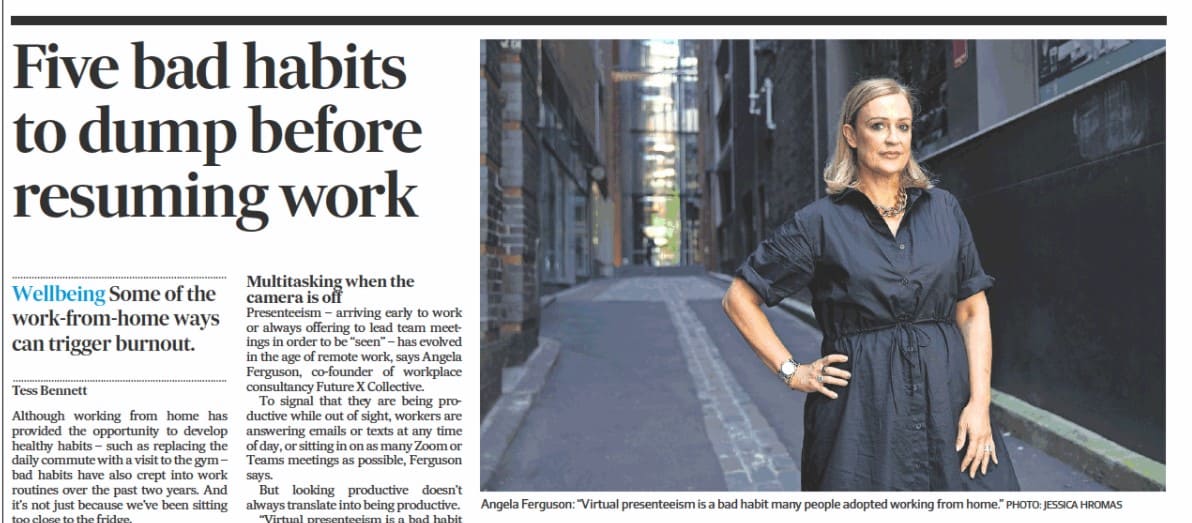
Bad work “habits” are part of the problem

The headline immediately caught my attention:

“Five bad habits to dump before resuming work”

Australian Financial Review, January 4, 2022

Such is the power of the click-bait headline.

This article is aimed at middle managers and those working from home. It is in the Australian financial/business newspaper so articles about individual empowerment and entrepreneurship rather than structural change are expected. The article above is a classic example of the Australian Financial Review’s approach to workplace health and safety matters: a newspaper with significant influence on business leaders and executives but one that rarely quotes or approaches occupational health and safety (OHS) experts.

Subscribe to SafetyAtWorkBlog to continue reading.
Subscribe Help
Already a member? Log in here

Diagnosis is the key

Part 2 of 2

Safe Work Australia (SWA) has reported on “mental health conditions” in its latest report on workers compensation claims and that these conditions represent 9% of claims for the 2018-2019 period (page 20). Claims have also increased in this category from 6,615 in 2000-2001 to over 10,000 in the latest data period. Mental health conditions are described elsewhere by SWA as affecting non-physical bodily locations (page 38).

As with many other reports, “mental health conditions” are not defined, but SWA states that this phrase is an alternative to “psychological injuries”. It also gives a numerical and dollar value to these conditions:

Subscribe to SafetyAtWorkBlog to continue reading.
Subscribe Help
Already a member? Log in here

No psych regulation in Victoria until mid-2022

The Victorian Government has pledged to introduce regulations to address psychological risks in workplaces. According to a second consultation paper on psychological health regulations, seen by SafetyAtWorkBlog, the consultation process continues but has been extended, so the new regulations are unlikely before the middle of 2020. This extension would seem a little unnecessary given the work on this hazard already from Safe Work Australia and SafeWorkNSW.

Subscribe to SafetyAtWorkBlog to continue reading.
Subscribe Help
Already a member? Log in here
Concatenate Web Development
© Designed and developed by Concatenate Aust Pty Ltd