
When safety equipment fails to be safe, nobody’s watching

Twelve months ago, some Australia media, including this blog, began reporting on safety concerns raised by the Working At Heights Association (WAHA) about the reliability and suitability of anchor points.  Australia is currently in the middle of Safe Work Australia Month and there seems to have been little progress on the issue.  A reader of SafetyAtWorkBlog provided the following summary and update of the situation:

Who checks the true safety of equipment designed to save the lives of Australian workers? Nobody in particular, it seems.

Last September, the Working At Heights Association, an industry body staffed by volunteers, revealed many of the most commonly-used roof anchors failed to meet basic safety standards. Almost a year later, the association is still battling to see rooftops made safe, despite repeated appeals for action from the OHS regulators and the absence of the Australian Competition and Consumer Commission (ACCC).

 An estimated 800,000 Australians work at height and routinely clip their harnesses onto safety anchors. A worker falls to his or her death every 12 days and WAHA chairman Michael Biddle said authorities should be concerned. Biddle told Industry Update magazine

“It’s the third highest cause of death in the workplace after motor vehicle accidents and being hit by moving objects. In most cases, regulators are more concerned in taking a reactive approach after an accident has happened.  There is a great need for an enhanced level of enforcement.   If we had an increase in penalties and stronger enforcement of standards I’m sure we would see a higher level of compliance by industry.”
Subscribe to SafetyAtWorkBlog to continue reading.
Subscribe Help
Already a member? Log in here

Integrated approach to OHS and wellbeing to be promoted in Australia

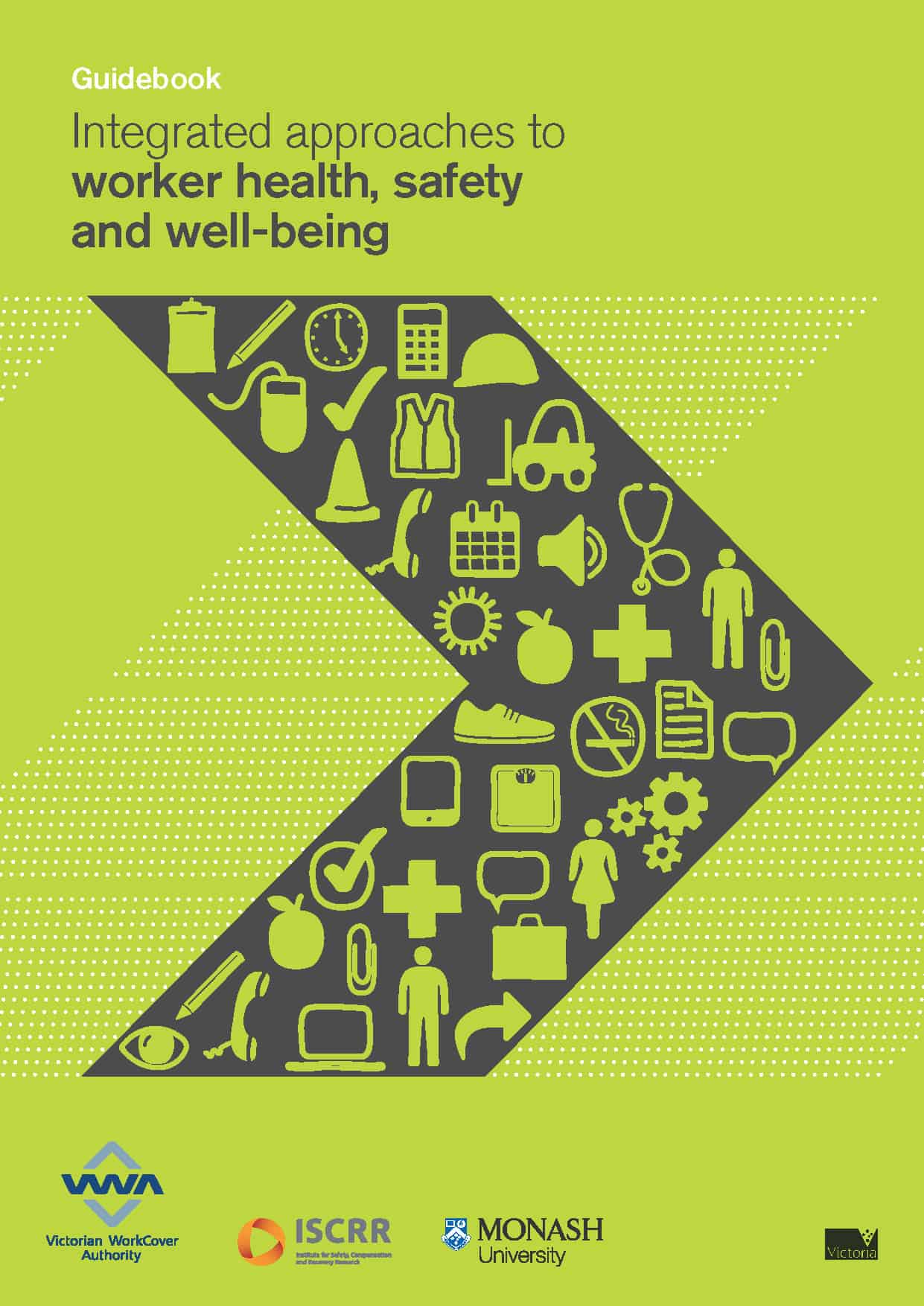
Cover from VWA_INTEGRATED APPROACH GUIDELINES_D3-2Later this month, the Victorian WorkCover Authority (VWA) will be releasing a document entitled “Integrated approaches to worker health, safety and well-being” (pictured right, but not yet available online).  It is intended to generate discussion on how to improve workplace safety performance by breaking down the walls of various disciplines, production processes, consultative silos and institutional or organisational biases.  This document builds on the overseas experience of the National Institute of Occupational Safety and Health (NIOSH – Total Worker Health program), the World Health Organisation (WHO – Healthy Workplace Framework) and others to provide an Australian context.

Those who are experienced in risk management principles may see little new in this approach and the publication’s success is likely to depend on how VWA explains the initiative and how its stakeholders, Victorian businesses of all sizes, accept the concept and believe it can work in their own workplaces.

Integration

The release of a publication advocating Integration implies that an unintegrated approach to safety management has been an impediment to change. This may be a surprise to risk managers and those who have been consulting broadly on OHS in their workplaces and those companies who have integrated systems managers with responsibility for Quality, OHS and Environment.

Subscribe to SafetyAtWorkBlog to continue reading.
Subscribe Help
Already a member? Log in here

Australian PM responds to Insulation Royal Commission

Australia’s Prime Minister Tony Abbott provided his interim response to the Royal Commission into the Home Insulation Program (HIP) in Parliament on 30 September, 2014.  One should not expect much sustainable or cultural change from an interim response but Abbott’s responses hold some promise.

The commitments include:

“…[asking] Minister Hunt [Environment] to assume responsibility to oversee the Commonwealth response and to coordinate actions across departments and ministers.”

“…[asking] the Minister for Employment to examine these [OHS] findings, particularly as they relate to the reliance of the Commonwealth on state and territory laws, and his work will inform the government’s final response.”

Minister Hunt and the Minister for Finance have been asked to recommend options to compensate their next of kin [of the deceased workers]”

Subscribe to SafetyAtWorkBlog to continue reading.
Subscribe Help
Already a member? Log in here

Safe Work Australia month begins with an online gamble

The annual Safe Work Australia month starts today.  The promotion of this month has fluctuated wildly over the last decade.  Sometimes there are physical launches with interesting speakers, sometimes balloons and merchandise, other times the national OHS authority has left most of the activity to the States.  In 2014, Safe Work Australia has jumped into internet videos, online presentations and webinars each day of the month of October (the full schedule is available HERE).  This initiative is to be supported but it has not been tried before in Australia and its success is not guaranteed.

As expected the first couple of videos are polite launches of the strategy with statements from Ministers and CEOs.  The potential for valuable content is after the initial launch but this value is debatable.  It is unclear who the target audience is.  If the seminar series is for OHS newbies, a restatement of legislative OHS obligations is of little interest to experienced safety managers and professionals.  Continue reading “Safe Work Australia month begins with an online gamble”

What is workplace “mental wellbeing”?

The 2014 Annual Report of the Victorian WorkCover Authority (VWA) states a new initiative on workplace mental health:

“…a new direction for the VWA’s WorkHealth program has led to the Victorian Mental Wellbeing Collaboration. The VWA has invested in a tripartite collaboration with peak health promotion agencies VicHealth and SuperFriend to develop a range of evidence based tools and resources that will be tested and refined through industry leaders and made broadly available to Victorian workplaces.” (page 25, links added)

Two significant points in this statement are the development of a range of “evidence-based tools and resources” and the pledge to consult.  However what is meant by a tripartite consultation in this context is unclear as traditionally OHS consultation has included employer associations, trade unions and government regulators.  If health promotion agencies are included in this latest “tripartite collaboration”.  Will the employer groups or trade unions be dropped?  Consultation on any new OHS/wellbeing initiative should not be constrained in a tripartite combination.

One of the traps in this initiative is the potential confusion by terminologies.  “Mental health” is a well-understood term that is readily applied to the workplace by organisations such as the Western Australian Mental Health Commission who quotes the World Health Organisation

“…. good mental health is not simply the absence of a mental disorder. It is a state of wellbeing whereby an individual can realise their own potential, manage everyday stresses, work productively and contribute to their community.” (page 6)

Subscribe to SafetyAtWorkBlog to continue reading.
Subscribe Help
Already a member? Log in here

New workplace bullying evidence

There have been many claims of a workplace bullying epidemic in Australia but there has always been a lack of evidence. Research has been targeted into specific industry sectors or regions but broad ranging studies have been few. This lack of evidence was a major frustration for the Parliamentary Inquiry into Workplace Bullying that concluded in late 2012. However useful evidence is beginning to appear.

A recent edition of the Journal of Health Safety and Environment included a report (subscribers only) entitled “The prevalence and nature of bullying: A national study of Australian workers”. The authors, Dr Sarven McLinton, Maureen Dollard, Michelle Tuckey and Tessa Bailey, wrote that the study

“… shows that nearly 7% of Australian workers reported bullying and harassment in the past six months.” (page 283)

Subscribe to SafetyAtWorkBlog to continue reading.
Subscribe Help
Already a member? Log in here

Technical and practical advice on applying the maturity matrix

Pages from d001323Corporate maturity, especially in the area of workplace health and safety, is an increasingly important consideration in determining the preparedness of an organisation to change and embrace OHS as a crucial element of its business operations.  There are several advocates of determining corporate maturity usually based around Hudson’s five levels of maturity, the most recent seems to be the Australian Constructors’ Association (ACA) in conjunction with RMIT University (see parts 8-7 of the document pictured below), but these tools are often aimed at the upper levels of an organisation.

Recently the Center for Construction Research and Training (CPWR) produced a series of handouts that apply a variation of the maturity matrix to separate components of safety culture.

These levels include:

  • Uninformed
  • Reactive
  • Compliant
  • Proactive
  • Exemplary.

Continue reading “Technical and practical advice on applying the maturity matrix”

Concatenate Web Development
© Designed and developed by Concatenate Aust Pty Ltd