A return to the Forgotten Royal Commission

Ministerial accountability. Occupational health and safety (OHS). Leadership. Industrial Manslaughter. These issues have existed in various combinations in various jurisdictions and discussed by many people. At the moment in Australia, this combination has in relation to COVID19 but some of the discussion contains tenuous links and some is masking long held political agendas. Much of it harks back to arguments put to the Royal Commission into the Home Insulation Program.

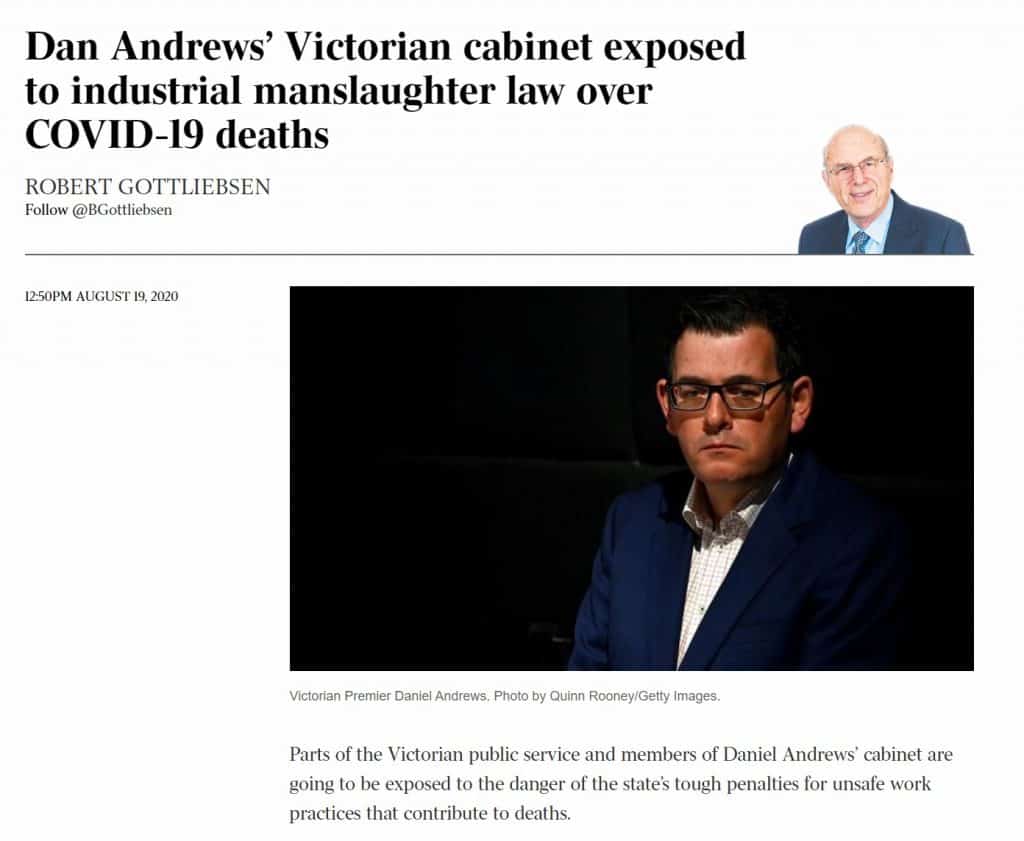
The latest combination came to my attention from an August 19 article in The Australian newspaper (paywalled) written by business journalist Robert Gottliebsen.

Subscribe to SafetyAtWorkBlog to continue reading.
Subscribe Help
Already a member? Log in here

“the point is not science, but safety”

Early last year Professor Andrew Hopkins wrote the following about making important safety decisions:

“If you are a CEO in charge of a large company operating hazardous technologies, you cannot afford to wait for conclusive evidence. You must act on the basis of whatever imperfect knowledge you currently have.”

page 110

This seems relevant to those who have had to make decisions about COVID19 this year. In response to the Hopkins quote, I wrote:

“This applies equally to directors and managers of companies of all sizes. It is hard, it is uncomfortable, but it is part of running a business. It is the application of the “precautionary principle” which, if the precaution proves valid, you are a hero, a visionary and a leader; if it does not happen, you are seen as a doomsayer – a reputational potential that few are willing to risk. However, in terms of OHS and the safety of people, the precautionary principle should be given prominence over reputation for many reasons, for if there is a disaster and fatalities the precautionary principle will be analysed through hindsight and may be influential in arguing reasonable practicability.”

The continuing COVID19 pandemic is a disaster with an horrendous fatality rate and the Precautionary Principle has started to be discussed in academic research about COVID19 and face masks.

Continue reading ““the point is not science, but safety””

Liability, COVID19, Manslaughter and Working from Home – Welcome to the new OHS

Last week WorkSafe Victoria followed some of the other Australian States by requiring employers to report positive COVID19 cases as “notifiable incidents”. (If they can do this fro COVID19, shouldn’t it be possible to do the same for mental health disorders?) Expanding the pool of notifiable incidents is of little practical consequence but it is indicative of how occupational health and safety (OHS) management is changing, and how Industrial Manslaughter is becoming a pervasive threat.

Managing Liability

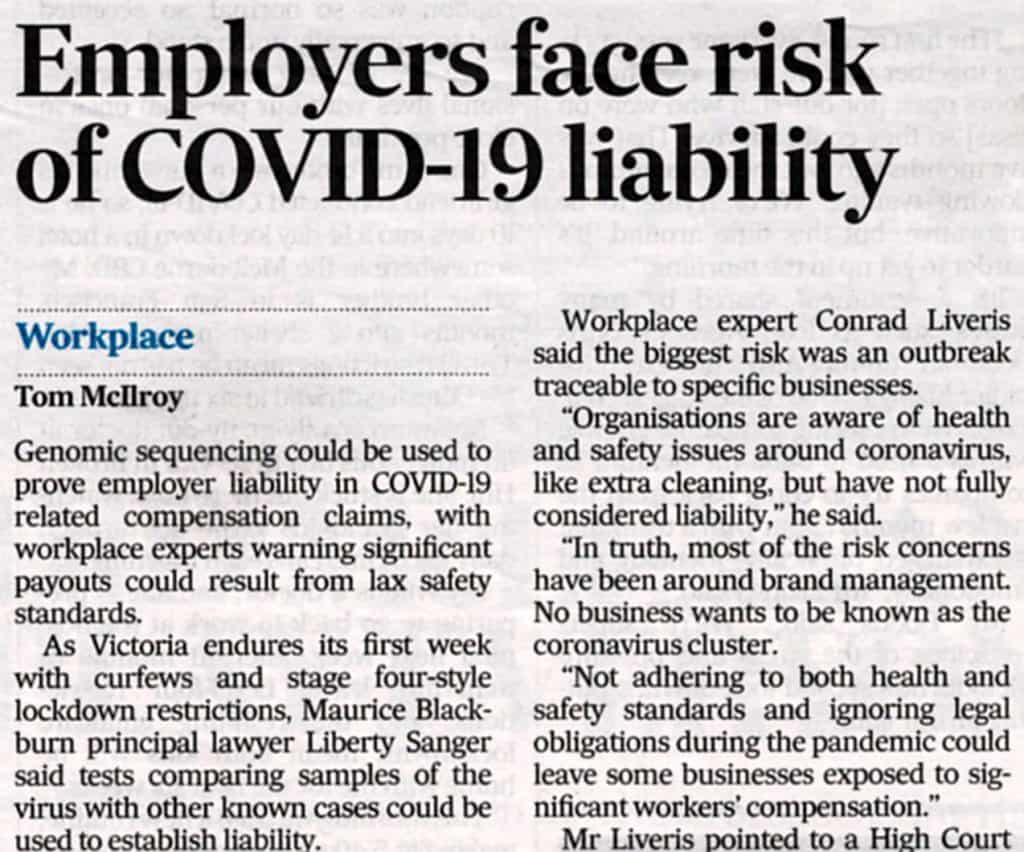
In the Australian Financial Review (AFR) on August 4 2020, employer liability for COVID19 incidents was discussed. Liberty Sanger of union-associated law firm, Maurice Blackburn, spoke of the importance of genomic testing to better identify the origin of the infection, ie. was it caught at work or at home.

Subscribe to SafetyAtWorkBlog to continue reading.
Subscribe Help
Already a member? Log in here

“Soldier On” should be “F### Off”

Many workers continue to work when sick. This is called presenteeism and in a time of infection pandemic, is a major problem. Many countries have addressed the COVID19 risks of presenteeism by requiring people to work from home if they can. In Australia, the message is not totally working with people ignoring the rules for various reasons.

However, presenteeism also has a deeper cultural and institutional origin that has been exploited by some and downplayed or ignored by others.

Continue reading ““Soldier On” should be “F### Off””

Two steps forward, one backward

The latest media release from the Australian Institute of Health and Safety (AIHS) shows a remarkable maturity and a newfound ability to be inclusive and topical.

The AIHS, in conjunction with several other occupational health and safety (OHS) related organisations, developed and released an important guidance on respiratory protection masks for the work environment. Not only is this super topical but the effort has the support of the Australian Council of Trade Unions (ACTU), an organisation that, historically, has been reluctant to support OHS initiatives from outside trade union resources.

The primary purpose of the media release is to push the Federal Government for “the urgent establishment of a register for approved respirators (aka face masks)”, but this may be too simplistic and too narrow a focus especially when the issue of face masks is a critical part of the Governments’ plans to “reopen” the economy.

Subscribe to SafetyAtWorkBlog to continue reading.
Subscribe Help
Already a member? Log in here

All jobs are now more dangerous

The COVID19 pandemic has shone a spotlight on the government agencies that regulate and enforce occupational health and safety (OHS) laws. These regulators are not the lead agencies in pandemic control but as some countries relax lock-down protocols and people return to work in changed work environments, the role and actions of the OHS regulators are being re-evaluated.

Sarah O’Connor, in the Financial Times, opened her 26 May 2020 article brilliantly with

” Covid-19 has upended our notion of what a dangerous job looks like”

Office were often dismissed as low-risk workplaces with many site safety walks, if they happened, reporting on torn carpet and other similar hazards. That way of assessing risk should have been replaced, or supplemented, with assessments of the psychosocial risks of stress, bullying, a harassment, excessive workloads and many more harmful practices. So, offices may have a low risk of traumatic physical injuries but a higher level of risk of psychological harm. On top of this reassessment comes an infection risk that can be spread by workers showing no symptoms. Office-based risk has increased again and made the workplace itself dangerous.

Subscribe to SafetyAtWorkBlog to continue reading.
Subscribe Help
Already a member? Log in here

COVID19 controls for sex work safety

Source: Ian Dyball, istockphoto

Thinking about the occupational health and safety (OHS) issues of sex work is fascinating and, to some, titillating. But work is work and the OHS issues are just as real in a room in a brothel as in any other workplace. The workplace hazards presented by COVID19 to the Australian sex industry have been identified and addressed in some excellent OHS advice from Scarlet Alliance.

Sex workers need to screen clients already for visible signs of sexually transmitted diseases so personal questions about health and infections is already part of the customer relations. (There are also requirements for customers to shower or wash prior to services) The questions asked in relation to COVID19 are the same as asked elsewhere:

Subscribe to SafetyAtWorkBlog to continue reading.
Subscribe Help
Already a member? Log in here
Concatenate Web Development
© Designed and developed by Concatenate Aust Pty Ltd