Curious Blog statistics

Analysing end of year statistics for the SafetyAtWorkBlog has uncovered a couple of curiosities.

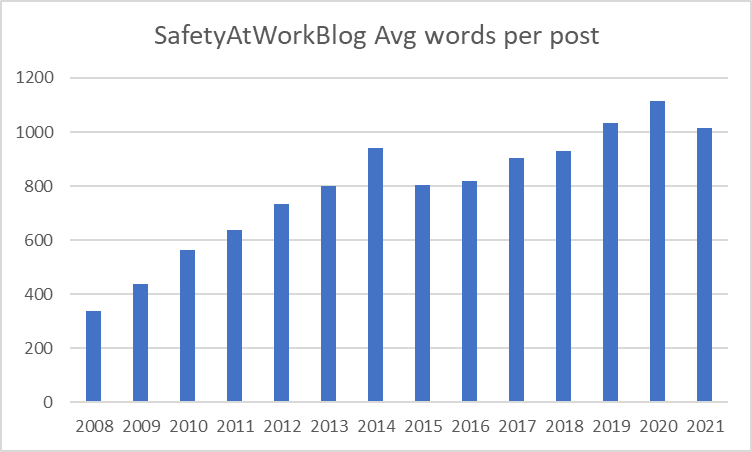
The blog has been operating for over 14 years, and the average number of articles each year is 223. The average number of words per article increased over that time to 1,016 in 2021. The graph below shows the change over time. (The subscription model commenced in 2017)
Subscribe to SafetyAtWorkBlog to continue reading.
Subscribe Help
Already a member? Log in here

Good COVID OHS book

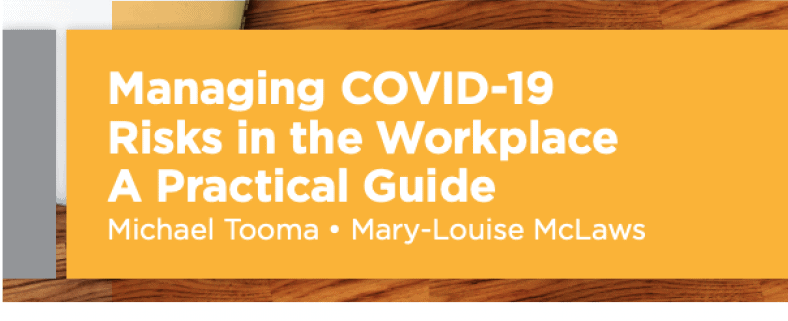
Late last year, lawyer Michael Tooma and epidemiologist Mary-Louise McLaws published “Managing COVID-19 Risks in the Workplace – A Practical Guide”. Given how COVID-19 is developing variants, one would think that such a hard copy publication would date. However, the book is structured on the occupational health and safety (OHS) obligation of managing risks, and whether the variant is Delta, Omicron or Omega (if we get that far), the OHS principles and risk management hold up.

Subscribe to SafetyAtWorkBlog to continue reading.
Subscribe Help
Already a member? Log in here

Missing the big picture

The Australian Institute of Health and Safety has released a new chapter of its Body of Knowledge project. This chapter is about occupational health and safety management systems. It offers a useful perspective but also identifies several of the general shortcomings of the BoK project.

Subscribe to SafetyAtWorkBlog to continue reading.
Subscribe Help
Already a member? Log in here

The unmentioned OHS

Occupational health and safety (OHS) people know how to fix most hazards at work but often have very little power and insufficient influence to apply the fix. That is why OHS people need to read the business sections of major newspapers and mainstream media business websites. It is there that the executives and corporate leaders discuss OHS changes, even if they never say “workplace health and safety”. An article in last weekend’s The Guardian provides a good example.

Subscribe to SafetyAtWorkBlog to continue reading.
Subscribe Help
Already a member? Log in here

We know how to prevent burnout but we have little desire to change

Probono Australia is reporting that employee burnout is on the rise. Burnout is increasingly being used as an alternative term for mental ill-health or stress at work. The report on which the writer based their article is not surprising, but the recommendations are. The subheading for the article is:

““Structural and cultural shifts, not wellness initiatives, are needed to address the chronic workplace stress of burnout.”

But the article also pulls together other workplace mental health factors:

“The rise of digitisation has brought with it a need to  ‘always be on’ and, with that, employee work-life balance has become harder to maintain. It was this type of ‘24/7 access to employees’ thinking, the study found, that led to burnout.”

Subscribe to SafetyAtWorkBlog to continue reading.
Subscribe Help
Already a member? Log in here

Blaming others after a cock-up

Occupational health and safety (OHS) has a long relationship with Blame. Blame has a long association with Responsibility. In the Australian Financial Review on January 19, 2022, Andrew Hill of the Financial Times wrote about both in relation to Novak Djokovic’s actions that led to his deportation.

Djokovic said that one of his administrative team completed his travel declaration incorrectly.

“…. my agent sincerely apologises for the administrative mistake in ticking the incorrect box.”

Hill states that regardless of who completes paperwork on your behalf, you are responsible for the document as it is your document that you are submitting. You are responsible for the document and ensuring that the document is correct.

Subscribe to SafetyAtWorkBlog to continue reading.
Subscribe Help
Already a member? Log in here

Australia’s Prime Minister shows his ineffectiveness on OHS and COVID

Pragmatism was a theme of yesterday’s blog article. On January 19 2022, Prime Minister, Scott Morrison, showed political pragmatism in his press conference. His comments could create more discomfort between State and Federal jurisdiction and more occupational health and safety (OHS) confusion for business owners and employers.

Subscribe to SafetyAtWorkBlog to continue reading.
Subscribe Help
Already a member? Log in here
Concatenate Web Development
© Designed and developed by Concatenate Aust Pty Ltd