Two steps forward, one backward

The latest media release from the Australian Institute of Health and Safety (AIHS) shows a remarkable maturity and a newfound ability to be inclusive and topical.

The AIHS, in conjunction with several other occupational health and safety (OHS) related organisations, developed and released an important guidance on respiratory protection masks for the work environment. Not only is this super topical but the effort has the support of the Australian Council of Trade Unions (ACTU), an organisation that, historically, has been reluctant to support OHS initiatives from outside trade union resources.

The primary purpose of the media release is to push the Federal Government for “the urgent establishment of a register for approved respirators (aka face masks)”, but this may be too simplistic and too narrow a focus especially when the issue of face masks is a critical part of the Governments’ plans to “reopen” the economy.

Subscribe to SafetyAtWorkBlog to continue reading.
Subscribe Help
Already a member? Log in here

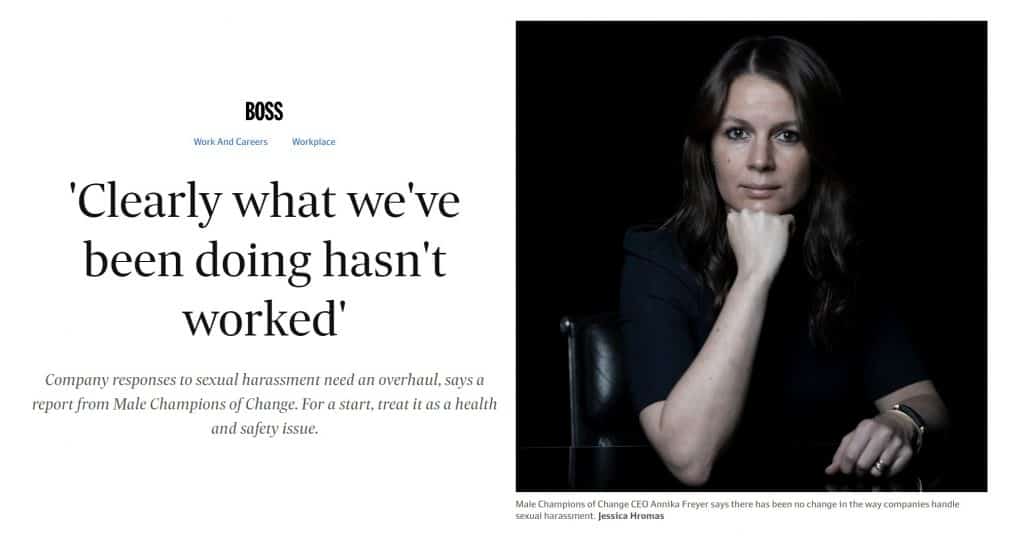
Lancing the boil of sexual harassment

The Australian Institute of Safety and Health’s online national conference offered some big topics this year. One of the most anticipated was the discussion of sexual harassment in the workplace. Luckily the panel discussion included big hitters such as Sex Discrimination Commissioner Kate Jenkins whose week was about to get a lot busier with the revelations of sexual harassment by Australia’s High Court Justice Dyson Heydon.

The Dyson Heydon sexual harassment accusations, which he emphatically denies, were revealed in an independent investigation for the High Court of Australia. The Justice Heydon case has generated copious media attention for many reasons including his prominence in a politically-charged Royal Commission into Trade Union Governance and Corruption. His sexual harassment offences are awful, but the most startling revelations are not necessarily about one man’s inappropriate actions. Here was an organisational, maybe even a professional, culture that permitted this behaviour to continue unchallenged for many many years. It is this context that, I believe, offers the most significant lessons for the occupational health and safety (OHS) profession and where OHS skills can help others.

Subscribe to SafetyAtWorkBlog to continue reading.
Subscribe Help
Already a member? Log in here

Quad bike market changes for the safer

Honda, Yamaha, Suzuki and Polaris have previously announced that they will no longer be supplying quad bikes to the Australian market in response to the imposition of new safety standards. This has left a hole in the market for agricultural all-terrain vehicles (ATVs) that CFMOTO is happy to fill by including an Australian-made crush protection device (CPD) with the sale of some of its quad bikes.

Several Australian farmers continue to be unhappy about the removal of some models of quad bikes from the market. The Weekly Times reported on one disgruntled quad bike dealer, Craig Hartley. What the newspaper article failed to mention was that Hartley’s dealership is with Honda, Yamaha and KTM or that the dealership has been on the market since 2014 but it did include this quote from Hartley:

“Many rural motorcycle businesses, which support the ag industry throughout Australia, may have to close the doors as quad bikes are in many cases at least 40 per cent, if not more, of their turnover.”

Subscribe to SafetyAtWorkBlog to continue reading.
Subscribe Help
Already a member? Log in here

Will IR reform again ignore OHS?

Government policies that directly affect occupational health and safety (OHS) have been determined on a tripartite structure for many decades. This model comprises of representatives from business groups and trade unions in a consultation usually led by the government representatives. SafetyAtWorkBlog believes that this structure excludes important voices and is outdated, especially in a time when technology and the internet allows for a much broader consultation.

The limitations of the tripartite structure were on display recently when the Australian Government released the names of the organisations involved in the review of the industrial relations system. It is worth reading the list for you to understand who will be deciding your working future. It is also worth considering whether the negative OHS impacts of job and employment structures will be given the attention they deserve.

Subscribe to SafetyAtWorkBlog to continue reading.
Subscribe Help
Already a member? Log in here

Why isn’t workplace health and safety improving?

On Wednesday June 24 2020 at 1.30pm (AEST) I will be presenting my conference paper on the topic above. This is the first Australian Institute of Health and Safety conference to be conducted virtually and I am proud to be part of this year’s conference. As it is virtual, there is no limit on tickets so if you could not attend previous AIHS conferences, get to this one. Below is an extract from my paper:

The workplace fatality rates have been falling consistently for decades.  Occupational health and safety (OHS) professionals seem to be busier than ever.  So, the world must be safer than it has been in the past?  Maybe.  But this may not be the reality if we think a little deeper about the causes of harm and about the actions the OHS profession has applied.

Here is a typical graph showing the rate of workplace fatalities since 1985, when the modern OHS legislation was enacted in Victoria.

Subscribe to SafetyAtWorkBlog to continue reading.
Subscribe Help
Already a member? Log in here

From a spark to a flame

The recent employment data for Australia shows record levels of unemployment due, largely, to COVID19. People are out of work and are seeking jobs in areas and occupations with which they are unfamiliar, and we know that new workers are at a high risk of injury. But “safe jobs” has rarely been a government priority.

Prime Minister Scott Morrison and Treasurer Josh Frydenberg held a long press conference after the release of the employment statistics on June 18 2020. Nine times the pair stressed the government’s priority was to get Australians “back into work”. Safe and healthy jobs were never mentioned. One could argue that occupational health and safety (OHS) was not part of the economic discussion on that day (it never is) but there is an equal argument to say that the inclusion of either adjective “safe” and “healthy” could create a cultural change in Australian workplaces, a cost-reduction strategy for Australian businesses and an increased quality of life and improved social cohesion for all Australians.

Subscribe to SafetyAtWorkBlog to continue reading.
Subscribe Help
Already a member? Log in here

Important safety, environmental, political and personal stories in book on the Morwell Mine fire

Dr Tom Doig has continued to build on his earlier work about the Morwell mine fire, expanding his “The Coal Face” from 2015 into his new book “Hazelwood” (after court-related injunctions, now available on 18 June 2020).

SPECIAL OFFER: The first four (4) new Annual subscribers in the month of June 2020 will receive a copy of Hazelwood.

The Morwell mine fire created great distress to residents in Victoria’s Latrobe Valley, ongoing health problems, and a parliamentary inquiry, but can also be seen as a major case study of occupational health and safety (OHS) laws, enforcement, role and the obligation on employers to provide a safe and healthy working environment that does not provide risks to workers and “protect other people from risks arising from employer’s business”.  The management of worker and public safety is present in almost every decision made in relation to the Morwell Mine fire. The overlay of an OHS perspective to Doig’s book is enlightening.

Subscribe to SafetyAtWorkBlog to continue reading.
Subscribe Help
Already a member? Log in here
Concatenate Web Development
© Designed and developed by Concatenate Aust Pty Ltd