More than warm lettuce needed on Industrial Manslaughter laws

Applying the most effective way to have companies comply with their occupational health and safety (OHS) obligations has been debated in Australia and elsewhere for years.  The issue will arise again in 2019 and in relation Industrial Manslaughter laws as Australian States have elections, or the political climate suits.

There are several elements to the argument put by those in favour of Industrial Manslaughter laws. Workers are still being killed so the deterrence of existing OHS laws has seen to have failed.  Deterrence has been based on financial penalties and workers are still being killed so financial penalties have failed. Jail time is the only option left.

This is a simplistic depiction of the argument, but it is not dissimilar to some of the public arguments. The reality is that deterrence is achieved in two ways – telling the person of the consequences of an action and enforcing those consequences.

Subscribe to SafetyAtWorkBlog to continue reading.
Subscribe Help
Already a member? Log in here

Heat

The occupational risks of exposure to excessive heat have usually been assessed in remote locations in Australia, and almost exclusively for outdoor workers. The changing environmental conditions, regardless of the global cause, are changing the risk assessment of heat for outdoor workers and, increasingly, indoor workers such as those in food production or kitchens.

Recently Safe Work Australia released a seminar online which discussed the issue of heat in the occupational health and safety (OHS) context.

The panel discussion operates from the perspective of what can be done rather than what could be done and remains within the occupational context. Professor Dino Pisaniello mentioned his recent research into the issue, which looks like it was meant to be the focus of this seminar and which found:

Subscribe to SafetyAtWorkBlog to continue reading.
Subscribe Help
Already a member? Log in here

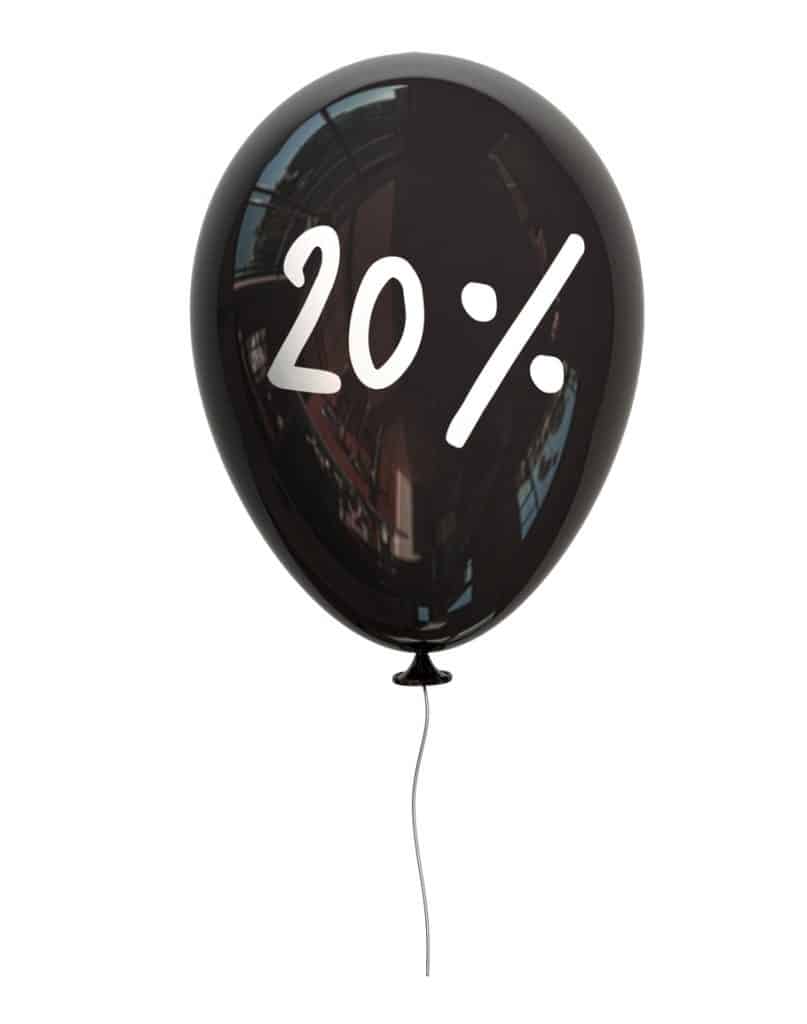
The mental health “one in five” statistic examined for validity

This blog has a policy of linking to source documents wherever possible. Recently I investigated the origin of the statement and its variations:

“In a 12 month period, 20 per cent of Australians will experience a mental health condition.”

Clarity on this is going to be important as Australia has several formal inquiries relating to mental health and this statement often crops up in strategy documents and policies related to occupational health and safety (OHS).

Subscribe to SafetyAtWorkBlog to continue reading.
Subscribe Help
Already a member? Log in here

Mental Health Issues Paper provides opportunity for OHS to pitch for legitimacy

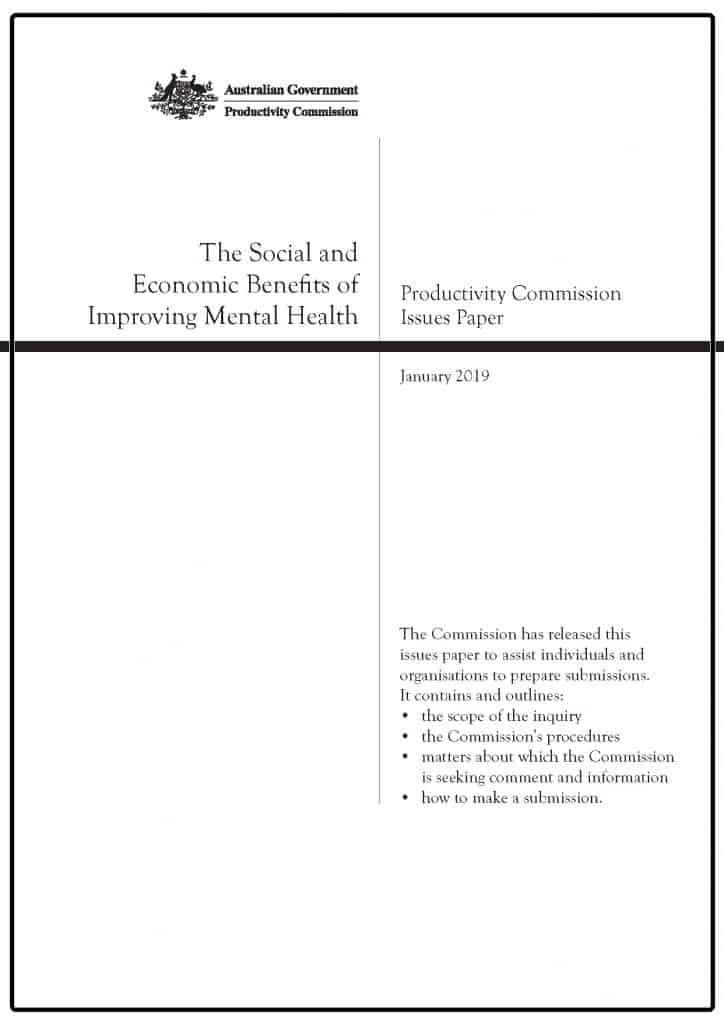
Australia’s Productivity Commission (PC) has released its first Issues Paper to assist people in understanding the purposes of the Inquiry and to lodge a submission. The Report provides opportunities for the occupational health and safety (OHS) profession and advocates to explain the relevance of OHS principles in preventing psychological harm. It includes specific work-related questions for people to address in submissions.

Subscribe to SafetyAtWorkBlog to continue reading.
Subscribe Help
Already a member? Log in here

The absence of OHS says much

Workplace safety is an integral element of managing any business. The acceptance of this reality by business leaders is restated every time a Chief Executive Officer claims that “safety is our number 1 priority”. The mismanagement of safety and health can also subject personal and corporate reputations to considerable damage So it is reasonable to expect some mention of occupational health and safety (OHS) in a recent survey from the Australian Industry Group concerning business prospects for 2019. Nah, nothing.

Subscribe to SafetyAtWorkBlog to continue reading.
Subscribe Help
Already a member? Log in here

Too big to change

The strong readership of the article on truck driver safety based on the research of Dr Clare George resulted in one reader remind me of Australian research from 2017 that looked at similar issues.
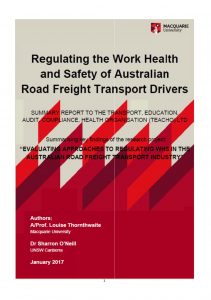
In 2017 Louise Thornthwaite and Sharron O’Neill published “Regulating the work health and safety of Australian road freight transport drivers: summary report“.  The authors wrote:

“Work health and safety (WHS) is a significant issue for the heavy vehicle road freight transport industry. The sector has a history of the highest fatalities and serious injury rates of any industry in Australia. While media focuses on drivers killed in road crashes, these represent only a subset of the hundreds of drivers killed or permanently disabled, and thousands more injured, in and around trucks each and every year.

Subscribe to SafetyAtWorkBlog to continue reading.
Subscribe Help
Already a member? Log in here

Jordan Barab provides important OHS insights

I learnt more about the politics of the United States from Doonesbury than I did from television news and analysis.  I learn more about the politics of occupational health and safety (OHS)  in the United States from Jordan Barab‘s Confined Space newsletter/blog than I do any other media source.  Although the US’s OHS legal structures are different from Australia and other Commonwealth countries, the political ideologies and maneuverings, and fads and statistics are noted by political parties outside the United States.

Recently Barab posted a Year in Review article which is obligatory reading.  His key issues included:

  • A New and Improved Congress (or at least the House)
  • A Headless Agency
  • Inspectors down, enforcement units down, penalties down
  • Return of Black Lung
  • Brett Kavanaugh
  • Regulatory Rollback
  • The Fate of the Labor Movement

Anything sound familiar in your own jurisdiction?

Subscribe to SafetyAtWorkBlog to continue reading.
Subscribe Help
Already a member? Log in here
Concatenate Web Development
© Designed and developed by Concatenate Aust Pty Ltd