
Sometimes it is better to read Sidney Dekker than listen to him. His presentation style is lively but his research and thoughts deserve more measured analysis than a conference or seminar presentation allows. A recent research paper, “‘Just culture:’ Improving safety by achieving substantive, procedural and restorative justice“, shows the advantage of reading over watching.
Category: Premium
Australian politicians not “playing well together” on OHS
Occupational health and safety (OHS) returned to the Australian
Extracting good from maps of death
Ever since I read the London Encyclopaedia during my honeymoon in England, I have waited for a similar encyclopaedia based on workplace safety. However, the world has changed since then and such an encyclopaedia would most likely to be created as an app.
The London Encyclopaedia is indexed by places, streets and addresses, and so should a “Safety Encyclopaedia” app through a localised map of workplace fatalities.
Safety is the highest priority. Really?
Workplace safety can have a bizarre logic. A recent example can be seen in the continuing controversy about the deaths of two workers on a construction site in Western Australia.
In November 2015 two workers Joe McDermott and Gerard Bradley were crushed to death by a concrete slab while on a break at a Jaxon Construction site in East Perth. The Construction Forestry Mining and Energy Union (CFMEU) concerns about the site have been discussed on ABC television last week and on the union’s social media. WorkSafe WA is investigating.
Some of the statements by Kim Richardson, the construction director of the Master Builders Association of Western Australia (MBAWA) seem ill-timed but reflect many of the perspectives held by employers towards occupational health and safety (OHS).
Shortly after the the incident Richardson stated that
“All workers have the right to go to work and have the expectation and the right to come home safely,…. That did not happen.
There’s been a move to have a tremendous amount of paperwork where people will tick boxes to say they have a safe system in place. But that doesn’t guarantee safe systems of work. The way the work is performed is where the focus needs to be.”
Richardson’s complaints seem to be that
- occupational health and safety has too much paperwork
- the paperwork misrepresents the level of safety at the workplace
- greater attention should be given to how work is performed.
Few OHS professionals in Australia would argue these points but there are some uncomfortable implications in these complaints.
Important research into workplace cyber-bullying
Last week several Australian news sites reported on a new thesis about public servants and cyber-bullying which is discussed in detail below. The reports are based mostly on a media release about the research issued by Queensland University of Technology (QUT). What caught my eye was the statement in the one media report that the researcher, Dr Felicity Lawrence,
“…said traditional workplace bullying already cost the nation about $36 billion a year, “so the cost of cyber bullying on productivity could be profound”.
Not true. In the QUT statement, Lawrence stated
“Traditional workplace bullying costs the national economy up to $36 billion each year, so the cost of cyberbullying on productivity could be profound,…”
“up to” vs “about? This differentiation is important because the lack of clarity creates OHS myths and these myths can misinform policy priorities and public understanding of workplace hazards.
The forgotten Royal Commission
Australia conducted a
Trade Union Royal Commission shows exploitation of OHS
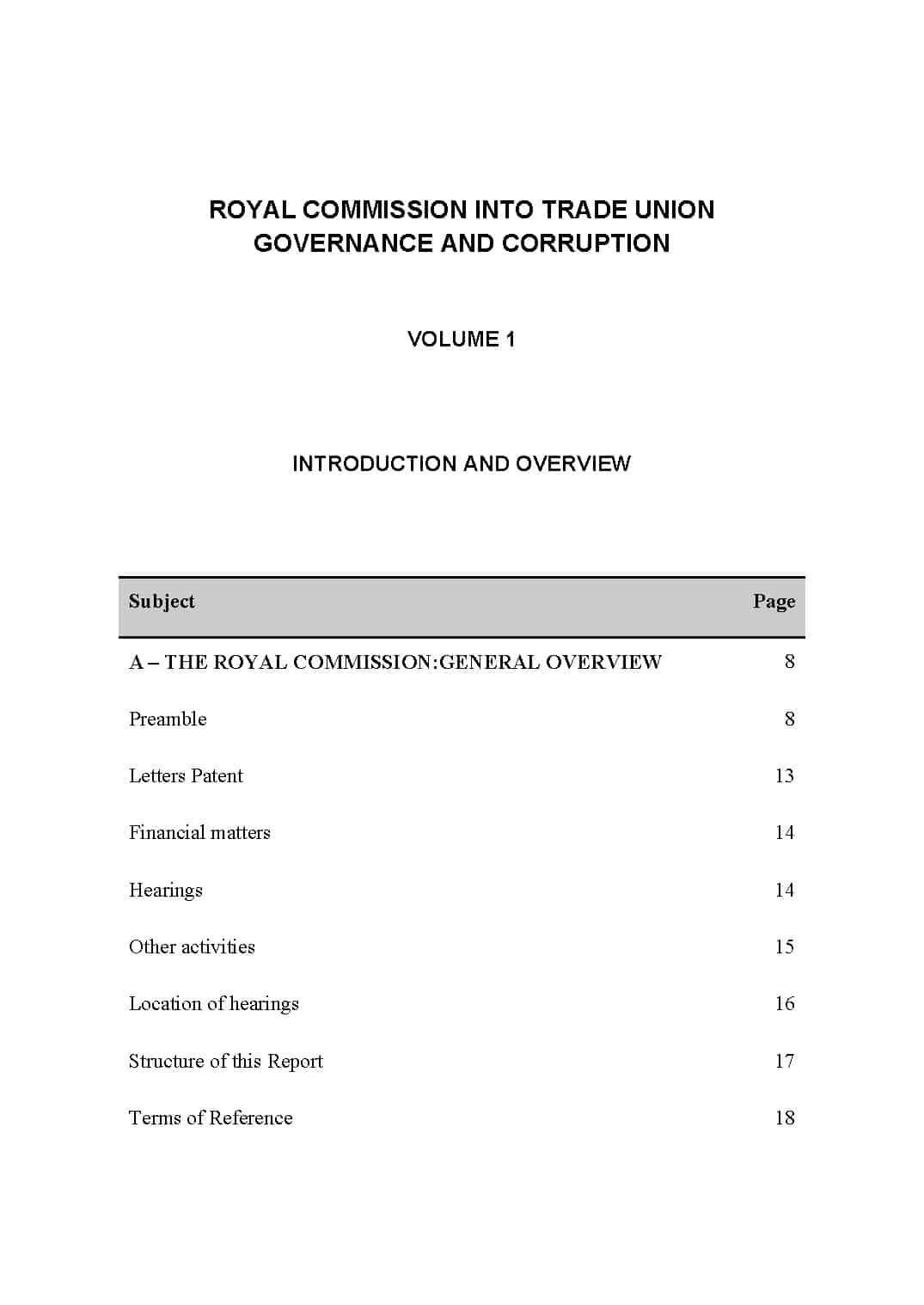 In January 2015, this blog said of Australia’s Royal Commission into Trade Union Governance and Corruption (TURC):
“Workplace safety has not been the focus of this Royal Commission but it is one of its victims”.
The Royal Commission’s final report was released on 30 December 2015, and it is time to look at the mentions of occupational health and safety (OHS), at least in Volume 1, and see how processes, decisions and reporting in the safety sector may change.