
Occupational health and safety (OHS) cannot exist outside social, economic and political contexts. Some OHS professionals try to convince themselves that OHS is a special case but to do so ignores the components of change that need to be addressed in order to improve workplace safety. There are parallels between OHS and contemporary political thought.
Category: Premium
Unfair expectations on the individual
Harvard Business Review (HBR) is a justifiably respected business publication but it often sells occupational health and safety (OHS) short. A new HBR article, “Stress Is Your Brain Trying to Avoid Something“, is a case in point.
Too much of the contemporary approaches to psychosocial hazards at work focus on the individual without addressing the organisational. This often compounds the struggles of individual workers and encourages managers to blame workers instead of analysing the organisational and cultural factors that lead to a hazard or incident.
Analysing safety leadership can be distracting
Any blog about occupational health and safety (OHS) will write repeatedly about leadership. Safe Work Australia advocates leadership as beneficial to OHS:
“When leaders make sure all business risks, including work health and safety, are effectively managed, and continually monitor and review all areas of their business’ performance, they will be open to opportunities for innovation, and alert to emerging hazards.”
But leadership requires someone to apply it and often, in the OHS sphere, people wait for others to show leadership rather than seeing their own potential.
Safety is missing from the political lexicon
At the moment in Australia, a
Psychologically health workplaces
In some of his research into the operations of WorkSafe Victoria, OHSIntros provided this graph of workers compensation claims for psychosocial issues. Not only does it show the extent of the issue in recent years, it provides a clear historic starting point for the hazard – a hazard that has created an industry of its own and that has complicated the management of workplace safety.
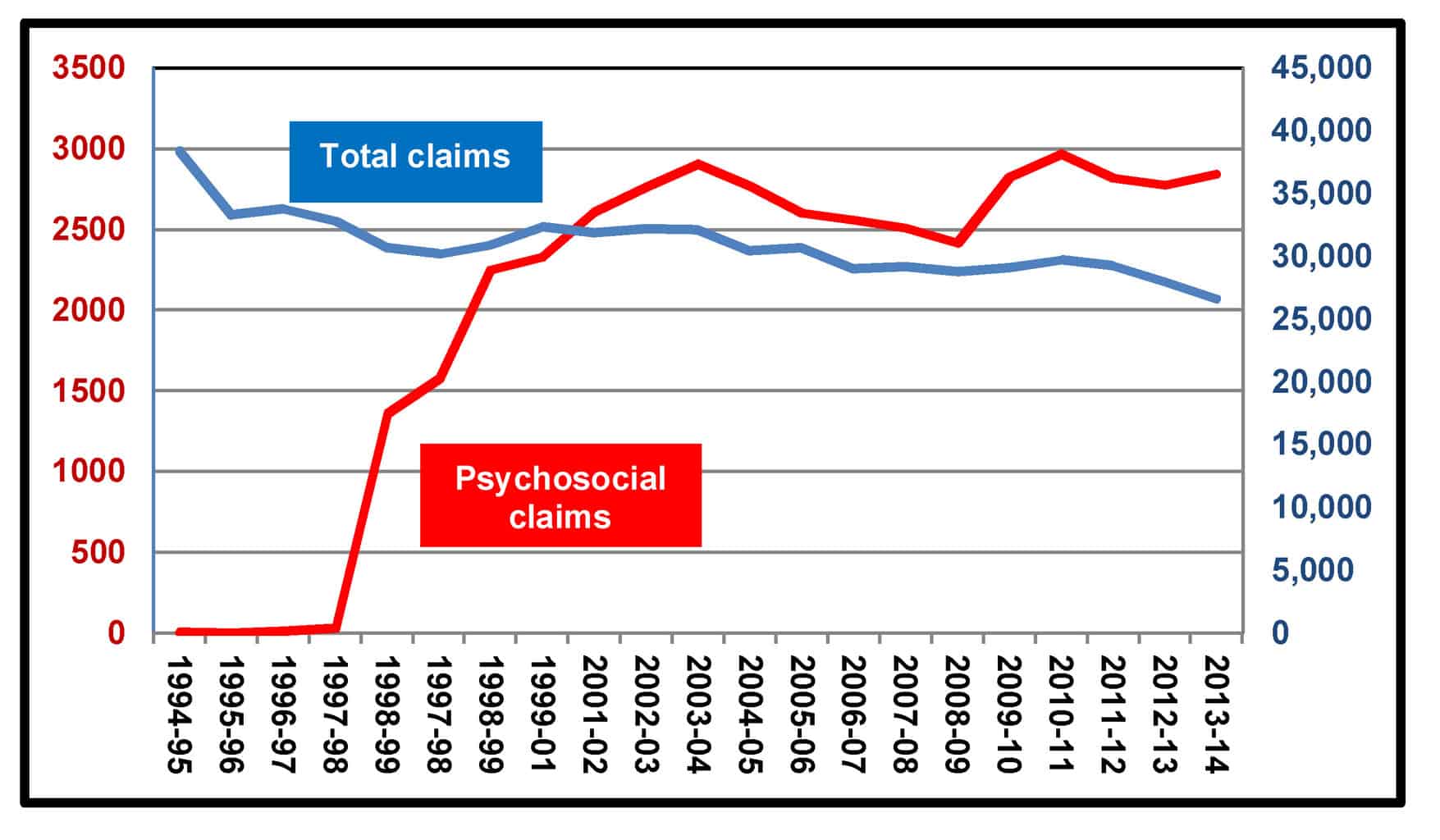
OHSIntros comments on this increase by saying “the conventional rationale in OHS is that when you identify and focus on a risk, the claims flood in…” but significantly states that this logic remains untested. Occupational health and safety (OHS) seems to run on untested logic.
Clearly psychosocial issues in the workplace present a problem. OHSIntros writes that in 2013-14 psychosocial claims overtook manual handling on average cost amounts of A$88,000 to A$67,000, respectively (page 11)
Recently
Sedentary work research features at ergonomics conference
The current International Ergonomics Congress in Melbourne seems to be successful in a number of ways:
- The size and variety of its program
- The quality of its keynote speakers
- Out of 900 delegates, 600 are from outside Australia.
Where it seemed to be less successful was in its profile outside of the ergonomics profession. The information available, some identified on other blog articles, has relevance well beyond ergonomics and it is disappointing that the conference was not marketed more to the general occupational health and safety (OHS) profession. (It should have been possible to exceed 1000 delegates just from local promotion.) The OHS profession needs livening up and have its body of knowledge expanded to areas that both support and challenge its own principles and processes.
Sedentary Work
A major thread in the Congress was the issue of sedentary work, something discussed by the first day’s keynote speaker, Professor
Ergonomics conference provides good, free knowledge
The 19thTriennial Congress of the International Ergonomics Association (IEA 2015) is currently running in Melbourne Australia with 900 delegates, of which 600 are from outside Australia. It offers a fascinating (online) library of ergonomic and occupational health and safety (OHS) research. Below is a sample of the research on offer picked, largely, at random.
It seems unnecessary to state that ergonomics is an essential part of the knowledge base of safety and production but ergonomics still seems to be a “dark art” to many. This is acknowledged by many in the sector and is summarised well by Ruurd N. Pikaar