WorkSafe Victoria heads roll

Victorian Premier Daniel Andrews has spoken publicly about the removal of the CEO and Chair of WorkSafe Victoria describing them as liars and incompetent.  As Jon Faine pointed out in the radio interview, the Premier has established a high level of accountability.  Hopefully this results in an increased diligence on OHS matters by government departments and authorities.

The Industrial Relations Minister in the Andrews Government, Robin Scott, was a

Subscribe to SafetyAtWorkBlog to continue reading.
Subscribe Help
Already a member? Log in here

Master guide or handbook

In 2012, SafetyAtWorkBlog reviewed the first edition of the Australian Master Work Health and Safety Guide. CCH Wolters Kluwer has released its second edition and, sadly, it repeats many of the criticisms in the 2012 review.

The title of Australian Master Work Health and Safety Guide (2nd ed) seems inaccurate if one considers a book with “master ” in its title to be a “masterwork”. This is not a masterwork and the publishers have emphasised to SafetyAtWorkBlog that the book was never intended to be.  The book is intended to be a brief outline of the most important contemporary occupational health and safety (OHS) issues in Australia and to provide practical advice, checklists and templates.  In fact, the word that should be focussed on in the title is “guide”.

The publishers advised that “master” is in the title to indicate it is part of its “Master Series“, a “brilliant” series described as

“Australia’s premium range of professional books, widely accepted as the leaders in their fields.”

SafetyAtWorkBlog looked at a couple of chapters to assess the quality of the content.  As workplace bullying is such a contentious issue. the Bullying and Violence chapter was a focus. There were a surprising number of omissions in this chapter.

Subscribe to SafetyAtWorkBlog to continue reading.
Subscribe Help
Already a member? Log in here

New research on OHS business case

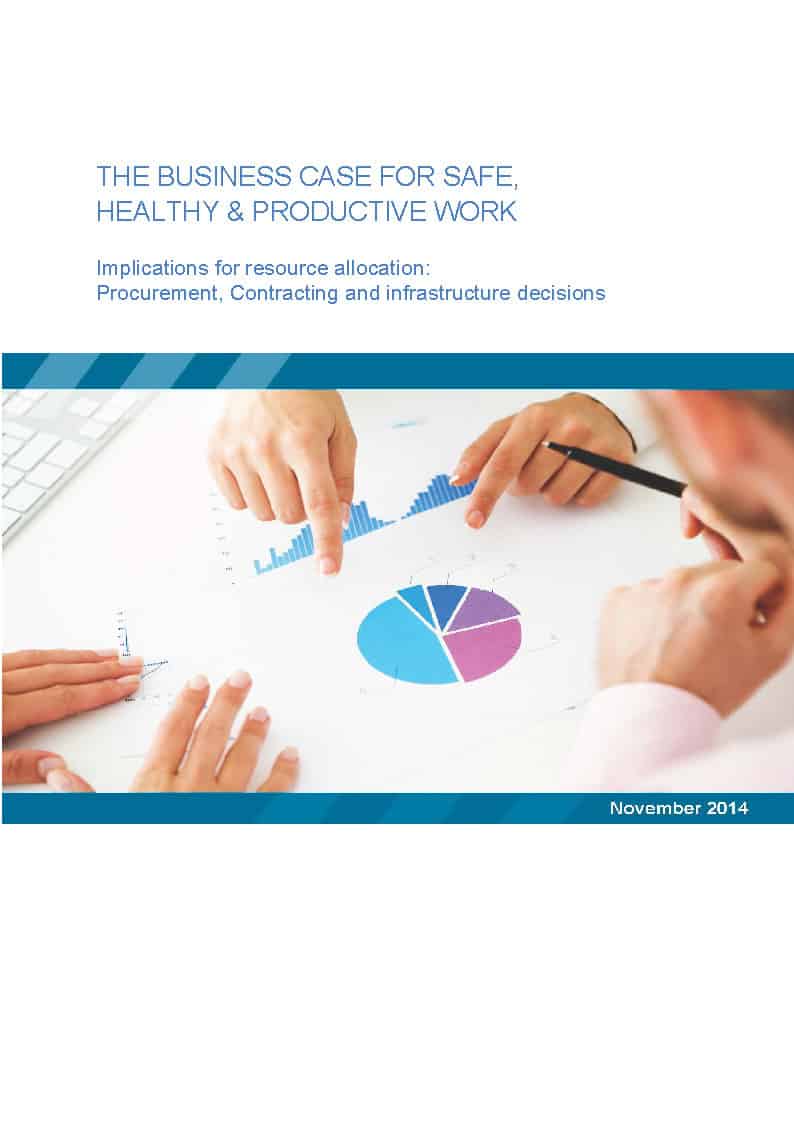
cover of business-case-for-safe-healthy-productive-workSafe Work Australia recently released its second research paper related to developing or communicating a business case for occupational health and safety (OHS).  The paper has been authored by Sharron O’Neill and is called “The Business Case for Safe, Healthy and Productive Work – Implications for resource allocation: Procurement, Contracting and infrastructure decisions“.  O’Neill’s paper clearly challenges the dominant thinking of OHS and costs.

O’Neill states that the quality of previous analyses of OHS business costs have been “fundamentally poor”, partly because

“Rather than strategically examining the cost-benefit to business of work health and safety, the typical ‘silo’-driven analysis produces a narrow focus on a very different concept; the cost-benefit to business of health and safety interventions. This has obscured much of the potential for improving  organisational productivity and operational decision-making.” (page 4, link added)

Subscribe to SafetyAtWorkBlog to continue reading.
Subscribe Help
Already a member? Log in here

WorkSafe Victoria’s Len Neist addresses safety profession breakfast

Herbert Smith Freehills (HSF), in its Australian partners and as a firm, has been prominent in occupational health and safety (OHS) matters, even though the organisation is “on the nose” with much of the trade union movement. This week HSF conducted a breakfast for the Safety Institute of Australia (SIA) in Melbourne, the first in a couple of years after an alleged falling out with the SIA.  The presentations did not sparkle as some have in previous years.

The most anticipated presentation was from Len Neist, an executive director of WorkSafe Victoria.  Neist outlined the aims of the organisation but much of this was familiar.  He reiterated the obligations on WorkSafe from the various legislation and pledged to focus on prevention.

Neist is not beyond executive jargon (“risk tolerability framework” ?) and stated one of his aims was to “incentivise compliance and improvement”.  One can argue that compliance should require no encouragement only enforcement.  Why provide incentives to businesses for what is their legislative and moral duty?

Subscribe to SafetyAtWorkBlog to continue reading.
Subscribe Help
Already a member? Log in here

Productivity Commission looks at workplace bullying – not really

The Australian Government has announced an inquiry into workplace relations through the Productivity Commission (PC). The most obvious occupational health and safety (OHS) element of this inquiry relates to workplace bullying which is discussed in the fourth of five issues papers released in January 2015. However the purposeful separation of workplace bullying actions through the Fair Work Commission (FWC) from actions in other sectors, such as OHS regulators, limits the potential impact of the inquiry on this issue.

The PC issues paper acknowledges the lack of the anticipated avalanche of anti-bullying applications and accepts that the structure of the FWC process may be partially responsible.  This lack of applications, an issue discussed

Subscribe to SafetyAtWorkBlog to continue reading.
Subscribe Help
Already a member? Log in here

New book challenges current OHS trends

Quinlan coverProfessor Michael Quinlan has a new book that focuses on lessons from recent mining disasters but, as with the best of occupational health and safety (OHS) books, it challenges orthodoxies.  Some OHS consultants and experts have built careers on these orthodoxies, trends and fads, and will feel uncomfortable with the evidence put forward by Quinlan in “Ten Pathways to Death and Disaster – Learning from Fatal Incidents in Mines and Other High Hazard Workplaces“. The honesty and humanity in this book makes it an essential part of any OHS professional’s library.

Quinlan establishes an important tenet from the very start:

“… knowledge is not created in a social vacuum.” (page xi)

This simple dictum is vital to an understanding of the true causal factors on OHS decision-making.  People die from OHS failures.  Politicians create laws and situations that can encourage failures, increase risk and can provide a veneer of respect for heartlessness and exploitation.  Business owners may feel pressured to place production before safety.  Some OHS writers and advocates stop, often unconsciously, at the point where their theory or market research would fail scrutiny.  Some apply critical thought only “as far as is reasonably practicable” to continue a business activity that is short-term or to sell their consultancy package to gullible or naive corporate executives.

Quinlan writes of the “political economy of safety”:

“The political economy perspective argues that safety, including workplace disasters, can only be understood in the context of the distribution of wealth and power within societies, and dominant social policy paradigms that privilege markets and profit, production or economic growth over safety.” (page 24, emphasis added)

To many readers this may sound like socialism in its mention of wealth distribution and power but such a perspective is valid even though it may be unfashionable.  Such a broad perspective allows for a critical assessment of other OHS research approaches such as, for instance, the culture advocates. 

Subscribe to SafetyAtWorkBlog to continue reading.
Subscribe Help
Already a member? Log in here

WorkSafe Victoria returns

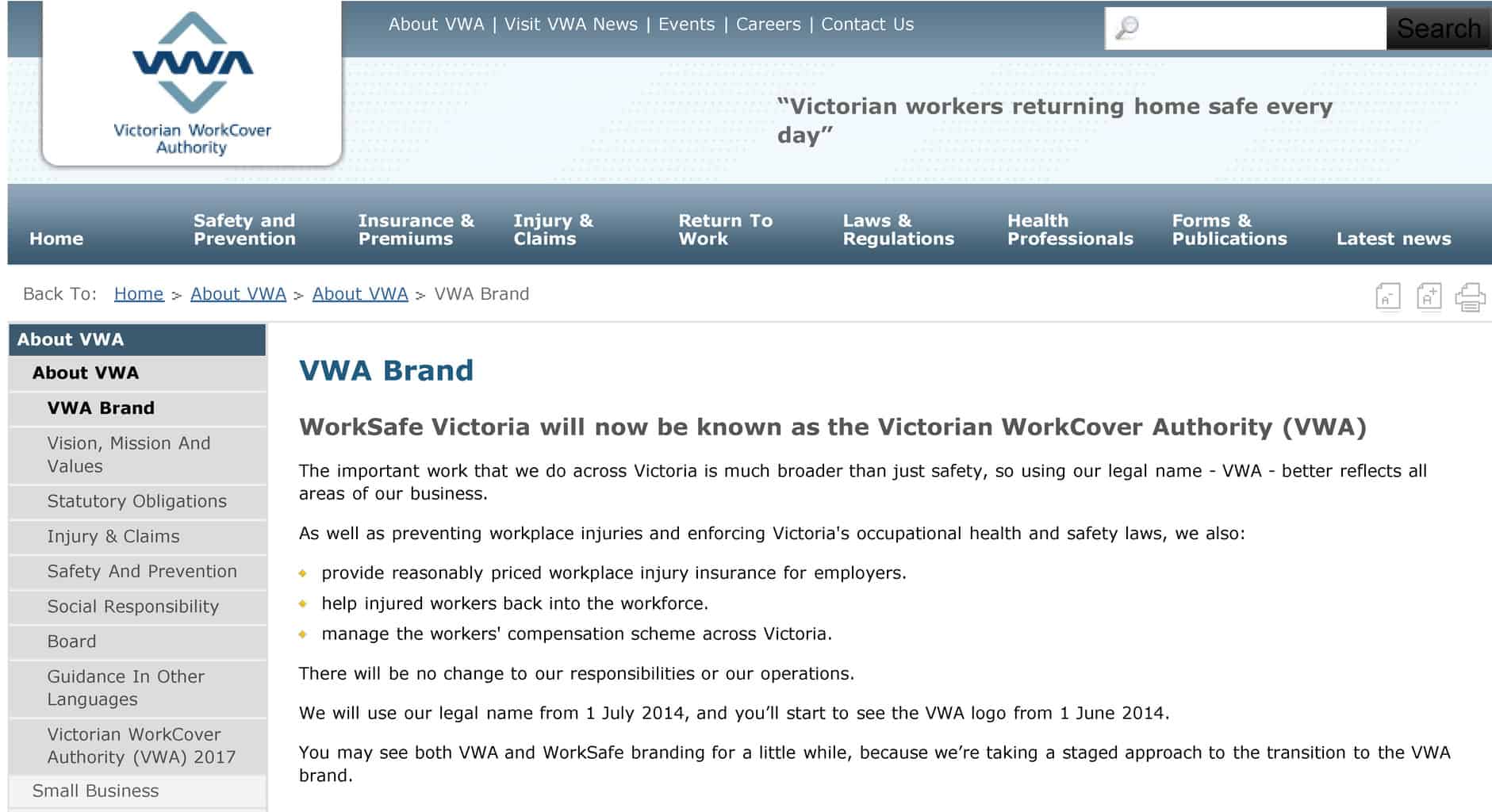
VWA BrandJust over six months ago the (conservative) Victorian Government announced that it was dropping the WorkSafe brand (pictured right).  This made little sense at the time as the WorkSafe brand was so established that it became accepted shorthand for the OHS inspectorate. On 23 January 2015, less than two months after the election of a new (Labor) Victorian Government, the brand has been resurrected.  It seems that this indicates an ideological change.

The benefits of dropping the brand were stated on the Victorian Workcover Authority’s (VWA) website (pictured above) as better reflecting all areas of the VWA’s business but the decision was widely interpreted as a diminution of attention to harm and injury prevention.  Such a strategic shift echoed  the increased

Subscribe to SafetyAtWorkBlog to continue reading.
Subscribe Help
Already a member? Log in here
Concatenate Web Development
© Designed and developed by Concatenate Aust Pty Ltd