In late December 2019, Dr Graeme Edwards provided an update on Australia’s silicosis situation to the Australian Broadcasting Corporation’s PM program in which he mentions the movement of businesses to avoid occupational health (OHS) and safety obligations and duties.
Category: risk
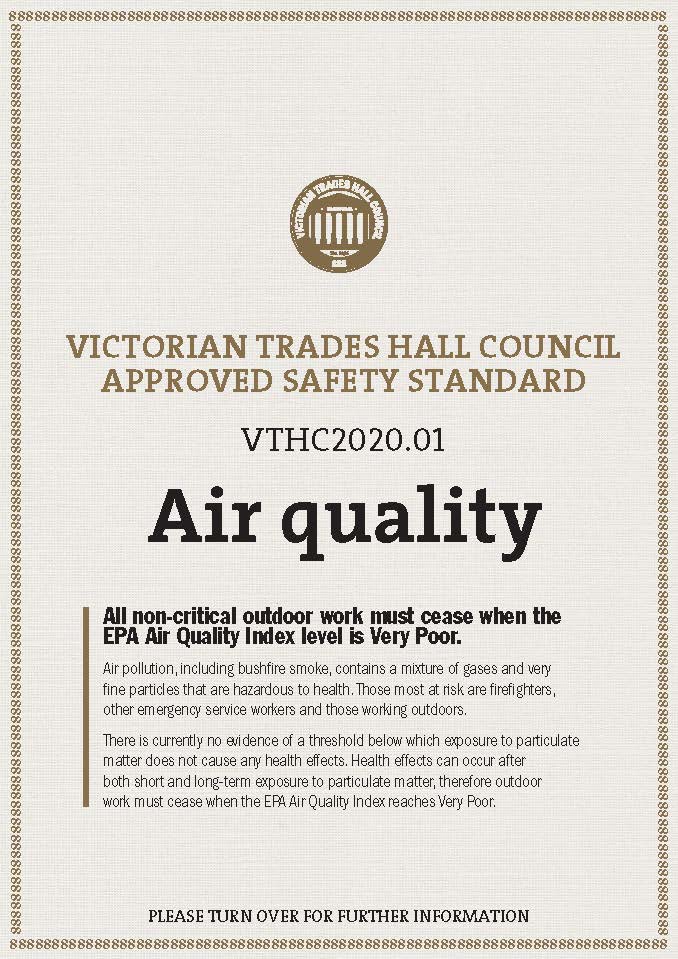
This year’s bushfires should change the management of outdoor work

Safe Work Australia (SWA) has reminded Australian businesses that they have a formal occupational health and safety (OHS) responsibility for workers exposed to poor air quality. Its guidance provides sound risk considerations for outdoor workers and their managers, but needs further explanation to help businesses reduce the risk in a practical sense.
Mining comments are revealing

The reader’s comments on online articles can be very revealing. Below is a discussion of some of the comments posted on The Australian website in response to an article about the accuracy of workplace fatality data in the mining industry. Given that this is one of the few mainstream media articles about occupational health and safety (OHS), they are telling.
One commenter asked the newspaper:
“… if one of your accountants based in the Sydney office were to have a car accident in Parramatta while driving to work in the morning, would you include that in your OHS statistics as a workplace fatality?”
Even neuroscience needs sociology

Summer in Australia means a lot of time traveling in a car, often to the extent of completing an abridged audiobook and/or several podcasts. One episode of BBC’s The World This Week caught my ear, not because it is titled “Australia Burning” but for the opinion piece by Martin Bashir (17 minute mark). Bashir discusses mid-life crises, risk aversion and neuroplasticity. I look at the relevance to occupational health and safety.
Bashir spoke about the importance of challenging oneself, especially at “an age of comfort” (my term) an achievement. This may not seem related to OHS, the raison d’être of this blog, but the age of comfort can be defined as an age of safety or risk aversion, or as Bashir says “a mechanism for self-protection”, and this period in our lives may bleed into the way we see the world, the type of OHS advice we may provide our clients and, perhaps, the way that our OHS legislation is constructed.
Instead of throwing stones, build a stronger house

On 19 December 2019, the Australian Council of Trade Unions (ACTU) issued a confusing and, ostensibly, three-paragraph media release about working in heat, a hazard that has been regularly analysed by SafetyAtWorkBlog. It states:
“OHS laws which are designed to keep workers safe at work need to be updated to deal with the reality of climate change, which will mean hotter days and more bushfires, resulting in conditions which are hazardous to workers, especially those who work outside.”
Paragraph 1 – update the occupational health and safety (OHS) laws. Paragraph 3 – new regulations needed:
“… we call on the Morrison Government to act urgently to implement new regulations to protect workers from these hazards.”
So which is it – enforce the old or create new?
Continue reading “Instead of throwing stones, build a stronger house”Negligence or Neglect

At the moment, there is a growing concern about accountability of political leaders, business executives and established institutions. In Australia’s occupational health and safety (OHS) community that has manifested in a movement to introduce Industrial Manslaughter (IM) laws aimed at negligent employers. These laws have caused some business sectors and leaders to, figuratively, shit themselves. But this fear exists largely when looking at business and OHS through a legal compliance perspective. Breaking down Negligence to a concept that many more people understand – Neglect – may help some better accept their accountability for safe and healthy workplaces.
OHS approach to sexual harassment gets an airing
Tracey Spicer has been a very public face of the campaign against sexual harassment in Australian workplaces. She, and her campaign, has not been without controversy but recently Spicer presented a three-part documentary on the issue. In Episode 2, the viewers heard, all too briefly, from Dr Rebecca Michalak about the occupational health and safety (OHS) context of sexual harassment.