
“So far as is reasonably practicable” is often used by scoundrels

On May 4, 2006, John Della Bosca advised the New South Wales Parliament:

“The Government will clarify that the general duties and obligations under the Act apply so far as is reasonably practicable. Ensuring the health and safety of employees will mean eliminating risks to health and safety so far as is reasonably practicable. Where it is not reasonable to eliminate a risk, employers will be required to reduce the risks to the lowest level reasonably practicable. Practical risk management does not require employers to go to extraordinary, unrealistic lengths, and never has. Rather, it requires the management of risks that are likely to affect health and safety over which the duty holder has a level of control. This is what the Government has always said, and it has always been Government policy. This is what it intends to enshrine in legislation to give greater certainty to both employers and employees.”

Della Bosca paints “so far as is reasonably practicable” (ASFAIRP) as an integral part of eliminating risks to health and Safety, and it is an integral part of OHS laws, but it is also a limitation, a condition and a concession in achieving safe and healthy workplaces and one that is drastically in need of a thorough independent review.

Subscribe to SafetyAtWorkBlog to continue reading.
Subscribe Help
Already a member? Log in here

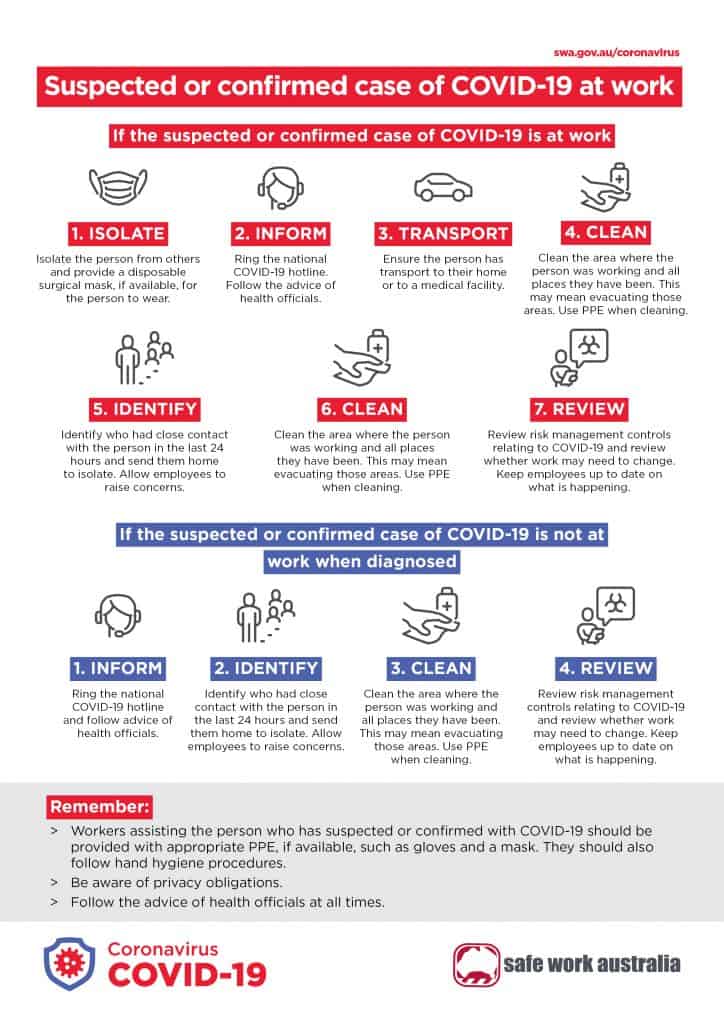
Safe Work Australia’s COVID19 guidance

In mid-March, pandemic advice from occupational health and safety (OHS) regulators was assessed with the generic guidance from WorkSafe Victoria being praised. Many changes to workplaces have occurred since then and Safe Work Australia (SWA) has caught up with the demand for industry-specific guidance on managing work in this pandemic. SWA’s advice is very good and is discussed below.

Subscribe to SafetyAtWorkBlog to continue reading.
Subscribe Help
Already a member? Log in here

Safety In Design to be included in new digital construction research

In March 2020, several Victorian universities and others were proud to announce their being provided government grants to

“…. transform how buildings are designed and manufactured in Australia”.

Given that safety in Design of buildings has been an ongoing initiative for many years, several questions on this topic were sent through to the Interim CEO of Building 4.0 CRC, Monash University Professor Mathew Aitchison. Below is the response.

Subscribe to SafetyAtWorkBlog to continue reading.
Subscribe Help
Already a member? Log in here

The challenge of preventing harm beyond just “primary prevention”

Fay Calderone’s article in HRDaily on workplace sexual harassment and her responses to some questions from SafetyAtWorkBlog illustrate several points of difference between the usual Legal/HR approach to the management and prevention of workplace risks and the application of the occupational health and safety (OHS) approach. These points of difference are discussed below.

Leadership discussion, policies and training

The prevention of harm is a core principle of occupational health and safety. OHS professionals strive to eliminate hazards at the earliest opportunity and apply the precautionary principle as often as possible. Prevention is aimed at detecting early indications or precursors of hazards, such as those occurring in a Near Miss.

Subscribe to SafetyAtWorkBlog to continue reading.
Subscribe Help
Already a member? Log in here

OHS, sexual harassment, HR and the pursuit of prevention

HRDaily unlocked an article concerning workplace sexual harassment on March 6 2020. The article was written by lawyer Fay Calderone and SafetyAtWorkBlog sought clarification from her on a number of points.

Some of the issues raised in the original article and Calderone’s responses will be discussed in a secondary article.

Subscribe to SafetyAtWorkBlog to continue reading.
Subscribe Help
Already a member? Log in here

The concept of “Coercive Control” should be applied to workplace violence

“Coercive control” is getting attention in New South Wales in relation to domestic violence but there are similarities to workplace behaviours such as sexual harassment and bullying.

The Chief Psychiatrist of Victoria’s “guideline and practice resource: family violence” says

“Family violence is understood as a pattern of repeated and
coercive control, aiming to control another person’s thoughts, feelings and actions.”

page 5
Subscribe to SafetyAtWorkBlog to continue reading.
Subscribe Help
Already a member? Log in here

Mixed messages in a new world – does OHS fit?

There has been much discussion about mixed messages in relation to the COVID19 coronavirus pandemic. Occupational health and safety (OHS) is still trying to adjust to the new working environment and needs to be careful it does not contribute to the confusion that mixed messages is creating.

Some of the mix comes from the growth in influence of alternative information and media sources linked to the Internet. Some is concerned with the declining trust the community has in government and private institutions. Some more may have come from the complacency of the OHS profession and community.

Below is an example of the mixed message problem when OHS is jumbled up with other considerations, even though one article says that OHS has become everything.

Subscribe to SafetyAtWorkBlog to continue reading.
Subscribe Help
Already a member? Log in here
Concatenate Web Development
© Designed and developed by Concatenate Aust Pty Ltd