Heart disease risk findings in women

The May 2010 edition of the  Journal of Occupational and Environmental Medicine includes an important report about the increase of heart disease risk in young women.  There is often a lot of reports into the cardiovascular health of men so this report is very useful.

The basic findings of the report are:

“Nurses who indicated that their work pressures were a little too high were 25% more likely to have ischaemic heart disease as those who said their work pressures were manageable and appropriate.

But those who felt work pressures were much too high were almost 50% more likely to have ischaemic heart disease. After taking account of risk factors for heart disease, such as smoking and lifestyle, the risk fell to 35%, but still remained significant.” Continue reading “Heart disease risk findings in women”

Is the Education Dept getting off lightly?

If Victoria is the jurisdiction with the least changes needed to meet the new Work Health & Safety Act, it is worth looking at a recent enforcement activity.  On 21 April 2010, WorkSafe Victoria announced an enforceable undertaking with the Department of Education & Early Childhood Development (DEECD).

According to the WorkSafe media release this agreement

“…requires all equipment in woodwork, metalwork and automotive secondary school classrooms to be audited by the end of the year – including equipment like planers, grinders and drills.  Equipment which isn’t safe will be removed from use immediately or repaired, and all equipment will be recorded on a centralised register……

The undertaking also requires the DEECD to implement health and safety management systems across all secondary schools, which will be audited annually by specially trained staff members and overseen by WorkSafe.”

This undertaking implies that some schools did not already have an OHS management system or that some had not maintained the system in place at the time.  There are thematic similarities with the Orewa College explosion and prosecution in New Zealand in 2009. Continue reading “Is the Education Dept getting off lightly?”

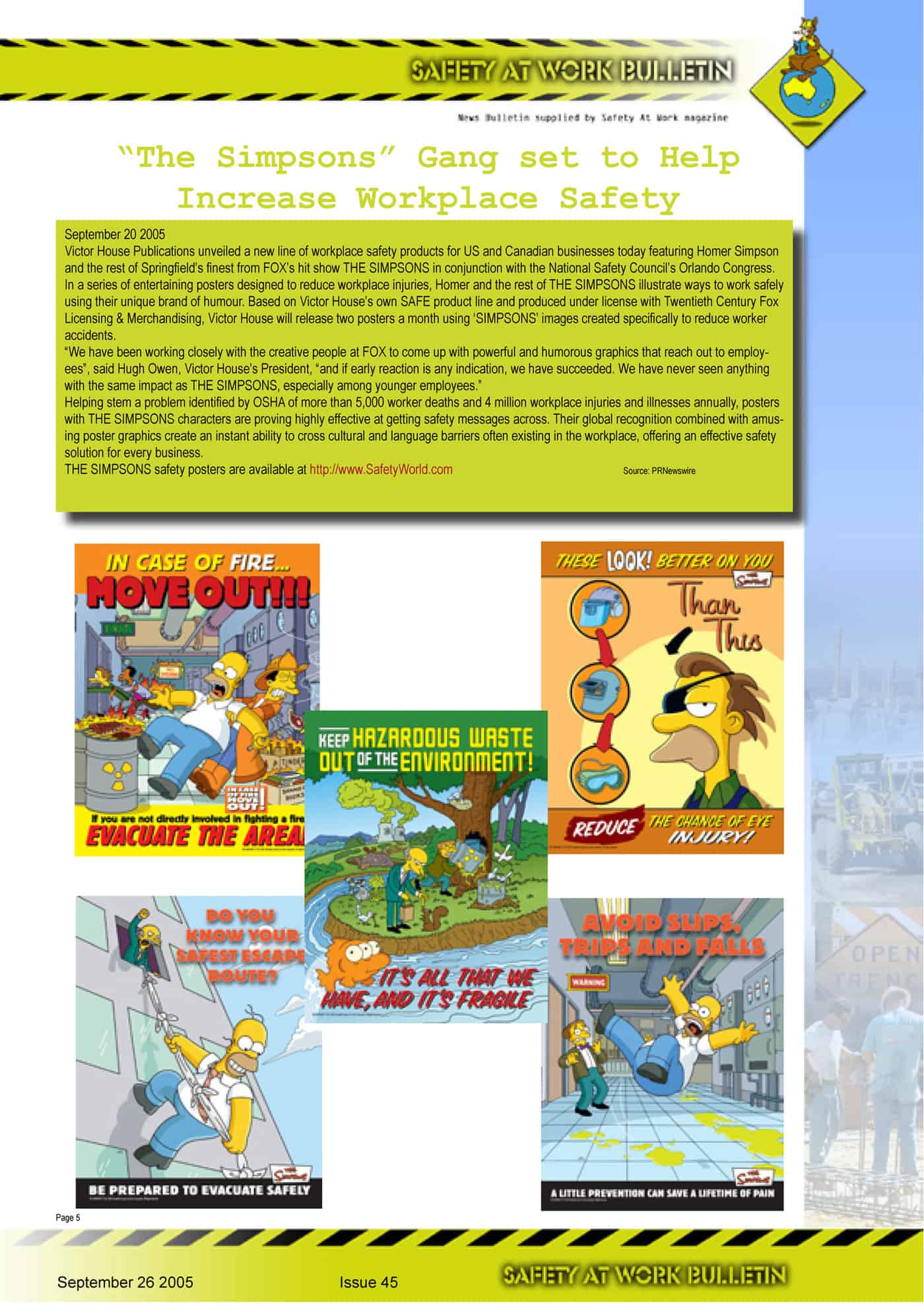
Simpsons safety reaches Australia after 5 years and at twice the price

In 2005, a series of safety posters based on The Simpson TV characters was released in support of the National Safety Council’s Orlando Congress, as reported in SafetyAtWork Bulletin at the time, picture right).  The posters have finally reached Australia and will be unveiled at the Safety In Action exhibition on 2 April 2010.  They are sure to be popular.

A small selection of Simpsons posters will be available through WorkSafety Solutions, the Australian distributor.  Many more have been added through the original US distributor, SafetyWorld since the original launch. Continue reading “Simpsons safety reaches Australia after 5 years and at twice the price”

Good ergonomics advice but prevention should have been emphasised

A link to an article of sound ergonomic advice was emailed to SafetyAtWorkBlog in early April 2010 suggesting readers may be interested.  The article is entitled “The Ultimate Guide to Ergonomics: 50 Tips & Tricks for Serious Students” and contains  some good suggestions but it seems to be based on some assumptions that are not necessarily present in the real world of students. Continue reading “Good ergonomics advice but prevention should have been emphasised”

Canadian research shows occupational link to breast cancer

“Certain occupational exposures appear to increase the risk of developing postmenopausal breast cancer”, is a conclusion reached by Canadian researchers and released in April 2010 edition of the Journal of Occupational & Environmental Medicine.

The researchers acknowledged that “some findings might be due to chance or to undetected bias some findings might be due to chance or to undetected bias”, but there is enough evidence to generate concern in occupational sectors and, often, the media shows increased interest in breast cancer research.

Several Australian scientists have advised caution on interpreting the research findings.   Continue reading “Canadian research shows occupational link to breast cancer”

Australian MP mentions workplace bullying but is short on practical controls

On 18 March 2010, the last sitting day of that session of Australia’s Parliament, Labor Member of Parliament , Bill Shorten, spoke about workplace bullying and the OHS prosecutions that stemmed from the bullying and suicide of Brodie Panlock.  Some of his short speech rehashed details of the workplace bullying prosecutions but, according to the draft of Hansard (page 93), Shorten made some useful remarks:

“I rise to speak on the issue of workplace bullying.  We would not think it was acceptable for people to come to work and be exposed to asbestos or toxic chemicals.  We should not think, therefore, that it is appropriate for them to be exposed to the toxic behaviour that is sustained and malicious bullying.  I believe that this kind of bullying is something which can be eradicated.  We have changed attitudes on smoking in the workplace and on sexual harassment; there is no reason why we cannot eliminate forever bullying in the workplace.

Bullying is an absence of kindness and Continue reading “Australian MP mentions workplace bullying but is short on practical controls”

Workplace bullying and restorative justice – how to help the families left behind

A feature article on workplace bullying in The Age newspaper on 10 March 2010 has the additional or secondary benefit of again raising the relevance of “restorative justice” to the issue of occupational safety and health.

The main element of the article is the McGregor family who had two children commit suicide over related issues.  The son, Stuart McGregor,  described as being chronically depressed, was being bullied at work.  He confided in his sister, Angela McGregor, over the issues.  Angela had been bullied at school.  Alannah killed herself.  A month later, Stuart followed.

WorkSafe investigated the bullying at Stuart’s place of work, substantiated Stuart’s claims are is determining what further action to take.  The newspaper reports that there may be insufficient evidence to pursue the case through the Courts.

What the reporter, Helen Westerman, does is to relate the grief and hurt of the parents to the potential benefits of the application of “restorative justice” in workplace incidents.   Continue reading “Workplace bullying and restorative justice – how to help the families left behind”

Concatenate Web Development
© Designed and developed by Concatenate Aust Pty Ltd