
Explosive near-miss deserves safety investigation

There was a brief ABC report from Western Australia on 12 November 2011 about a young man receiving serious burns from an industrial explosion.  Information is scant on this incident in the press but SafetyAtWorkBlog has been told that the incident occurred at drinks after work.  As the incident is not considered related to work, WorkSafeWA is unlikely to be involved with any investigation.

This seems an odd situation as it is reported that the serious injury occurred “when a large engine exploded in an industrial yard”!

Young worker + alcohol (potentially) + industrial workplace = a serious near miss, if nothing else.

It is hoped that whoever investigates the incident shares some of the findings so that important OHS lessons will be offered.  WorkSafeWA seems to be the logical choice for investigator but we will have to wait to see who takes the lead.
Kevin Jones

Australian politician jumps on possible OHS concession from Government

Politics has again entered the OHS harmonisation debate in Australia.  Federal Workplace Relations Minister, Chris Evans, issued a statement on 10 November 2011, part of which that has been pounced on by the Opposition and slightly twisted by the online media.

“Senator Evans also announced that transitional arrangements for the model OHS laws have been developed by Safe Work Australia to assist businesses to move to the new harmonised arrangements.

“The transitional arrangements will apply to the model OHS Regulations and provide delayed commencement of up to 12 months or more where the new laws result in a new or significantly different set of duties,” Senator Evans said.

“The developments of sensible transitional arrangements are part and parcel of any new laws.”

The Shadow Minister for Workplace Relations, Eric Abetz, quickly responded with a media release of his own.

“Minister Evans has today conceded that businesses will be able to delay implementing new national health and safety laws by up to 12 months if the regulations result in them having to undertake significant change.  Given that almost every business will have to make significant change, this is the Minister’s back door way of delaying the laws implementation.”

It is important to read the entirety of Senator Evans statement as it reiterates some of the points that SafetyAtWorkBlog reported on several weeks ago.   Continue reading “Australian politician jumps on possible OHS concession from Government”

Small fine of $1250 but important safety lessons

An OHS fine of $A1250 hardly seems newsworthy but several important issues are illustrated by a prosecution in Western Australia on 10 November 2011, particularly, individual responsibility and accountability.

WorkSafe WA has released details of a prosecution against an individual worker over the fall of material from 15 metres towards fellow construction workers.  The media release (not yet available online) says that

“In July 2009, Mr Bell was employed by Perth Rigging Company Pty Ltd on a site at Naval Base where steel roof sections were being placed on concrete silos. He was in charge of arranging how the steel roof sections would be lifted into place.

The first roof section had been placed on one of the silos, and the second section (which was 18 meters long, six metres wide and weighed more than 10 tonnes) was to be lifted onto another of the silos.

Perth Rigging did not have available the necessary rigging equipment to lift this roof section, and the site supervisor offered to obtain this equipment. The offer was accepted, but Mr Bell did not stipulate what rigging equipment was required. Continue reading “Small fine of $1250 but important safety lessons”

Australia releases official statistics into work-related injuries

Data released by the Australian Bureau of Statistics (ABS) in early November 2011 has revealed that 18.5% of people injured at work in 2009-10 received no OHS training prior to the incident.

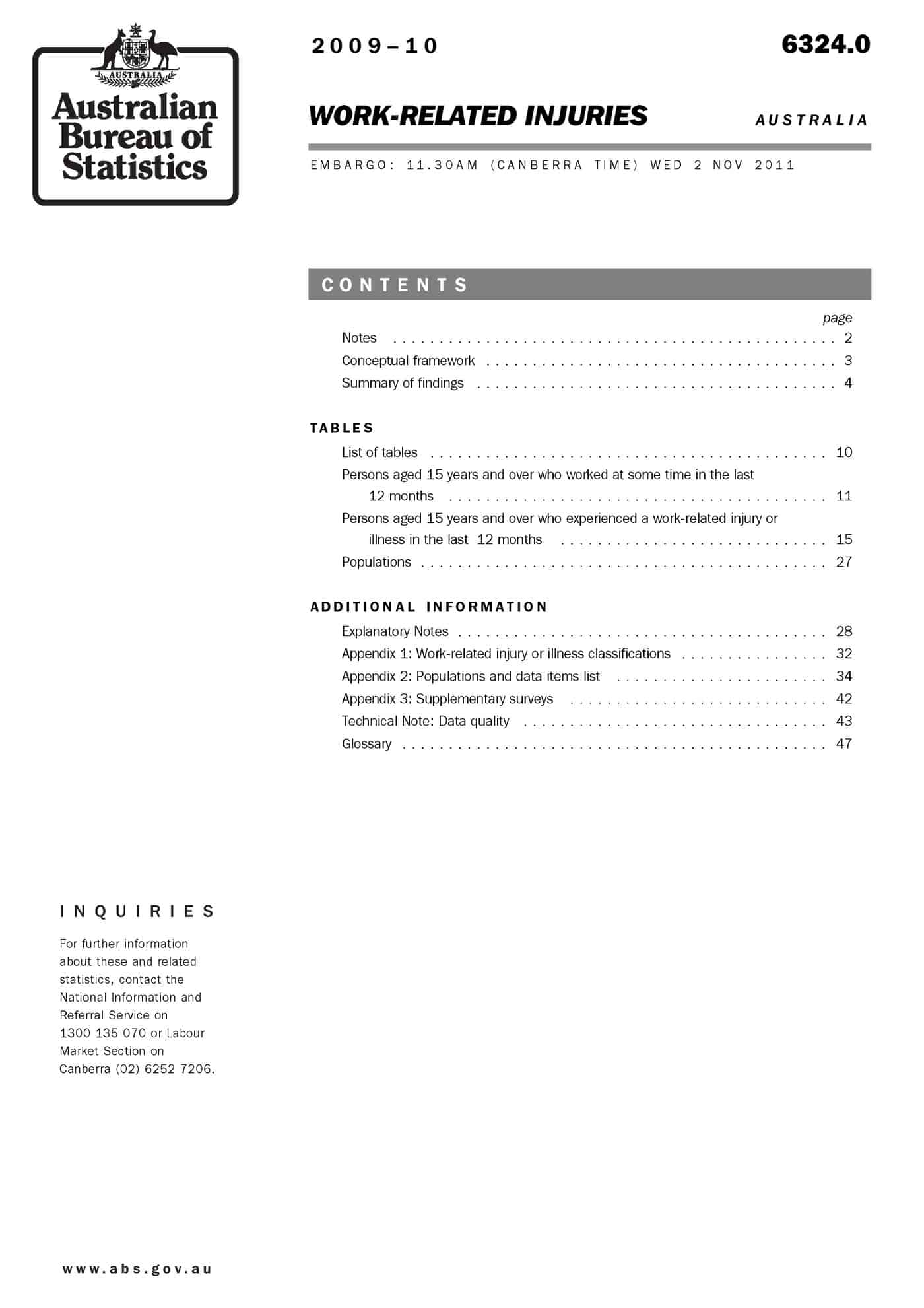
The basic findings of the 2009-10 data are not all new as a December 2010 media release shows but the new report, “6324.0 – Work-Related Injuries, Australia, 2009-10” does include new data on OHS training.

Most of the OHS training data is included in table 13 but other tables should not be overlooked.  Table 3 shows that of those injured in 2009-10:

“82% (522,400) had received occupational health and safety training in the job prior to their work-related injury or illness occurring…”

and that 18.5% did not.

A legitimate question is “what is meant by occupational health and safety training?”   Continue reading “Australia releases official statistics into work-related injuries”

Australia inactive on environmental tobacco smoke

Safe Work Australia has released a couple of packages of draft codes of practice in line with the Australian Government’s OHS harmonisation strategy but where is the code that addresses the established risk of environmental tobacco smoke (ETS) or second-hand smoke?  This is a question that was asked during the recent Safe Work Australia week by Smoke Free Australia, an alliance of employee and health groups.

Smoke Free’s media release stated that

“….thousands of Australians are working in areas contaminated by highly toxic, carcinogenic tobacco smoke – and Safe Work Australia has done nothing to prevent it”

Stafford Sanders, the coordinator for Smoke Free Australia, was struggling to understand why ETS had not been given prominence in the new draft codes of practice given that second-hand smoke is a known killer. Continue reading “Australia inactive on environmental tobacco smoke”

Workplaces are under-prepared for first aid incidents

The Australian Medical Association (AMA) has reported that

“Less than 10% of people are aware they need to cool burn wounds for 20 minutes in cool water as a first aid measure.”

Research* published in the AMA’s Medical Journal of Australia, in October 2011, found that

“Unprompted, 82% of (7320) respondents said they knew to cool the burn with cool or cold water but 41.5% said they didn’t know for how long cold running water should be applied.”

SafetyAtWorkBlog has followed the issue of first aid treatment for burns and the evidence for burn creams.

The application of the recommended treatment for burns continues to be a contentious issue in practice in Australian workplaces.  Part of the reason could be that first aid treatment in many workplaces is seen as little more than a “bandaid treatment” because this is the first aid treatment most seen and most received.  But this perception does not site well with the evidence for burn treatments.

The first aid (band aid) treatments in most workplace is quick and usually does not interrupt work.  To properly treat a burn, a worker must stop work for twenty minutes.  Most workplaces where burns are likely to occur, for instance, construction sites, manufacturing, food preparation, are unlikely to welcome a stoppage of one worker for twenty minutes.  Can one imagine a burger flipper at a fast food restaurant standing with a hand under a running tap for twenty minutes?  It would be unlikely that this absence could be covered. Continue reading “Workplaces are under-prepared for first aid incidents”

Social obligation is lost on some

In response to the Weekly Times’ articles on quad bike safety and the mandatory use of helmets, one letter writer in this week’s edition of the newspaper wrote:

“More state lunacy… Accidents happen, legislation cannot stop this. Free people have the right to decide such things for themselves.”

The letter writer has a strong belief that accidents happen and that nothing can be done to stop the harm, particularly through the application of legislation. This view is in the minority but is still spoken in some social circles, although the volume of such statements may have reduced over time.

The statement shows a misunderstanding of the cause of accidents and there is always a cause, or several. It is no longer socially acceptable to concede a workplace death as an Act of God or “shit happens”, although only recently in an expensive rail safety seminar, “shit happens” was said repeatedly. The letter writer’s statement is one of hopelessness, the antithesis of the values of the safety profession and OHS regulators.

Philosophers can argue the point more effectively but if one is to concede that “accidents happen”, that “shit happens”, then one should also not expect to be covered by workers’ compensation or compensated if injured in a public footpath or seek financial restitution if assaulted at a crowded nightclub or in a dark alley. What outrage would be felt if one was to lodge a workers’ compensation claim and the insurer’s response was “accidents happen, good luck with your disability”.

The “nanny state” epithet is short hand for lazy thinking, social ignorance and selfishness.

Safety often involves investigation, perhaps even “CSI:Safety” – Grissom in a fluoro vest. We must seek the root cause, in loss prevention terms, or contributory factors in the modern OHS and risk management context. From analysis comes insight and from insight comes prevention.

It is hard to imagine that anyone who may have lost a loved one in an industrial, or agricultural, incident could have written this letter to the Weekly Times. It is slightly easier to imagine that there are people in society who just do not care about the welfare of others and they write occasionally to the Weekly Times about the “nanny state”.

Kevin Jones

Concatenate Web Development
© Designed and developed by Concatenate Aust Pty Ltd