Undercover Boss is an example of executive alienation

Undercover Boss” has become a popular television program in many countries over the last few years.  The format is fresh and the results revealing.  The eyes of each boss are opened to the deficiencies of a business and to the value of the workforce.  Each episode ends with the reward of acknowledgement to the workers and new wisdom to the boss.

But the show is also an indictment of the attitudes of, and the management training provided, to senior executives.  Why were the employees not being valued by the executives already?  How did the executives lose touch?

If business management, corporate structures, and management training was rooted in the reality of work rather than profit, a series like Undercover Boss would never have been possible.

The concept of an executive maintaining a perspective of frontline customer contact is not new.   Continue reading “Undercover Boss is an example of executive alienation”
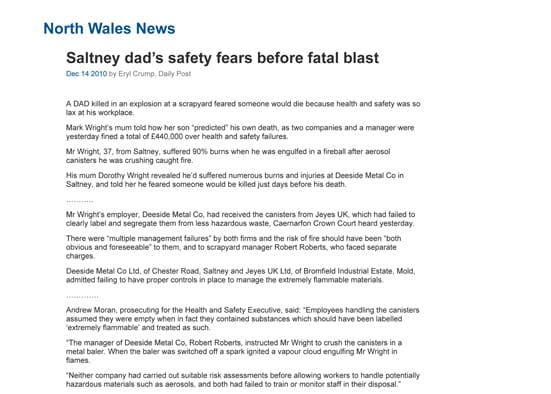
How much significant information do workplace fatalities provide?

Workplace fatalities are terrible, lingering tragedies that generally don’t teach anything new about OHS failures.  I couldn’t find anything new in the frightening detail in the article below (dated 14th December 2010) or in scores of Google searches of industrial/occupational fatalities; though disease fatality epidemiology can be  informative.

If all workplace fatalities in Australia were stopped overnight, most workers wouldn’t notice a single improvement in their own workplace.  They’d still be working in the same cluster of hazards, useless risk assessments and a regular sprinkling of near misses and daily shortcuts.  Despite regulators’ and politicians’ shrieks of dismay at workplace deaths, such fatalities don’t represent the main OHS problem at work.

If any regulator was informed in advance – in some detail – that in a particular industry there would be three fatalities in the next three months (or even intolerable risk) they wouldn’t know how to prevent them.  Example?  Think of the insulation program, which still has some way to go and a few more surprises in store.  Example?  Over the next six months there are likely to be 3-6 quad bike-related fatalities in Australia, mostly as a result of rollovers.

Or think of the value of risk assessments:  example?  Consider the 60,000-80,000 barrels (10,000 tons) of the most dangerous hexachlorobenzene (HCB) waste stockpiled and being repackaged (ultimately, drum to drum) by workers in a primitive work process at Botany Bay Industrial Park, Sydney.  One of the world’s largest stockpiles of such dangerous wastes that no one around the world is prepared to handle.   This is the only place I’ve ever had to wear two layers of protection to inspect. What has the regulator done? Continue reading “How much significant information do workplace fatalities provide?”

Preparing for occupational violence in fast food outlets

On 17 December 2010, the parents of Luke Adams were abused outside a court in Melbourne, Australia.  The mother of the killer of Luke Adams berated the parents after her son received further time in jail.

SafetyAtWorkBlog touched on Luke Adams’ death in an article in 2009 in which we pointed out that several violent deaths had occurred in, and around, fast-food restaurants and yet there is little focus on the role of the restaurants in these incidents.

On 4 January 2011, the media is reporting that McDonalds has issued a security warning to its restaurants after a couple of violent robberies on its Victorian stores in the last few days.

Such acts in fast-food establishments are particularly worrying because of the young age of many workers in the sector.  Over this holiday period in Australia, many teenagers experience their first “real” work in fast-food outlets and other than working very long shifts (that’s a different story) the experience should present them with a positive approach to work. Continue reading “Preparing for occupational violence in fast food outlets”

2010 in review – SafetyAtWorkBlog

The stats helper monkeys at WordPress.com mulled over how this blog did in 2010, and here’s a high level summary of its overall blog health:

Healthy blog!

The Blog-Health-o-Meter™ reads Wow.

Crunchy numbers

Featured image

The Louvre Museum has 8.5 million visitors per year. This blog was viewed about 160,000 times in 2010. If it were an exhibit at The Louvre Museum, it would take 7 days for that many people to see it.

In 2010, there were 406 new posts, growing the total archive of this blog to 1141 posts. There were 216 pictures uploaded, taking up a total of 220mb. That’s about 4 pictures per week.

The busiest day of the year was August 31st with 866 views. The most popular post that day was The cost of not having first aid.

Where did they come from?

The top referring sites in 2010 were wotnews.com.au, linkedin.com, google.com.au, twitter.com, and oz.labourstart.org.

Some visitors came searching, mostly for safety at work blog, near miss reporting, safety at work, work safety, and cath bowtell.

Attractions in 2010

These are the posts and pages that got the most views in 2010.

1

The cost of not having first aid August 2010
5 comments

2

OHS and the death of Brodie Panlock from bullying February 2010
11 comments

3

Prof. Andrew Hopkins Interview from 2000 October 2008
5 comments

4

BP oil rig explosion – lawyer video May 2010
1 comment

5

Latest Australia workplace fatalities data November 2008

WorkSafe tries new twist on OHS ads

On 2 January 2011, WorkSafe Victoria launched a new advertisement that presents a new twist on their “homecoming” campaign.  It focuses on the “door knock” – a process many police dread where they must inform the family of the death of a relative.

The ad is a fresh and new dimension on the long-running OHS awareness campaign and is welcome.  Continue reading “WorkSafe tries new twist on OHS ads”

Conkers and risk assessments

In September 2007, UK’s Health & Safety Executive produced a safety poster on the myth of students wearing safety goggles while playing conkers.  HSE did not demystify the issue by examining the origin of the myth and only chose to debunk the myth.

The February 2011 edition of the Fortean Times provides a little more detail on the origin of the myth in its “mythconceptions” column.  It reports on primary school teacher, Shaun Halfpenny’s, claim about starting the myth.  Continue reading “Conkers and risk assessments”

The Social Media is the Message

Melody Kemp in Vientiane writes:

The apoplectic brouhaha that greeted Wikileaks in the past few months has shown us the power of the internet to upstage, discomfit and enrage.  Governments like corporations operate under a variety of ‘commercial-in-confidence’ scores, the cadence of which changes with the degree of self interest at hand.  That Wikileaks has been disclosing documents for years is of no consequence to our reactionary leaders.  Just as labour groups and activists, long been warning industry about workplace hazards, have been greeted with similarly leaden ears.

Earlier this year, a delegation of international labour activists and trade union leaders visited Laos.  While being taken around various work sites by Lao trade union and government officials, they were horrified to find bags of asbestos labeled Produced In China in one roofing tile fabrication shop.  They should not have been surprised.  The nominal communist bloc states of Asia have close trade, military and strategic ties.  In that bloc the proletariat has little status and, like mushrooms, are generally kept in the dark.

One of Lao’s four Vice Presidents is known to foster and enjoy close and at times unseemly business relationships with Yunnan, Continue reading “The Social Media is the Message”

Concatenate Web Development
© Designed and developed by Concatenate Aust Pty Ltd