What is the OHS “public interest”?

On 7 May 2010 Judge Lacava of the County Court of Victoria increased the $A25,000 fine applied to A Bending Company to $A75,000.

WorkSafe’s Acting Director for Health and Safety, Stan Krpan, said in a media release:

“The fact that the Director of Public Prosecutions [DPP] found the original penalty inadequate, and the increase in the fine on appeal, demonstrates the courts’ attitude towards health and safety offences.”

The DPP made the appeal to the County Court after a request for review of the original fine was made by WorkSafe Victoria.  According to the judge’s decision (not yet available online):

“The appeal by the Director is made pursuant to section 84 of the Magistrates’ Court Act 1989. The section gives the Director the power to appeal to this Court “if satisfied that an appeal should be brought in the public interest“.” [emphasis added]

So how was the public interest served by increasing the fine by $A50,000? Continue reading “What is the OHS “public interest”?”

US workplace bullying interview with Gary Namie

Ben Merens of Wisconsin Public Radio interviewed Gary Namie of the Bullying Institute on 26 May 2010 for 45 minutes on his At Issue radio program.  The interview is very timely as new “Healthy Workplace” legislation is being considered in the United States.

What was useful in this interview was that the discussion centred on workplace bullying and Namie summarised how this is substantially different from schoolyard bullying – a  significant difference which requires different methods of control.  Namie says that although bullying in childhood is significant, the impact on an adult of similar treatment may have longer lasting effects.

The broadcast, of course, applies to the US context principally but Namie has a long and strong international reputation in workplace bullying advice and deserves an audience.  Tellingly, Namie says that the comparison for workplace bullying is not schoolyard bullying but domestic violence.

In 2001, Namie provided me with a review copy the 2000 edition of The Bully At Work for the SafetyATWORK magazine.  The review is available HERE.

Kevin Jones

Planning for an ageing workforce – statistical clues

There has been a lot of media attention on the potential impact of an ageing population on all aspects of our society, workplaces included.  In terms of OHS, there may be an increased risk of injury as people are encouraged to work longer and past the compulsory retirement age of around 60 to 65.  But it is worth looking beyond the newspaper reports to get a better understanding 0f the level of risk presented by current population trends.

A report by Professor Diane Gibson for the Academy of Social Sciences in Australia is a terrific way to begin to comprehend the reality of the risk.  The report, Beyond life expectancy,  was released in May 2010 and provides an interpretation of the 2006 Australian Census data.  From a cursory scan of the contents there are important facts that challenge us, particularly if we manage, in any way, people in the workplace. Continue reading “Planning for an ageing workforce – statistical clues”

Guidance on the impacts of a workplace death

A short time after a traumatic death of a family member will cause the family to feel they are in a mental spin.  Not only are the usual funeral arrangements required but there can seem to be involvement in a personal loss from a mess of government departments and legal bodies.

It is not expected that all families have a manual to life and death but there is information for families who may have to face a workplace death.  Perhaps, more importantly, this information should be read by safety professionals so that they understand the social and familial complexities of workplace incidents.  Companies may call in the lawyers but there is also an obligation to their employees and families and guides, like the Kit for Families produced by the Workplace Tragedy Family Support Group, may help put all the processes into perspective.

Other online guidance material is available from

The Victorian Trades Hall Council

WorkCover New South Wales

SafeWork SA

One regulator’s perspective can be found at Health & Safety Executive

SafetyAtWorkBlog readers are welcome to suggest other similar online  guidelines.

Kevin Jones

Blog increases readership by over 6,000 in one month

The title is right.  SafetyAtWorkBlog readership statistics are 6,000 higher than for April 2010 and over 4,000 higher than the previous monthly record.  For May 2010, monthly readership topped 18,000 for the first time.

Thanks to everyone who has supported the blog and those new readers.

Please don’t be shy in commenting on the articles or in telling your friends and colleagues about the blog.

Eye injury campaign evidence clarified

A 19 May 2010 SafetyAtWorkBlog article commented on a new eye safety campaign by the  Optometrists Association Australia.  The eye safety brochure included several statistical references upon which clarification was sought.

Shirley Loh, OAA’s National Professional Services Manager has provided references, and we thank her for her efforts.

A couple of quotes in question were:

“60% of all eye injuries happen in the workplace and about 95% of eye injuries are the result of carelessness and lack of attention.”

“Up to 48% of office workers suffer from computer-related eye fatigue and this rate appears to be increasing.   Excessive computer use can cause eye strain and reduce productivity.” Continue reading “Eye injury campaign evidence clarified”

In ROPS we trust

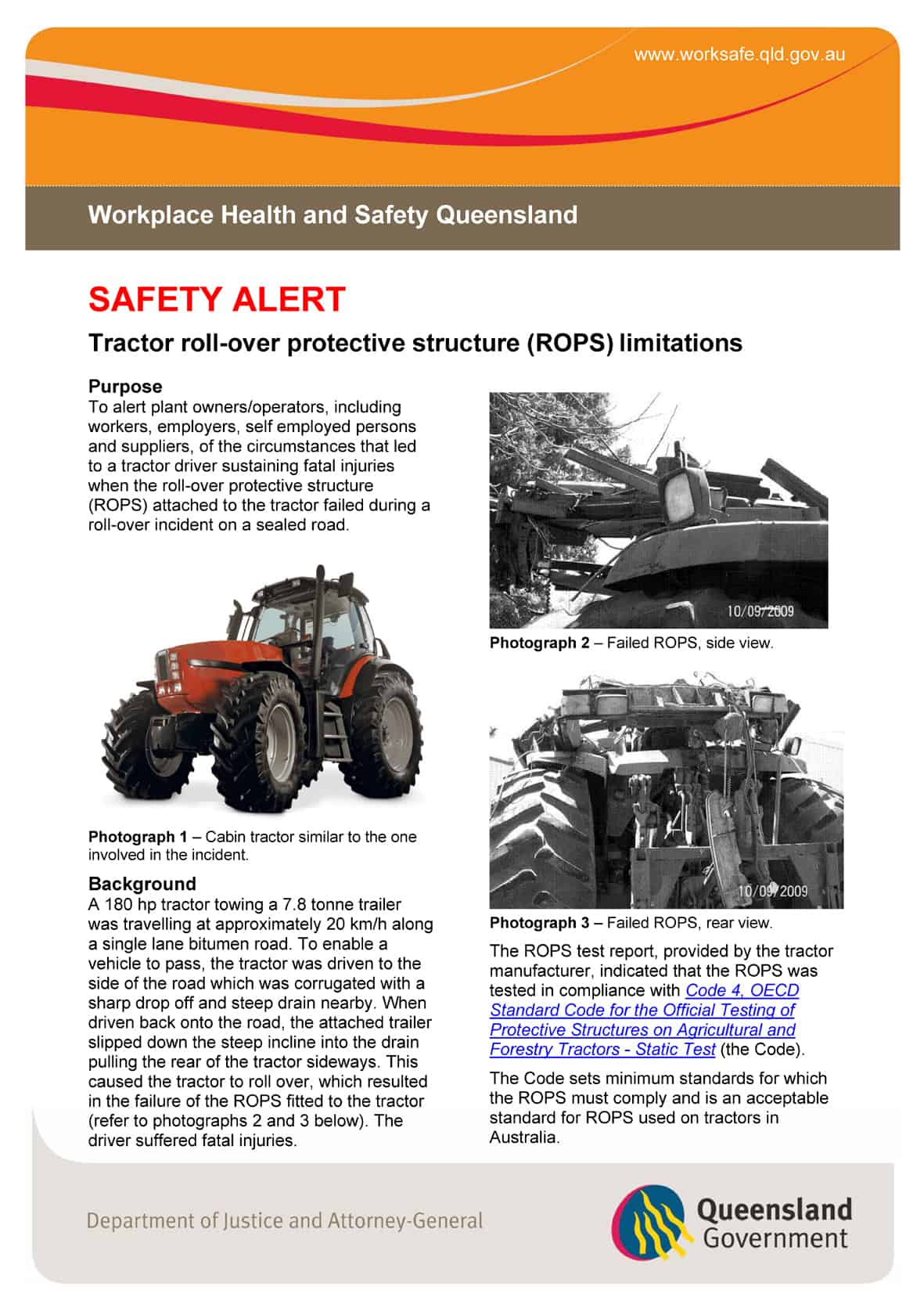
Roll Over Protective Structures (ROPS) are a standard safety design feature on many items of agricultural equipment from tractors to quad bikes.  But ROPS do not prevent a rollover, only minimise the risk of injury from a rollover.

The Workplace Health and Safety Queensland has issued a safety alert over a tractor ROPS that failed.  The background for the safety alert is:

“A 180 hp tractor towing a 7.8 tonne trailer was travelling at approximately 20 km/h along a single lane bitumen road.  To enable a vehicle to pass, the tractor was driven to the side of the road which was corrugated with a sharp drop off and steep drain nearby.  When driven back onto the road, the attached trailer slipped down the steep incline into the drain pulling the rear of the tractor sideways.  This caused the tractor to roll over, which resulted in the failure of the ROPS fitted to the tractor.  The driver suffered fatal injuries.”

Kevin Jones

Concatenate Web Development
© Designed and developed by Concatenate Aust Pty Ltd