
“Imagination at work” but not safety

GE Capital placed a full-page pictorial advertisement in The Age newspaper on 4 March 2010 (page 5 of the business section).  The ad, partly reproduced below, promotes the company’s financial services with the corporate slogan of “imagination at work”.  Sadly safety at work wasn’t included in the ad.
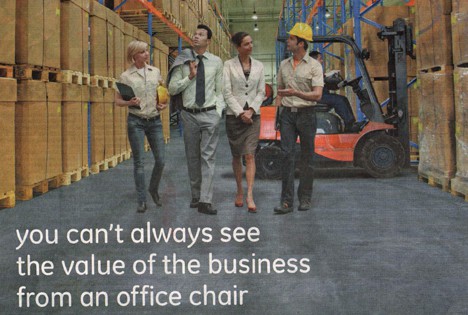
SafetyAtWorkBlog readers are asked to list the workplace hazards in this picture.   Continue reading ““Imagination at work” but not safety”

Workplace bullying data from Denmark

In occupational health and safety (OHS) and other workplace research, Scandinavia is often quoted.   The application of research findings to other nations is of dubious value but often Scandinavian research provides clues to potential OHS hazards or control options.

In February 2010, the European Working Conditions Observatory published online a research report into workplace bullying.  The report says

“Investigating the impact of bullying on psychological stress reactions according to the Impact of Event Scale, the NFA study finds that negative acts which potentially isolate the individual at the workplace, acts directed towards the person and unreasonable workloads induce most psychological stress.” Continue reading “Workplace bullying data from Denmark”

Is overwork part of the Australian Government’s project management difficulties?

On the Insiders television program on 21 February 2010, host Barrie Cassidy closed a long interview with the Communications Minister Stephen Conroy but asking about the workload of public servants in supporting government programs.  The video is available on-line and the comments are at the 11 minute mark.

Conroy says that the “cracking pace” the Prime Minister, Kevin Rudd, established from the start of his government has continues.  Rudd continues to expect high performance from his Ministers, staff and public servants.  Conroy talks about the change that has been demanded of the public service and that this has generated more workload.  He forecasts that the workload may ease if the Government achieves a second term of office.

Cassidy makes the link between the “pushing people too hard” and the failure of Government schemes such as the insulation scheme that was cancelled by the Environment Minister, Peter Garrett on 19 February 2010. Continue reading “Is overwork part of the Australian Government’s project management difficulties?”

US report is aimed at the wrong workplace safety target

A media release from Utah in the United States has been circulating through the internet overnight that claims:

“A new study released today by VitalSmarts found that five threats to workers’ safety are commonly left undiscussed and lead to avoidable injury or fatalities.” [link added]

The release lists those five threats as:

Workers’ compensation for travel time injuries will need resolving

Following on from BHP Billiton‘s shift to employees over contractors, a media report on 21 February 2010 illustrates changes in shift lengths that one union says may increase fatigue in the workplace.

BHP Billiton says the company has a fatigue management policy and procedure that can allow for the flexibility of the new shift options but the CFMEU is very concerned about the safety impacts of the shift options.  The Mining Industry Road Safety Alliance illustrates a major flaw in the process that is often reflected in issues of shiftwork and fatigue management  in other industries – increased risk in travelling to and from work. Continue reading “Workers’ compensation for travel time injuries will need resolving”

Unsuitable PPE

Information is trickling out about Paul Quinlivan’s decision to repeatedly not wear PPE.  A common reason for workers to not wear personal protective equipment is that it does not suit the individual.  Quinlivan says he kept removing his goggles because they kept fogging up.

Goggles must retain their visibility for them to function.  Fogging up may indicate that the goggles are the wrong type for the work being undertaken or for that work environment.  Frequently business want one type of PPE to be applicable to a range of circumstances and this may not be a reasonable expectation. Continue reading “Unsuitable PPE”

Small business OHS shortcomings

The home insulation debate in Australia is fragmenting.  Workplace safety is one of the chunks of debate heading in an unknown direction (political safety goggles anyone?)  The Australian newspaper included an article on 19 February 2010 that, although coming from the insulation sector, illustrates a dominant misunderstanding by small businesses.

The proprietor has run many businesses in a range of industries but he clearly has little understanding of his OHS obligations as he denies any responsibility for the death Matthew Fuller, an employee of the firm he contracted to undertake insulation installations, QHI Installations.  The proprietor states the reason is that “we did not employ him.”   Continue reading “Small business OHS shortcomings”

Concatenate Web Development
© Designed and developed by Concatenate Aust Pty Ltd