CFMEU steps up the OHS pressure

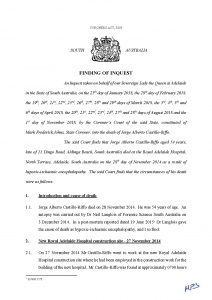
SafetyAtWorkBlog has dipped into the occupational health and safety (OHS) and political issues around the death of Jorge Castillo-Riffo in Adelaide in 2014.  On October 4 2018, the CFMEU issued a media release outlining the recommendations it made to the Coronial inquest into Castillo-Riffo’s death.  They deserve serious consideration:

  • Mandatory coronial inquests should be held into all deaths at work, with a mandatory requirement for the reporting of any action taken, or proposed to be taken, in consequence of any findings and recommendations made;
  • Families should receive funding to be represented;
  • An independent safety commissioner should be established in SA whose duty it is to review, comment and provide recommendations concerning the safety record of companies who tender for government construction contracts work over $5 million;
Subscribe to SafetyAtWorkBlog to continue reading.
Subscribe Help
Already a member? Log in here

Workers’ Inferno

Recently the 20th anniversary of the Esso Longford disaster was commemorated in Victoria. Coinciding with this anniversary was the release of a book about the disaster and its personal aftermath, Workers’ Inferno, written by Ramsina Lee.

This book has been in development for many, many years and the Lee’s writing talent is on display in the structure of the book and the stories within.  These stories largely linear But the multiple strands allow Lee to jump from one to the other providing a variety tone.

Subscribe to SafetyAtWorkBlog to continue reading.
Subscribe Help
Already a member? Log in here

OHS needs to accept the influence of neoliberalism and rebuild

Many have been claiming that the era of neoliberal economics and the associated politics is over or, at least, coughing up blood.  However, occupational health and safety (OHS) is rarely discussed in terms of the neoliberal impacts, and vice versa, yet many of the business frustrations with red tape, regulatory enforcement strategies, reporting mechanisms and requirements and others have changed how OHS has been managed and interpreted.

One of the most readable analyses of neoliberalism in Australia comes from

Subscribe to SafetyAtWorkBlog to continue reading.
Subscribe Help
Already a member? Log in here

Bill Shorten reflects on the Esso Longford disaster

Tonight, SafetyAtWorkBlog will be attending the launch of a new book that includes personal stories about the 1998 Esso Longford explosionWorkers’ Inferno.  The book is being released on the 2oth anniversary of the explosion that killed two workers, injured many others, disrupted gas supplies to the State of Victoria, resulted in a then-record fine for occupational health and safety (OHS) breaches and generated a Royal Commission.  It is also, perhaps, the best example of a company trying to blame the worker for a major incident.

The Federal Opposition leader, Bill Shorten, was an official of the Australian Workers Union at the time and today he published an opinion piece Continue reading “Bill Shorten reflects on the Esso Longford disaster”

The risks of having an OHS policy

If you ask a lawyer for advice about any issue related to occupational health and safety (OHS) their first piece of advice is likely to be “write a policy”.  There are good legal reasons for advocating a policy, but policies can also create major problems.  Policies are both a reflection of a workplace and the base on which improvements can be created.

Search for OHS policy guidance from the Victorian Government  and it takes you to a page that describes an OHS policy as

“Laws, regulations and compliance codes which set out the responsibilities of employers and workers to ensure that safety is maintained at work.”

NO it’s not.  The page also directs you to a WorkSafe page about insurance!

WorkSafe Tasmania

Subscribe to SafetyAtWorkBlog to continue reading.
Subscribe Help
Already a member? Log in here

Where is the Senate Inquiry into Industrial Deaths heading?

As readers would realise, the transcripts for the Australian Senate inquiry into industrial deaths are fascinating. It is worth looking at the other presentations and questions on the day when the Australian Chamber of Commerce and Industry received a grilling as this provides insight into how to present to a government inquiry addressing occupational health and safety.

The Senate Committee has probably heard more from relatives of deceased workers than has any other similar inquiry, perhaps even the Workplace Bullying inquiry in which this Committee’s member Deborah O’Neill participated.  This is an indication of the shift in OHS over the last few years where the human impacts of workplace safety failures, what some describe as the “lived experience”, gain an influence that used to sit with professionals and acknowledged subject matter experts.

Source: istockphoto, Credit: jotily – https://www.engel.ac/
Subscribe to SafetyAtWorkBlog to continue reading.
Subscribe Help
Already a member? Log in here

A possible licence to be safe

The Victorian Parliament continues to consider the Building Amendment (Registration of Building Trades and Other Matters) Bill 2018. According to one interpretation in the unofficial Hansard:

“This bill’s objectives are to deliver better outcomes for domestic building consumers and building practitioners through further improvements to the practitioner registration and disciplinary system, improve compliance with swimming pool and spa barrier standards and implement some recommendations of the Victorian Cladding Taskforce and the Coroners Court.”

There are many aspects to this Bill, one of which is occupational health and safety (OHS).

Subscribe to SafetyAtWorkBlog to continue reading.
Subscribe Help
Already a member? Log in here
Concatenate Web Development
© Designed and developed by Concatenate Aust Pty Ltd