Action demanded on sexual harassment in the entertainment industry

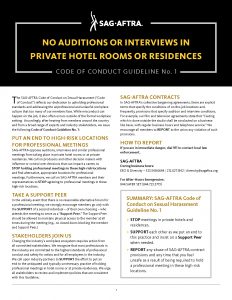
On 12 December 2017, part of Australia’s screen and television industry held a forum in Sydney about sexual harassment in the sector and what could be done to reduce this workplace hazard. This initiative occurred a day before an open letter was published about sexual harassment in the music industry.  There is a momentum for change on sexual harassment in the workplace, but it is at risk of resulting in a fragmented approach which will generate turf wars, confusion and, ultimately, ineffectiveness.

The

Subscribe to SafetyAtWorkBlog to continue reading.
Subscribe Help
Already a member? Log in here

What do Weinstein, Spacey and others have to do with OHS?

“Then I went, ‘Oh hang on, I’ve normalised so much of this as part of my industry…. This last three months has really made us all take a long hard look at what we have even let ourselves think is acceptable.” – Sacha Horler

Such a statement is familiar to those working in the field of occupational health and safety (OHS).  This normalisation, or habituation, has underpinned much of the discussion of what builds a safety culture – “the way things are done round here”.  As a result of revelations and accusations pertaining to Gary Glitter, Rolf Harris, Jimmy Saville, Robert Hughes, Harvey Weinstein, and Kevin Spacey, the entertainment industry around the world has been forced to assess the fundamental ethics on which sections of its industry are based.  Continue reading “What do Weinstein, Spacey and others have to do with OHS?”

Workplace mental health and wellbeing strategies must consider suicide

There is an increased blurring between the workplace, work and mental health.  In the past, work and life were often split implying that one had little to do with the other except for a salary in return for effort and wellness in preparation for productiveness.  This split was always shaky but was convenient for lots of reasons, one of which was the management of occupational health and safety (OHS).  However that perceptual split is over, now that mental health has come to the fore in many OHS considerations.

Recently

Subscribe to SafetyAtWorkBlog to continue reading.
Subscribe Help
Already a member? Log in here

Baked Beans and Bullying

Source: istockphoto

Workplace bullying has a strict and clear definition in Australian occupational health and safety (OHS) laws:

“…repeated and unreasonable behaviour directed towards a worker or group of workers that creates a risk to health and safety.”

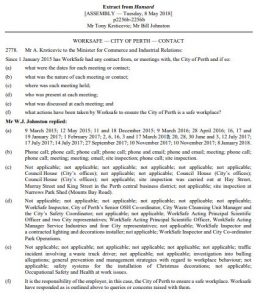
According to Mr Peter Katsambanis, a Liberal Party member of the West Australian Parliament, the slashing of tyres, paint damage on a car and an exploding tin of baked beans is a

“terrible issue of workplace bullying”.

Subscribe to SafetyAtWorkBlog to continue reading.
Subscribe Help
Already a member? Log in here

Workplace mindfulness? The jury is still out

At a well-attended La Trobe University alumni seminar in May 2017, researchers discussed the reality and the hype surrounding mindfulness. They explained the varieties of mindfulness, the clinic research history over the last four decades and the personal advantages of living mindfully. However in the workplace and organisational context, they said that there was insufficient evidence to show benefits from workplace mindfulness in this “emerging area of research”.

The seminar was hosted by Latrobe University with three speakers

Many mindfulness advocates have developed programs that they claim can offer substantial benefits to workplaces by increasing productivity and reducing injury and illness, primarily, by changing the behaviours and attitudes of employees.  This individual approach is often dropped into a workplace and promoted as an organisational opportunity.  But the La Trobe researchers mentioned that this is a very recent perspective.

Subscribe to SafetyAtWorkBlog to continue reading.
Subscribe Help
Already a member? Log in here

OHS and Maryam Omari

Maryam Omari is an Associate Professor at Edith Cowan University and Dean of its School of Business and Law. She has worked in the Middle East, UK and USA and SafetyAtWorkBlog had a chance to ask her some workplace safety questions. Professor Omari has published several books with her latest being “Workplace Abuse, Incivility and Bullying: Methodological…

Subscribe to SafetyAtWorkBlog to continue reading.
Subscribe Help
Already a member? Log in here

Bullying, evidence, ethics and solutions

Safety people love evidence, particularly evidence of hazards because evidence can validate what we thought we saw. Perhaps of more importance is evidence about what types of interventions work. A recent study  into the prevention of workplace bullying (abstract only) held the promise of solutions, even though it was a literature review and of some…

Subscribe to SafetyAtWorkBlog to continue reading.
Subscribe Help
Already a member? Log in here
Concatenate Web Development
© Designed and developed by Concatenate Aust Pty Ltd