

The State of Victoria had a big week on mental health, with the Labor Government allocating billions of dollars to the improvement of the mental health of its citizens. Much of the justification for the spend (and the imposition of a mental health levy on large companies) is in response to the recent Royal Commission into Mental Health Systems. Workplace health and safety was on the agenda in that Royal Commission. Hence, it is worth looking at how, or if, this recent Budget helps employers improve the psychological health of their workers in anticipation of new regulations on this hazard promised by Victoria’s Minister for Workplace Safety, Ingrid Stitt.
Category: bullying

Non-military safety lessons from the latest Royal Commission (open access)
The Australian Broadcasting Corporation broadcast an episode of The Signal on April 21, 2021, which discussed the complexity of the culture of Australia’s military, and I strongly recommend you listen to it. It does make some points about culture worth contemplating in the context of one’s own workplace and profession.
The most useful point was that an established institution cannot have a uniform culture that meets the expectations of all relevant stakeholders. Generations take their culture with them. So those who started in the military in the 1980s and 1990s (and later) will bring the values and lessons of that time into their maturity and when they move into senior and leadership positions – positions that are intended to both preserve and progress the organisation’s culture. This will result in conflict between the expectations of new recruits and the realities of the established military executives. Not open revolt, but a dissatisfaction that may or may not result in leaving the organisation.
The topic used by The Signal to illustrate the extremes of the defence force members and stakeholders was mental health.
Continue reading “Non-military safety lessons from the latest Royal Commission (open access)”
International perspective on bullying and harassment
In April 2021 the International Association on Workplace Bullying and Harassment conducted its 2002 conference online. The conference was enlightening for its inclusivity.
Many Western countries categorise work-related mental health as if they have minimal overlap. Workplace bullying is often seen as its own discipline with its own guidances, analyses and supporting industries. This can be convenient and has evolved from a reactive and often shallow response from Government.
This structure was acknowledged at the conference but many of the presentations ignored it and spoke about worker health, safety and welfare in the broadest terms.
The conference also balanced detailed local research with broad global contexts. This is the first of a series of articles based on presentations at the conference

Parliamentary culture must change
Australia is in the midst of a murky investigation into an alleged rape that occurred out-of-hours in an office of a Federal Minister in Australia’s Parliament House. The incident has raised discussions and debates about workplace culture, the reporting of crimes, the uniqueness (?) of the parliamentary workplace, the rights of women, the role of the media in reporting the allegations or in being complicit in the workplace culture…….
Prime Minister Scott Morrison has got himself into a pickle about how to respond, how to investigate and what he should have known and what he was expected to do. One of the actions that he and his government could do, and should have done, was to accept, and act on, the findings of the National Inquiry into Sexual Harassment in Australian Workplaces conducted by the Australian Human Rights Commission (AHRC) early last year. The relevance of this report is obvious:

The quad bike safety puzzle
According to The Weekly Times ($), the Victorian Farmers Federation has changed its stance on the fitting of operator protective devices (OPDs) to quad bikes at point of sale. Instead they want farmers to fit their own OPDs. The reason given for this change is reported as being
“… due to concerns many quad bike brands would no longer be available if manufacturers were forced to fit them.”
The failure of Leadership on sexual harassment
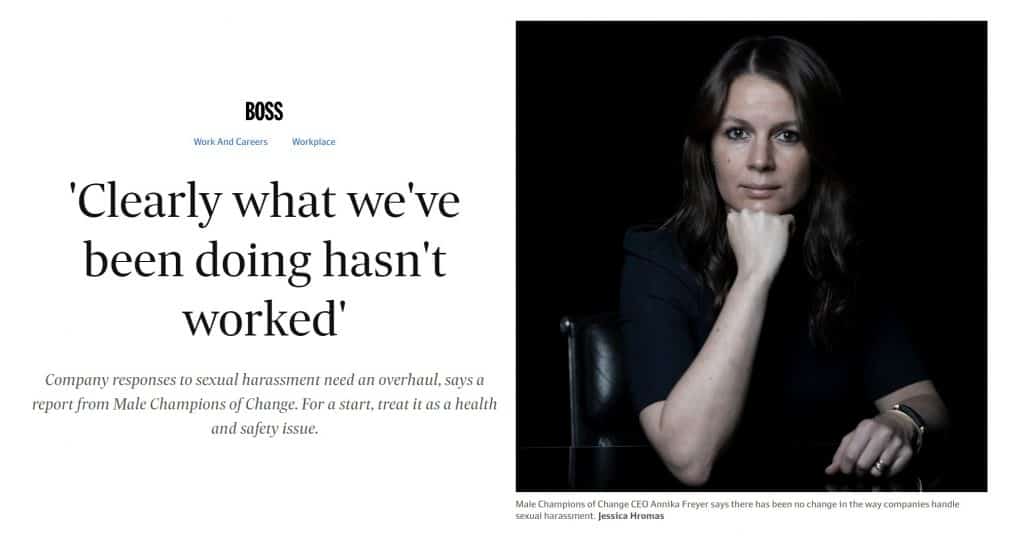
If prominent Australian lawyer, Josh Bornstein does not like something, it’s worth looking more closely at it. Last week on Twitter, Bornstein scoffed at the suggestion that occupational health and safety (OHS) could be a new approach to preventing sexual harassment in the workplace. He tweeted:
“To all those clamouring to support the idea that sexual harassment should be treated as an OHS issue, I have a simple message: Wrong Way, Go Back”
The OHS and sexual harassment nexus appeared primarily in response to a couple of articles (paywalled) in the Australian Financial Review (AFR) based on a leaked report from the Male Champions for Change (MCOC) organisation. Although the report is not publicly released for another couple of weeks, MCOC (hopefully not pronounced My Cock), proposes consideration of applying OHS laws and principles to sexual harassment.
The full report is likely to discuss the mechanics of this further but the advocacy of OHS is less interesting that the admission that MCOC and other leadership-based approaches to reduction and prevention of workplace sexual harassment have failed.
Tooma on Mental Health – Review
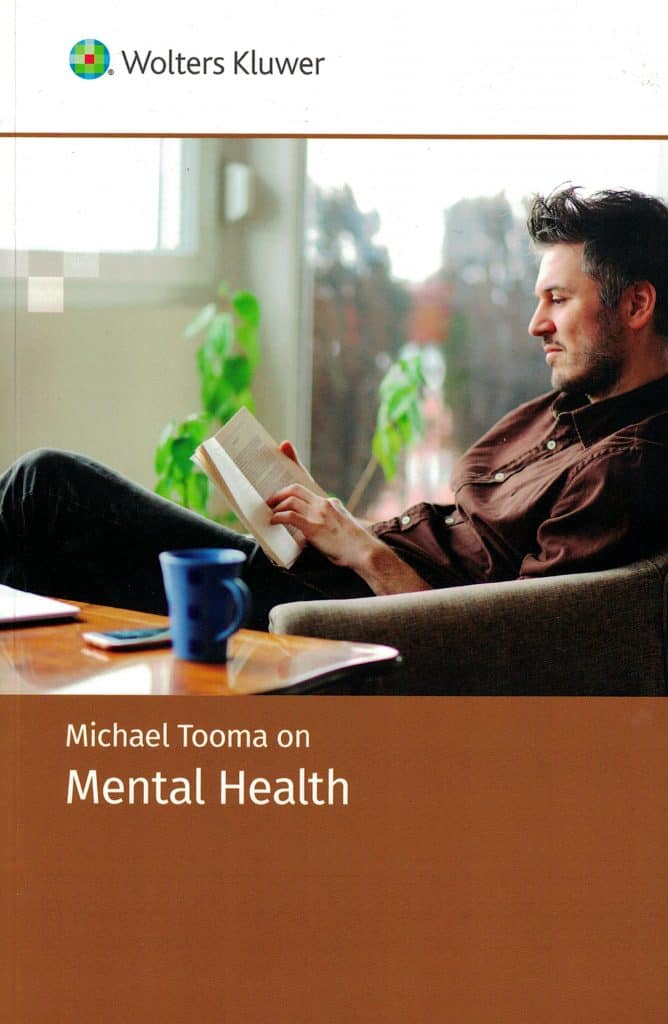
Michael Tooma is probably the most prominent occupational health and safety (OHS) lawyer in Australia. His latest book is, a little pretentiously, called “Michael Tooma on Mental Health“, but it fits with the series of OHS-related publications he has written for Wolters Kluwer. Unusually for a lawyer, there are only two chapters that specifically discuss legislative obligations, and, in many ways, these are the least interesting.
Positive Mental Health
In the Introduction, Tooma goes out of his way to stress the positive benefits of work. He is critical of the current OHS approach to workplace stress writing that we seek a “Goldilocks” application of perfection when this is really subjectively determined by each worker. Tooma challenges this in a major way through the 2012 study by Keller and others: