
 The publication date for the first truly international Standard on occupational health and safety (OHS) management systems, ISO45001, the rhetoric is heating up in Australia.
Category: business
Perhaps EAPs need to evolve more
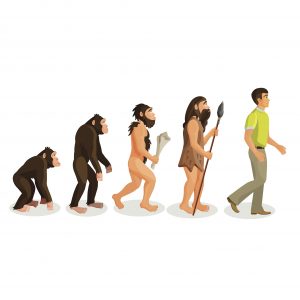 Last month a provider of Employee Assistance Programs (EAPs) circulated a media statement about a new health and wellbeing model that
“captures the essence of the shift towards holistic health and wellbeing for employees.”
This sounds positive and given the increasing emphasis on the prevention of harm from occupational health and safety (OHS) regulators and the evolution of organisational culture, SafetyAtWorkBlog approached
WorkSafe Victoria’s optimism is for the whole community
 Marnie Williams, Executive Director of WorkSafe Victoria launched 2018 with a presentation at a breakfast seminar organised by the Safety Institute of Australia and hosted by Herbert Smith Freehills in Melbourne. Williams illustrated that WorkSafe is very aware of community and business expectations on her authority’s performance and showed WorkSafe is very busy as it restructures around its relocation to Geelong and elsewhere However it could change even more or in different, more sustainable, ways.
Williams’ presentation proposed a positive future where the actions and issues associated with occupational health and safety (OHS) broaden to involve the Victorian community and address safety and health concerns that may no longer fit within the established OHS definitions, approaches and strategies.
5 top OHS issues for 2018
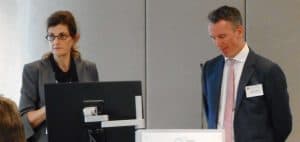 The annual Safety Institute of Australia (SIA) breakfast was held in conjunction with Herbert Smith Freehills (HSF) law firm on 21 February 2018. This year the audience heard from two representatives of WorkSafe Victoria – Marnie Williams, the Executive Director and Paul Fowler, the Director of the Enforcement Group.
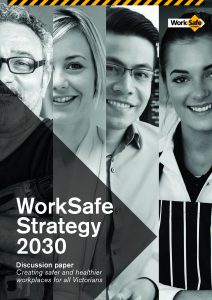
The WorkSafe presentations were interesting but included what was largely expected – an introduction to the recent Independent Review report and a reiteration of the WorkSafe Strategy 2030. (More on WorkSafe’s presentation in the next article)
Some of the more thought-provoking content came from HSF’s Steve Bell. He presented several issues and perspectives for consideration.
The review of Australia’s OHS laws starts
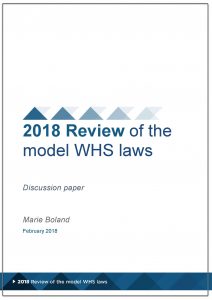 In 19 February 2018, Safe Work Australia (SWA) “launched” the independent review of Australia’s Work Health and Safety laws under former Executive Director of SafeWorkSA, Marie Boland. SWA has released a 49-page discussion paper, a summary and a list of questions. Below is an initial response to some of those questions.
What are your views on the effectiveness of the three-tiered approach – model WHS Act supported by model WHS Regulations and model WHS Codes – to achieve the object of the model WHS laws?
The structure works well, when business owners know of the relevant documents.
“so we know we’ve had laws, but why haven’t we had change?”
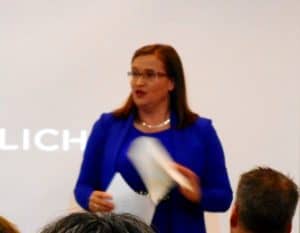 Australia’s Sex Discrimination Commissioner, Kate Jenkins, has been prominent in recent seminars about sexual harassment, particularly in the entertainment industry. In February 2018, Jenkins spoke at a seminar in Melbourne hosted by Screen Producers Australia and provided strong advice on how businesses can control sexual harassment.
Jenkins began her presentation with an uncomfortable reminder that business has been lax in addressing unlawful workplace behaviour.
New farming incident statistics
The latest statistics of farm injuries from the Australian Institute of Health and Welfare provide a useful insight in to the workplace risks of Australian farms. Given the workplace focus of the SafetyAtWorkBlog, and the articles written about the risk of working with quad bikes, the following statistics are of great interest:
“For quad bikes, almost 90% of injuries were sustained by the driver in people aged 15 and over.” (page 9)
“For injuries involving quad bikes, males accounted for two-thirds (66%) of all hospitalisations for children aged 0–14 and almost 80% of all hospitalisations for people aged 15 and over.” (page 9)