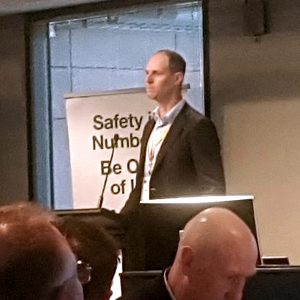
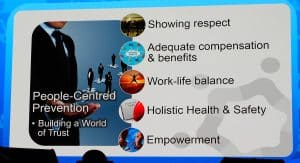
Half time at the Future of Leadership

This month the “Future of Leadership” conferences are travelling Australia.  The Melbourne stop, on 21 September, started really well with three on-topic speakers but declined strongly after morning tea with at least one speaker who had nothing to say about leadership.  At the half-time break, one hopes that the conference gets back on track because when it was, it was very good.

This leadership conference is very different from occupational health and safety (OHS) conference because it talks about a concept in such general terms that the audience can impose whatever context it chooses.  As this blog is about workplace safety, predominantly, OHS context was paramount.
Subscribe to SafetyAtWorkBlog to continue reading.
Subscribe Help
Already a member? Log in here

Financial targets preferred over OHS

Today’s issue of the Australian Financial Review (AFR)  contained an article that shows that the trend for companies and boards embracing their occupational health and safety (OHS) obligations is not uniform.  The article “Wesfarmers cuts incentive rewards for promoting women and safety” reports that the Managing Director’s share of annual incentives paid for non-financial targets, which includes OHS, has been reduced from 40% to 30%. Continue reading “Financial targets preferred over OHS”
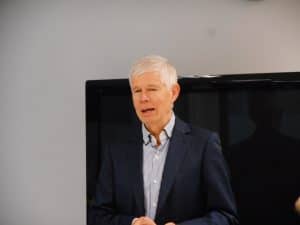
David Caple provides the latest in reality-based OHS thinking

Recently David Caple gave his annual address to the Central Safety Group in Melbourne.  Caple (pictured above) is a prominent ergonomist, an adjunct professor at the Centre for Ergonomics & Human Factors, La Trobe University, a representative on several government OHS-related committees and has an enviable information network.

Fresh from the Singapore OHS conference, Caple speculated on the future of the workplace safety profession at a time when many are indicating an increasing demand for OHS services and advice.  He used a graph of the membership of the Safety Institute of Australia to illustrate part of the challenge.

Subscribe to SafetyAtWorkBlog to continue reading.
Subscribe Help
Already a member? Log in here

The OHS profession urged to have a good look at itself

Every safety conference needs a Dave Provan.  Provan (pictured right) is researching the occupational health and safety (OHS) profession and discussed this research at a recent conference organised by the Safety Institute of Australia.  One of his earliest comments was also the most confronting:

“the safety profession is entirely discretionary”.

Provan’s perspective, shared by thought leaders in Australian OHS deserves further discussion as businesses may be investing in unnecessary people.

Subscribe to SafetyAtWorkBlog to continue reading.
Subscribe Help
Already a member? Log in here

People Centred Prevention should not be a new concept

The World Congress on Safety and Health is physically and mentally exhausting.  Physically, simply because of its size.  Mentally because there is so much information.  Some that confirms your occupational health and safety (OHS) approach and others that conflict with what you know. Some information that seems incredibly dated and anachronistic but you look around and this seems new and wonderful to other delegates.

A major theme of the Congress was “People Centred Prevention” (PCP). This is one of the anachronisms. Wasn’t OHS always about keeping people safe?  If this theme had originated in the United Kingdom, it could have been contextualised as redressing the red tape attack on OHS regulation by previous governments – bringing the humanity back to OHS – but it is being proposed in this Congress as a significant change of focus and perspective.

Subscribe to SafetyAtWorkBlog to continue reading.
Subscribe Help
Already a member? Log in here

Willox talks safety, fluidity, insurance and manslaughter

Innes Willox of the Australian Industry Group is a well-established figure in Australia’s political and industrial landscape.  As such he was a good choice to be the first speaker at a small safety conference in Melbourne Australia.

The best speakers about workplace safety are often those who do not speak about safety but those who speak about a world that includes occupational health and safety (OHS).  

Subscribe to SafetyAtWorkBlog to continue reading.
Subscribe Help
Already a member? Log in here

Broken Windows seems to work

I have written before about the use of Broken Windows theory in an occupational health and safety context.  Earlier this year another OHS professional, Bryan McWhorter, wrote about his success in following this approach.

One advantage of talking about this theory is that it applies a concept from outside the OHS field to affect worker and manager behaviours.  A safety professional can use the theory’s origin story to show a different approach to safety management.  It allows a rationalisation for enforcing safety on those “long hanging” hazards. Continue reading “Broken Windows seems to work”

Concatenate Web Development
© Designed and developed by Concatenate Aust Pty Ltd