Red tape (again) and Obama’s support – Melbourne’s Workers’ Memorial Day 2014

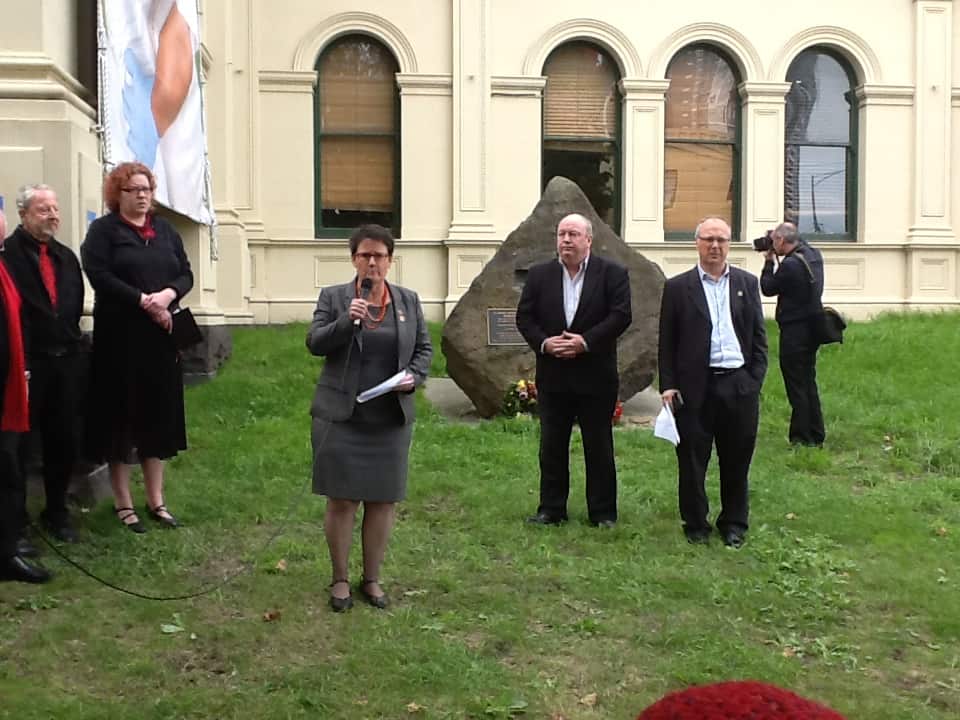
IWMD 2014 01A short time ago the International Workers Memorial Day commemoration in Melbourne, Victoria, concluded. The ceremony was less sombre than in previous years with, it seemed, fewer families and relatives of deceased workers.  Certainly there was no speech from a family member, nothing from workplace safety advocates other than the three trade union speakers, Meredith PeaceBrian Boyd and Michael Borowick (all pictured right), however there were tears for some in the crowd and wreaths were laid prior to a minute silence.

The politics was reduced this year as there were no noisy protests from the back of a tray truck and no march on Parliament afterward, however politics is never far from the surface of this type of event. Michael Borowick, Assistant Secretary of the Australian Council of Trade Unions  was the more effective of today’s three speakers.  Continue reading “Red tape (again) and Obama’s support – Melbourne’s Workers’ Memorial Day 2014”
“Safety is paramount”, “safety is our number one priority” = bullshit cliches

After a major incident or at an Annual General Meeting, it will be common to hear a senior executive state something like “Safety is our number one priority”.  This is unrealistic and almost absurd because even in the most worker-friendly company, the continued existence of that organisation is the real and ultimate goal.  Most corporate leaders believe these safety clichés because they think they reflect their own values but the statements are misrepresenting occupational health and safety (OHS) and need to be questioned.

Corporate leaders who say such statements are not hypocrites.  They are more likely to not understand the consequences of their statements.  If safety really is the number one priority, an executive should be able or expected to close the company if its work cannot be conducted safely.  If a company’s people are paramount to the success of the company, how does it handle an accusation of bullying against a manager?  Which of the people does the Board or the company choose to keep and which to lose?  Should it keep the “evil” sales representative because the rep is its most effective salesperson or sack the rep because he or she is abusive?

These are executive decisions that need to be worked through if any company is to develop an effective operational culture that truly values the safety of its workers.  It is vital that the reality behind the statements is analysed and acted upon, or perhaps such statements should not be uttered in the first instance.

Subscribe to SafetyAtWorkBlog to continue reading.
Subscribe Help
Already a member? Log in here

CEO survey shows odd attitude to OHS

Cover of AiGroup CEO Survey 2014One has to be very careful with surveys, particularly those involving business confidence or surveys of an organisation’s membership base.  These are often surveys of perception which may not correlate with reality and can be used as an excuse to lobby government or set an agenda rather than determining a societal truth.  A recent example of this type of survey seems to have been produced by the Australian Industry Group entitled “Burden of Government Regulation“.  The AIGroup’s media release accompanying the report states that

“Over 83% of employers surveyed listed regulation related to industrial relations and occupational health and safety as a significant regulatory burden in 2014.”

Continue reading “CEO survey shows odd attitude to OHS”

Lessons from Royal Commission into Home Insulation Program

Australia’s Royal Commission into the Home Insulation Program (HIP) demands the attention of all occupational health and safety (OHS) professionals, primarily, because a job creation and economic stimulus program was so poorly planned at the highest level of government, that it seems to have established a culture that led to workplace deaths. However the Royal Commission is already revealing information that shows how OHS is misunderstood by decision-makers, a situation that still persists in many jurisdictions and will only change by watching the Royal Commission carefully and analysing this information through the perspective of workplace safety.

State of Knowledge

The Royal Commission has been investigating when the workplace deaths in New Zealand from using metal staples with foil insulation were known by the Australian Government.  In OHS-speak, it is trying to determine the state of knowledge on this workplace hazard in the decision-making process.  The deaths of four young Australian workers prove that the state of knowledge was inadequate however it is well established that Australia and New Zealand operate independently and that, although there are legislative similarities, it is rare for a death in one country to generate regulatory change in another.  (One could look to the quad bike safety issues for an additional example.)  The recent legislative changes in New Zealand may indicate that they listen to Australia more than vice versa.

Subscribe to SafetyAtWorkBlog to continue reading.
Subscribe Help
Already a member? Log in here

GlencoreXstrata’s annual report shows more than 26 deaths

Last week the Australian Financial Review (AFR) brought some focus on occupational health and safety (OHS) by reporting on the most recent annual report from GlencoreXstrata in its article “Mining’s not war, why 26 deaths?” (subscription required). The article is enlightening but as important is that a business newspaper has analysed an annual report in a workplace safety context.  Curiously, although OHS is often mentioned as part of its sustainability and risk management program, safety is not seen as a financial key performance indicator, and it should be.

AFR’s Matthew Stevens wrote:

“Everybody in mining talks about ‘zero harm’ being the ultimate ambition of their health and safety programs. But talking safe and living safe are two very different things.”

GlencoreXstrata’s 2013 annual report is worth a look to both verify the AFR’s quotes but also to see the corporate context in which fatality statements are stated.  The crux of the AFR article is this statement from the Chairman’s introduction:

“It is with deep sadness that I must report the loss of 26 lives at our combined operations during 2013. Any fatality is totally unacceptable and one of the Board’s main objectives is to bring about lasting improvements to our safety culture.” (page 76)

(A curious sidenote is that the interim Chairman is Dr Anthony Howard, formally of BP and brought to prominence by the Deepwater Horizon oil spill.) Continue reading “GlencoreXstrata’s annual report shows more than 26 deaths”

Important OHS titbits in latest Productivity Commission report

Cover of infrastructure-draft-volume1Productivity and regulation is the rationale behind most of the workplace policies of the current Australian Government.  Occupational health and safety (OHS) has a role to play in both of these economic and social elements but it rarely gets considered in a positive light.  This is partly an ideological position of the conservative politicians but is also due to a lack of economic argument in favour of OHS and an inability, or an unwillingness, to identify essential regulations.

This week Australia’s Productivity Commission (PC) released a draft paper into the costs of public infrastructure projects that includes some telling OHS information even though most of the media has focused on the political angle or on the taxing of cars?!

A brief review of the draft report reveals OHS dotted throughout both volumes of the report and early on there is some support for Safety in Design in the tender development stage.  

Subscribe to SafetyAtWorkBlog to continue reading.
Subscribe Help
Already a member? Log in here
Concatenate Web Development
© Designed and developed by Concatenate Aust Pty Ltd