Managing Safety After A Vacation

On 4 January 2009, the Sunday Age contained a curious article based around some quotes from Eric Windholz, acting executive director of WorkSafe Victoria. The article reports Eric as saying that when workers return to work after a holiday break they can be careless. 

“People come back, they’ve taken their mind off the job, they’ve had a well-earned holiday and sometimes it takes them a little while to do the basics of making sure they’re working safe….. Recommissioning their equipment, starting plant, starting at construction sites again, people may not have their minds on the job and they get hurt.”

WorkSafe has advised SafetyAtWorkBlog (and provided the original media statement) that

Continue reading “Managing Safety After A Vacation”

Indonesian Mines & Depleted Uranium

As in most professions during time in occupational health and safety, one meets amazing people.  One that SafetyAtWorkBlog  cherishes is Melody Kemp.  

Melody is an ex-pat Australia who currently resides in Laos. As well as working on OHS matters throughout the Asian region she is also the author of the excellent OHS publication Working for Life: Sourcebook on Occupational Health for Women, a free download.

In 19 December 2008 Melody had an article printed in Asia Times Online concerning the social impacts of a proposed mine on the small Indonesian island of Lembata.  In this era of corporate social responsibility, safety professionals have a broad brief which covers many industrial, corporate and environmental responsibilities and it is often company behaviour in far-flung outposts of the corporate structure or the world that indicates a clearer picture of corporate and safety culture.  

Melody’s article is highly recommended for those with a social conscience, for those in the mining sectors and for those whose companies have Asian operations.

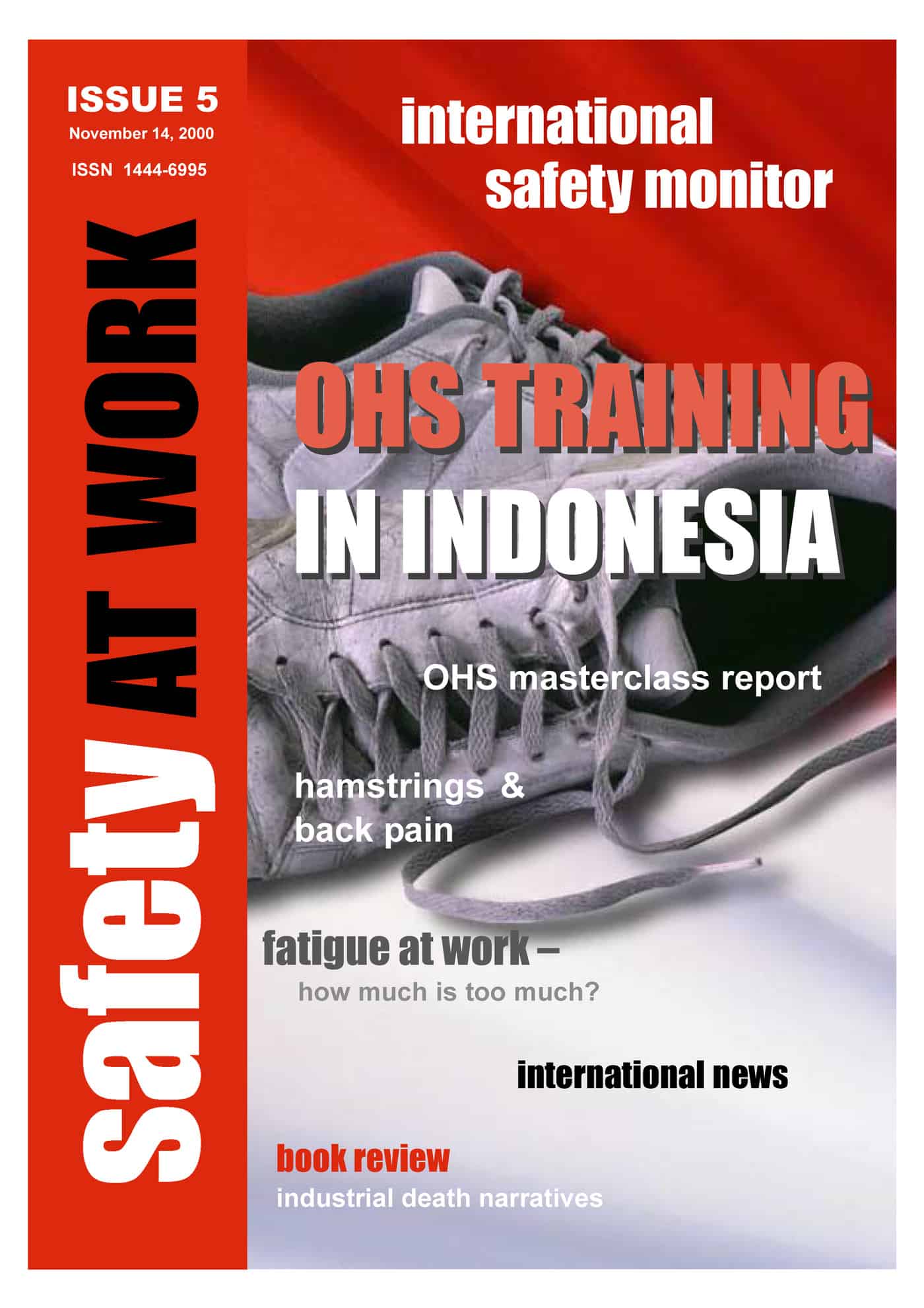
In 2003, Melody wrote an article on the health risks of the use of depleted uranium for Safety At Work magazine (pictured below).  That article can be accessed HERE.

Kevin Jones

4i14-cover

Workplace Choirs

As workplaces approach the winter break or Christmas, there will be in increase in communal singing.  One Australian has started to establish workplace choirs

Tania de Jong makes some good arguments about the benefits of greater worker contact and understanding through communal singing.  It sounds logical and I am sure there is evidence to show positive benefits,  just as there is to show the stress management benefits of laughing.

There are parallels everywhere with this not-wholly-original concept and one I am reminded of is the Fortune Battle of the Corporate Bands.  (Maybe the economic downturn will cause an increase in trios and duets)

I foresee lots of niggly problems such as the singing of religious songs during Christmas, and singing ironic songs that obliquely criticise corporate strategies and performances.  I can think of many and ask that SafetyAtWorkBlog readers suggest others through comments below.

Suggestions already include

Money, Money, Money – ABBA

I Wanna Be a Boss – Stan Ridgway

Nine to Five – Dolly Parton


Kevin Jones

Passport to Safety in Australia

Around the turn of the century a father told me this

“My son was 19 years old and he was killed in an accident in a small warehouse in a suburb of Toronto. In this little shop, it was a small business with only 4 or 5 people there. He got the job through a friend whose Father ran the business. It was the second or third day on the job and he was asked to go back and decant some fluid from a large drum to some small vessels. The action violated every OHS regulation in the book. There were multiple ignition sources, there was no grounding. A spark went off and lit up the fumes that went back in the drum and it exploded over my son. He died 24 hours later.”

That father was Canadian, Paul Kells, and this traumatic event set him on a journey to improve safety for young workers.  Paul established the Safe Communities Foundation.

Paul has travelled to Australia several times and he has been granted audiences with many OHS regulators but it seems that government of South Australia is the most ardent supporter of Paul’s Passport to Safety program.

Over 5000 students in South Australia have completed the program since 2005 and the government is trying to reach the target of 20,000 teenage students.  A sponsorship form is available for download.

SafetyAtWorkBlog supports Paul’s work and the sponsorship initiative of the South Australian government.

This is what the workplace safety ads in Australia are missing, a passionate advocate who speaks about the reality of workplace death and personal loss – someone who has turned grief into a social entrepreneurship.  If only this type of inspiration could happen without the cost of a life.

My 2000 interview with Paul is available by clicking on this link kell-interview.  It was originally published in SafetyAtWork magazine in February 2001.

2i9-cover3


OHS impact of the Fair Work Australia Bill

Over the next few weeks, many Australian law firms are running information seminars on the government’s Fair Work Bill.  This legislation will change the way that workplaces are managed, particularly in the area of personnel management.

The overlap with OHS will come through the increasingly contentious issue of “union right of entry”.  Frequently unions request access to a site in order to investigate an OHS matter.  This is a legitimate part of the tripartite consultative structure that underpins workplace safety.

Given that the National Review into Model OHS Law has already flagged Victoria’s OHS Act as a useful template, it is worth noting that Victoria went through the same right-of-entry concerns in the development of its 2004 OHS Act as the Fair Work Bill is generating now.

Victoria established a system of licensed union OHS delegates through the Court system in 2005.  Earlier this year the CEO of WorkSafe Victoria, John Merritt said 

the ARREO system had been working well since it was introduced in mid 2005.

Mr Merritt said only eight matters involving ARREOs have been reported to WorkSafe since this section of the Act (Part 8 – Sections 79 to 94) took effect in mid-2005.

In seminars prior to the 2004 Act, workplace lawyers, some who have gained considerable prominence since, warned that “the sky was going to cave in” once unions gained this level of access.  It didn’t, but the law firms gained some new clients.  This type of scaremongering is being repeated currently in the Australian press at the moment.

Yes, under the Fair Work Bill, unions can access a broader range of company data than ever before, including salary information of senior executives, as asserted in The Australian Financial Review, but there are considerable safeguards and limitations in place within the legislation.  These safeguards have worked in relation to Victoria’s OHS laws and they will in industrial relations.

In terms of safety management, the establishment of a cooperative relationship with employees is the best way to minimise union involvement.  It is also the best way to minimise the visits of the OHS regulators.  

Remember that those who complain loudest are those with the most to fear.

Kevin Jones


OHS Right of Entry Guide

“Pilgrim’s Plague” and workplace absenteeism

 Last year, Sydney Australia hosted World Youth Day (WYD).  In some ways Australia had not seen such a large influx of people from so many countries for a single event before.  The Sydney Olympics had a high proportion of locals attending and the 1956 Melbourne Olympics never had the infrastructure to provide so many overseas visitors.

For several months after the 2008 World Youth Day, it was rumoured that the level of absenteeism in workplaces was very high.  At the time of WYD there were several reports of quarantined pilgrims and the risk to public health of the Sydney population was assessed. (Peter Curson, professor of population and security in the Centre for International Security Studies at the University of Sydney wrote a discussion piece on this)

There were reports of influenza and viral gastroenteritis amongst pilgrims who were required to be quarantined.

The Medical Journal of Australia has released a report into the impact of World Youth Day on the emergency departments of hospitals (MJA 2008; 189 (11/12): 630-632).  This study found minimal impact in this sector of the hospital care.

However, SafetyAtWorkBlog is not aware of any research having been done on the impact of  World Youth Day on workplace absenteeism.  The EMJA study correlates World Youth Day with hospital admissions but it would be useful to see a comparative study of workplace absenteeism in the weeks after WYD, during the incubation period of influenza in particular.

World Youth Day did seem to overlap with the existing flu season in Australia’s winter but those statistical peaks are well-established and it would be interesting to see if those peaks had increased just after World Youth Day.

If there were a correlation, cost estimates for hosting the event may need adjusting to include the reduced productivity due to the “pilgrim’s plague”.


The insidiousness of “reasonably practicable”

WorkSafe Victoria recently released a guideline, or clarification, on what it considers to be the issues surrounding “employing or engaging suitably qualified persons to provide health and safety advice“.

SafetyAtWorkBlog remains to be convinced that such a process will lead to better safety outcomes in the small to medium-sized enterprises at which this program is aimed.  The OHS legislation clearly states that the employer is the ultimate decider on which control measures to implement to address a workplace hazard.  This is echoed in the WorkSafe guideline

“It is important to note that employing or engaging a suitably qualified person to provide OHS advice does not discharge the employer from their legal responsibilities to ensure health and safety as required under Part 3 of the OHS Act. This duty cannot be delegated.”

A business manager will weigh up the advice sought or given from a variety of sources and make a decision.  A good business manager will take responsibility for the good or bad results of their decision.  But they need to have a clear understanding of their obligations and Victoria’s legislation could be confusing.

The guideline says that

“Employers are expected to take a proactive approach to identify and control hazards in the workplace before they cause an incident, injury, illness or disease.”

This reitereates one of the safety principles in the 2004 OHS Act

“Employers and self-employed persons should be proactive, and take all reasonably practicable measures, to ensure health and safety at workplaces and in the conduct of undertakings.”

But the principles are not legislative obligations.  As Michael Tooma writes in his “Annotated Occupational Health and Safety Act 2004

“… it is the intention of the Parliament that the principles be taken into account in the administration of the Act.”

The principles are there for judicial colour and community reassurance but with no real impact.

The obligations on an employer, the section that determines the actions and plans of the business owner or managers, are, as well as general duties:

“Duties of employers to employees

(1) An employer must, so far as is reasonably practicable, provide and maintain for employees of the employer a working environment that is safe and without risks to health……..

(2) Without limiting sub-section (1), an employer contravenes that sub-section if the employer fails to do any of the following-

(a) provide or maintain plant or systems of work that are, so far as is reasonably practicable, safe and without risks to health;

(b) make arrangements for ensuring, so far as is reasonably practicable, safety and the absence of risks to health in connection with the use, handling, storage or transport of plant or substances;

(c) maintain, so far as is reasonably practicable, each workplace under the employer’s management and control in a condition that is safe and without risks to health;

(d) provide, so far as is reasonably practicable, adequate facilities for the welfare of employees at any workplace under the management and control of the employer;

(e) provide such information, instruction, training or supervision to employees of the employer as is necessary to enable those persons to perform their work in a way that is safe and without risks to health. “

The “as far as is reasonably practicable” insertions allow business considerable flexibility in arguing the validity of their decisions after an incident but hamper the employer in being “pro-active” – (a hateful and lazy piece of business jargon).

The impediments to “pro-activity” can be seen in the general duties of Section 20 where 

“to avoid doubt, a duty imposed on a person…to ensure, as far is reasonably practicable, health and safety requires the person –

(a) to eliminate risks to health and safety so far as is reasonably practicable:…..”

This contrasts with the objects of the, same, Act which states that one of the aims is

“to eliminate, at the source, risks to the health, safety and welfare of employees and other persons at work:…”

It is strongly suspected that a crucial element of OHS legislation and management will likely disappear and this is to eliminate hazards “at the source”.  Outside of the objects of the Act this aim is not mentioned anywhere else in the legislation.  “Reasonably practicable” will erase this important social and moral clause.

Eliminating something “at the source” encourages research into new ways of eliminating hazards by placing an obligation on us to determine the source.  “Reasonably practicable” encourages us to research control measures until it is practicable to do so no more.  That is a half-quest that solves nothing.  What if Frodo was asked to dispose of the ring in Mordor only if “reasonably practicable”? The story would have been a novella instead of a classic trilogy.

Employer associations are lobbying for increased workplace flexibility.  That has nothing to do with the health and safety benefits of the employees but rather the health and safety of the balance sheet.  “Reasonably practicable” similarly focuses on business management and not safety management.

The battle against this insidious weakening of the OHS profession is not lost.  Heart should be taken from the preparedness of governments to roll-back unpopular legislation such as some industrial relations initiatives.  Hindsight can be an important motivator for change.

Recent fatalities data may sway some in government that OHS regulators are achieving their social and operational targets but OHS professionals know that fatality rates are not an accurate indication of the success of safety initiatives.  New workplace hazards are appearing regularly and many of the new ones don’t result in death but lead instead to misery and an incapacity to live a healthy life or to work again in a chosen profession.  

“Reasonably practicable” allows businesses to try, in differing degrees, to eliminate the hazards, such as psychosocial hazards, of its workforce and then shift them to social security and disability benefits.  And why not? It seems that corporations can serve their clients and stakeholders “as far as is reasonably practicable” and then expect a bailout from government over their mismanagement.  Immorality applies to much more than economics.

Concatenate Web Development
© Designed and developed by Concatenate Aust Pty Ltd