Industrial Manslaughter exemption for mining looks over

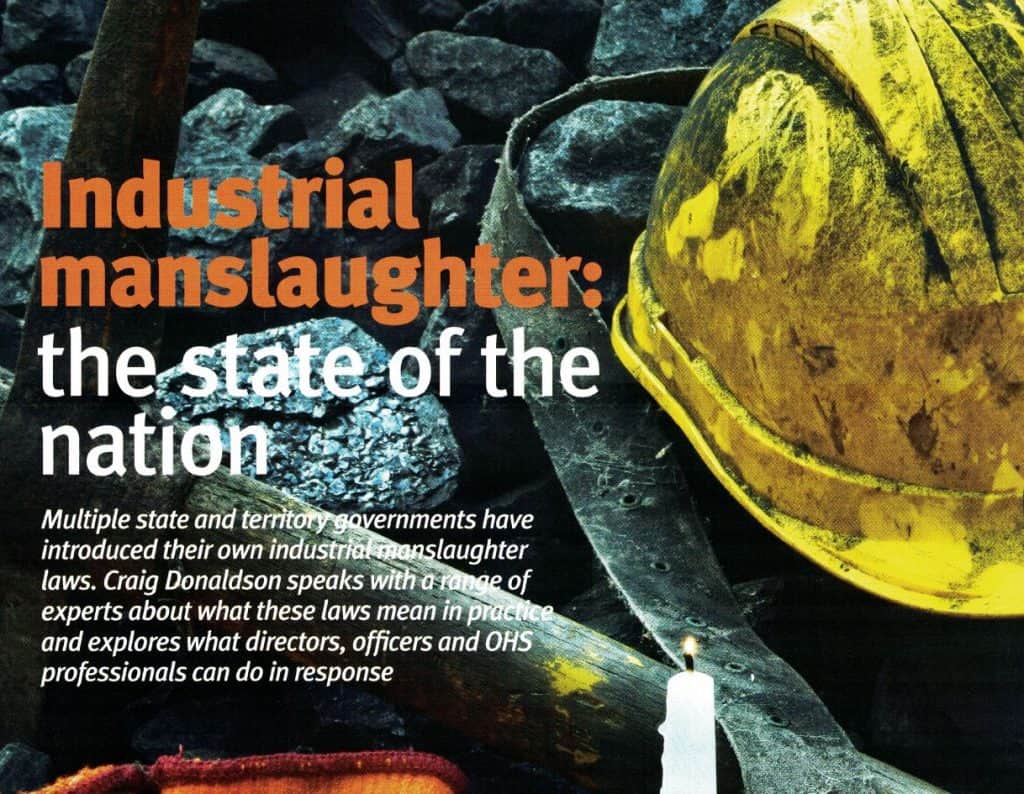
Many advocates see the introduction of Industrial Manslaughter laws as a glorious moment that will change the world for the better, in other words, a silver bullet. But if it is a silver bullet, it is being shot into the political murk. Queensland’s expansion of its Industrial Manslaughter laws to the mining and resources industries was presented to Parliament on February 4, 2020, and is likely to pass with the support of those industries.

Occupational health and safety (OHS) laws should apply to businesses and workers without exception. Queensland’s exemption of the mining and resources sector from Industrial Manslaughter laws was always a nonsense but that nonsense made good political sense in an election year.

Subscribe to SafetyAtWorkBlog to continue reading.
Subscribe Help
Already a member? Log in here

New air quality standards for outdoor work

On January 30 2020, the Victorian Trades Hall released a new “approved safety standard” on air quality risks for outdoor workers. It is the latest of a series of alerts and guidelines generated by the persistence of bushfire smoke in urban areas of, especially, New South Wales and Victoria. Bushfire smoke is only going to become more frequent in Australia, and its persistence over weeks, requires a coordinated discussion on how Australian workplaces and practices need to change to adapt to the new climate.

Subscribe to SafetyAtWorkBlog to continue reading.
Subscribe Help
Already a member? Log in here

On safety, the PM says it’s all about the economy

Source:istockphoto

Australia’s conservative Prime Minister, Scott Morrison, spoke at the National Press Club yesterday and his speech showed that if occupational health and safety (OHS) is to progress over his term of government, economic arguments will be the most persuasive.

Subscribe to SafetyAtWorkBlog to continue reading.
Subscribe Help
Already a member? Log in here

Kevin Jones

Kevin Jones with family in Paris 2012

I thought I might follow Wade Needham’s reflections and thoughts with my own. Indulgent? Maybe.

How did you get into Health & Safety?

My first contact with workplace health and safety was as an Administrative Officer in the Victorian Department of Labour in the late 1980s before moving to the Occupational Health and Safety Authority, the precursor to WorkSafe Victoria, in the early 1990s.  I worked in the Major Hazards Branch and was involved in preparing options for the relocation of the Coode Island chemical storage facility before it exploded.

What drives you?

The Health and Safety profession has been notoriously shy in expressing opinions for many reasons including timidity, insecurity and laziness.  This reluctance has contributed to the dominant perspective of H&S as a business nuisance rather than a profitable aid to business.  My frustration with this caused me to write and speak about H&S as an unavoidable and legitimate element of business.

Continue reading “Kevin Jones”

Avoid government interference, get in first

In occupational health and safety (OHS), there is evidence and then there is evidence. Regardless of the type of evidence, there is not as much as there should be. Many companies and organisations in Australia are required to publicly release annual reports that identify their financial status. Increasingly non-financial criteria, like OHS performance, is being included in these reports but why isn’t this mandatory and why isn’t it of a consistent type? Late on 2019, the Australian Council of Superannuation Investors (ACSI) looked at the issue of OHS reporting, with some assistance from EY.

ACSI’s CEO, Louise Davidson illustrates the problem in her Foreword to the report:

“Almost one third of ASX200 companies provide their investors and other stakeholders no information on health and safety performance. For the companies that do provide some information, the disclosure often provides no insight into how many severe incidents occurred…….”

page 6
Subscribe to SafetyAtWorkBlog to continue reading.
Subscribe Help
Already a member? Log in here

Take a good hard look at your business and do something about it

The Medical Journal of Australia (MJA) published an opinion piece on January 20, 2020 concerning working hours in the medical profession and the risk of mental health and suicide from working excessive hours. It uses the Japanese problem of “karoshi” to illustrate the severity of the workplace risks but it misses a couple of points.

It references the amendments to Victoria’s Occupational Health and Safety (OHS) legislation that introduced an offence of Industrial Manslaughter but implies that this amendment changes the duty of care expected of employers and changes a worker’s right to a safe and healthy workplace.

Subscribe to SafetyAtWorkBlog to continue reading.
Subscribe Help
Already a member? Log in here
Concatenate Web Development
© Designed and developed by Concatenate Aust Pty Ltd