Aim for prevention, to affect real change

The Minerals Council of Australia (MCA) has released its submission (not yet online) to the Safe Work Australia’s (SWA) review of the Regulatory Impact Statement on the recommendations from the Boland review of the Model Work Health and Safety laws. It is comprehensive but contains little that is new. An interesting interpretation of the submission comes from considering how the MCA’s recommendations prevent harm, for prevention is the challenge.

Subscribe to SafetyAtWorkBlog to continue reading.
Subscribe Help
Already a member? Log in here

Listening anew to the voice that has always been there

The growth of visible and prominent customer services, such as those in the collective term of “gig economy” – has coincided with an increased consideration of alternative socioeconomic structures and broader political diversity, especially in the UK and to a lesser extent Australia and New Zealand. One manifestation of this change is an emerging consideration of Co-operatives and worker ownership. This may seem outside the occupational health and safety (OHS) purview of this blog but co-operatives often allow workers more input into business operations and therefore more influence on OHS standards and management. However, should this influence come from increased worker wealth or is OHS more fundamental than money?

Subscribe to SafetyAtWorkBlog to continue reading.
Subscribe Help
Already a member? Log in here

Industrial Manslaughter campaign messages need scrutiny

Recently the State Secretary of the CFMEU Construction & General WA, Mike Buchan, wrote in Construction Weekly about the need for Industrial Manslaughter laws in Western Australia. There are several points made that deserve some assessment and clarification.

He starts by stating that current occupational health and safety (OHS) laws are inadequate. This may be the case, but as Nicole Rosie from WorkSafe NZ has, supposedly, said “you can’t regulate your way to safety”. What may be inadequate is people’s compliance with OHS laws, and there may be many reasons for this non-compliance – ignorance, illiteracy, lack of enforcement by government, complexity of laws and guidance, and/or a total disregard. According to Buchan, and the wider trade union movement, Industrial Manslaughter (IM) laws are supposed to fix this inadequacy.

Buchan writes that

“The penalties that are handed down, even when a builder is found guilty of negligence, have been a disgrace in the face of the extraordinary loss of life and the suffering of families left behind.”

Subscribe to SafetyAtWorkBlog to continue reading.
Subscribe Help
Already a member? Log in here

Oral biffo over safety in Queensland Parliament

Before Christmas, the Victorian Government will be presenting a Bill for Industrial Manslaughter laws to the Parliament. The core elements of accountability and penalty are expected to be little different to the Bill that failed to pass Parliament earlier this Century by a bee’s whatsit. The debate is likely to be on the same benefits and costs, so one can reread Victoria’s Hansard from 2002 or look at the debate in Queensland Parliament last week where that Government’s “Safety Reset” has generated arguments about which party is more committed to occupational health and safety (OHS).

Subscribe to SafetyAtWorkBlog to continue reading.
Subscribe Help
Already a member? Log in here

Keep talking and making submissions – what to ask about dust

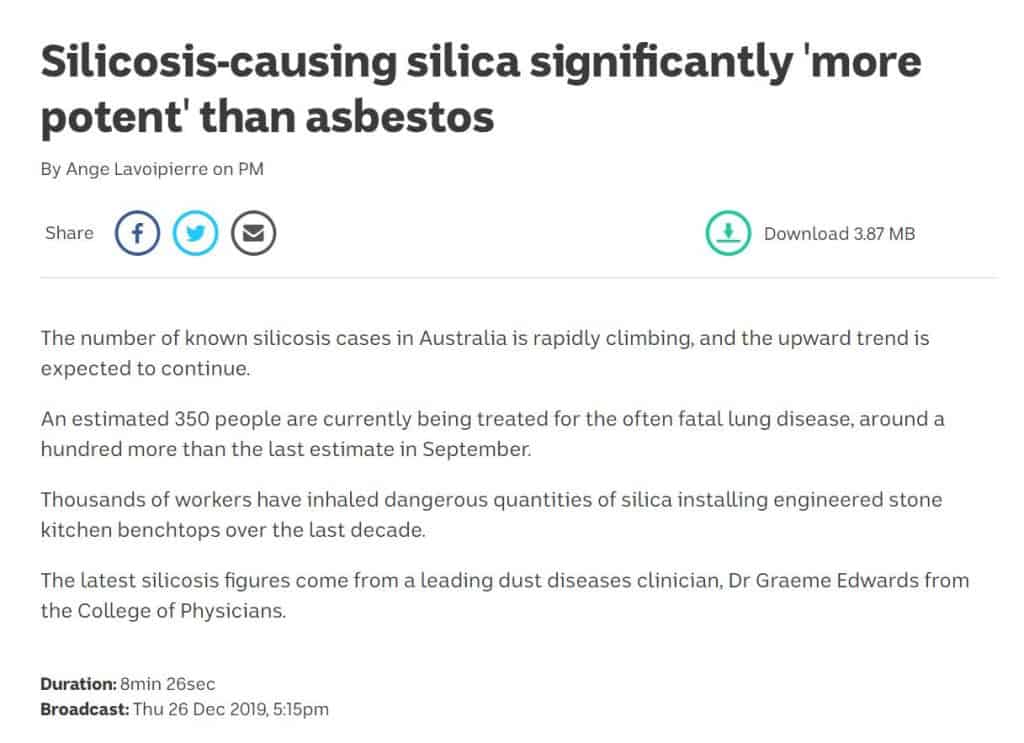
Government attention on the risks of silicosis, especially those related to engineered stone, continues to increase. Australia has established a National Dust Disease Taskforce to investigate the risks and to make recommendations to the government at the end of 2020. A national investigation is warranted but occupational health and safety (OHS) is regulated at State level so it could be many years until safety improves on this matter, if the States wait for the Taskforce’s final report.

Luckily, the debate on silicosis risks continue in various Parliaments and the Taskforce is seeking submissions.

Subscribe to SafetyAtWorkBlog to continue reading.
Subscribe Help
Already a member? Log in here

Caution. Misery (and Enlightenment) Ahead.

Having been born in the north of England, I enjoy watching movies and TV shows from there, even though I need subtitles sometimes. As a child watching Ken Loach’s film Kes for school, I thought that I could easily have been that kid standing in a cold muddy soccer pitch on an estate not far from our commission house. (I have been told our previous house was demolished because it was in a block of slums) So Loach’s latest film sounded interesting and given that it depicted life in the precarious and “gig” economy, I recently joined the hundreds in the audience at the Melbourne International Film Festival to watch “Sorry We Missed You”.

I really enjoyed the film but found the story very upsetting. It’s taken me almost a week to starting writing this article and the trailer still makes me cry, so I am split on whether to recommend you see the film.

Continue reading “Caution. Misery (and Enlightenment) Ahead.”

Big potatoes, small potatoes, trust and transparency

The Australian Council of Superannuation Investors (ACSI) has released a research paper that discusses the reporting of workplace fatalities by major companies in their Environmental, Social and Governance (ESG) reports. There are many informational benefits in this report but perhaps the most important is that the report reinforces occupational health and safety (OHS) in ESG reports. The risk is that OHS is seen only in relation to the ESG criteria in Annual Reports.

Australia has experienced a gentle push for inclusion of OHS performance measurements in company and government department Annual Reports. SafetyAtWorkBlog has reported on this and some peer-reviewed research and recommendations over many years. The ACSI report progresses this but also illustrates the sluggish rate of change.

Subscribe to SafetyAtWorkBlog to continue reading.
Subscribe Help
Already a member? Log in here
Concatenate Web Development
© Designed and developed by Concatenate Aust Pty Ltd