Better jobs should also be safer jobs

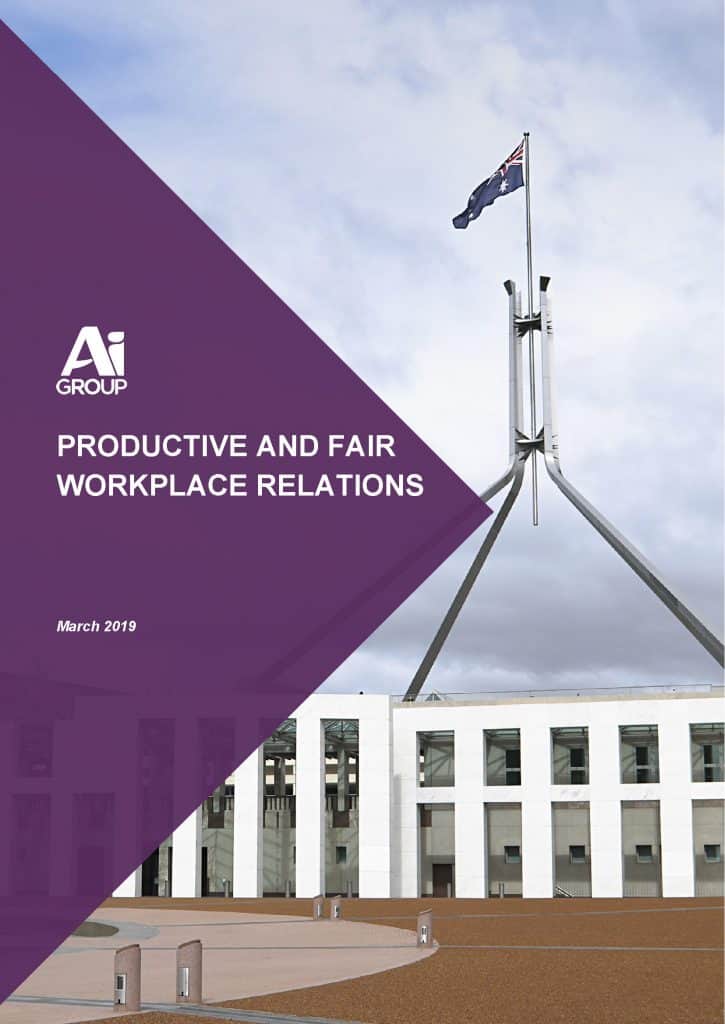
The impending election in Australia has started to generate various position statements and discussion papers from various lobbyists. The Australian Industry Group (AiGroup) and the Business Council of Australia (BCA) are the latest of these.

The AiGroup released its Productive and Fair Workplace Relations statement in late March 2019. Surprisingly there is no mention of occupational health and safety (OHS) even though its contribution to a productive workforce is well established. Its omission is doubly surprising given the political stink in some States about the introduction of Industrial Manslaughter laws.
Subscribe to SafetyAtWorkBlog to continue reading.
Subscribe Help
Already a member? Log in here

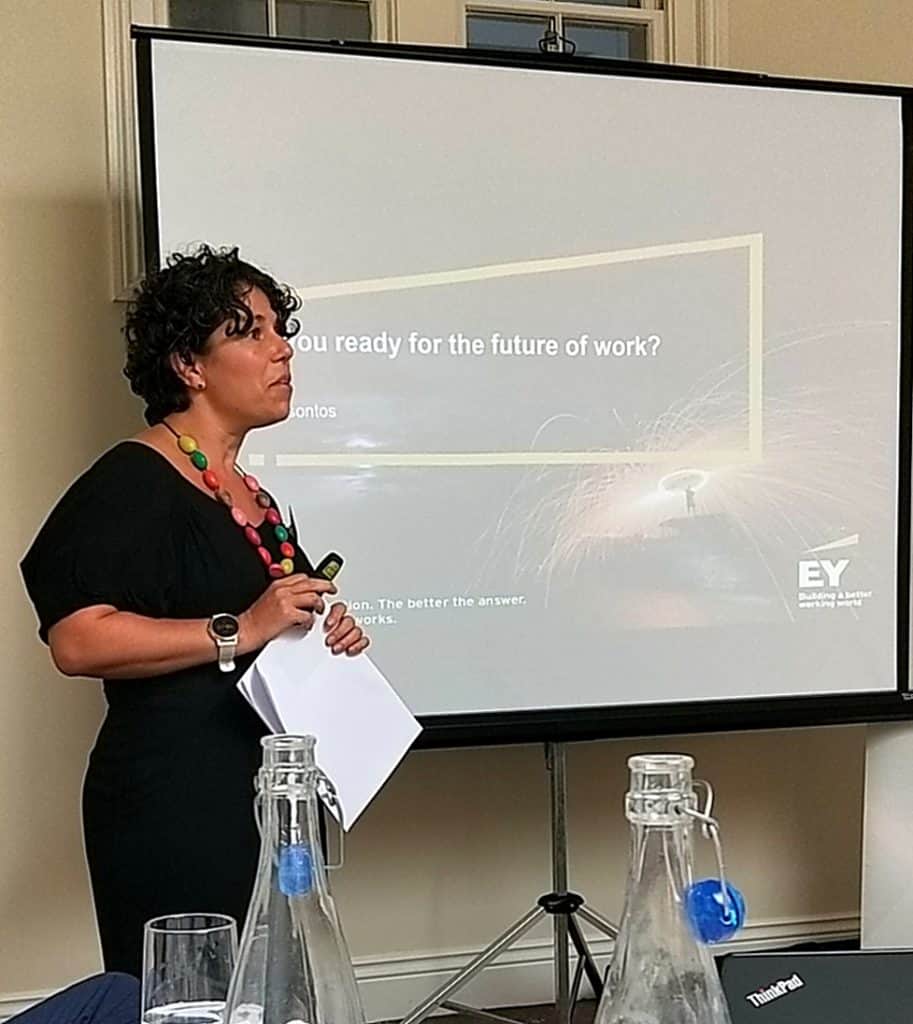
Andi Csontos, OHS futurist

Andi Csontos

The future of work is usually portrayed as a future dominated by Artificial Intelligence (AI) and electronic technology, and one with which humans will struggle to cope. As other industrial sectors panic over potential job losses, it may be good news for the occupational health and safety (OHS) profession which feeds on the potential for harm. The future will still contain harm, but probably new types.

Consultation has been critical to OHS and its ability to improve health and safety, but many OHS people do not have to leave the office. There activities revolve around complicated Excel spreadsheets of intricate injury classifications and risk calculations. But OHS existed long before these technological burdens, which some would describe as dead-ends and others as the accumulation of valuable data. However, talking about safety and, more important, listening to others discussing safety is the most important tool an OHS profession has and will have in the Fourth Industrial Revolution.

This was reinforced recently by EY’s EHS Partner Andi Csontos (pictured above) at a seminar in Ballarat Victoria. Csontos paraphrased a recent EY discussion paper:

Subscribe to SafetyAtWorkBlog to continue reading.
Subscribe Help
Already a member? Log in here

Good, but very limited, advice on workplace mental health

Member magazines, those magazines included in a professional’s membership, are an important source of information. Members of the Royal Automobile Club of Victoria, for instance, receive the RoyalAuto magazine which is really the primary source of information on changes to road rules. Most occupational health and safety (OHS) associations have internal magazines for a similarly targeted audience. Australian accountants have the In The Black magazine.

Recently In The Black published an article about mental health at work titled “Get smart with mental health”. No background to the author, Helen Hawkes, was provided and no references were included for the data used to support statements about the importance of the mental health. Context and sources are important to all articles but arguably moreso for member magazines and, especially, for professionals like accountants who can have a major impact on how OHS is managed.

Much of the information in the article would be familiar to OHS professionals – Return on Investment, the cost of Presenteeism as a percentage of payroll…. What is almost entirely missing is advice on how to prevent mental ill-health from occurring in the first place, and there is no mention of any of the OHS guidance in this area published by Safe Work Australia.

Subscribe to SafetyAtWorkBlog to continue reading.
Subscribe Help
Already a member? Log in here

Answers and clues on workplace bullying and mental health in a small package

Talking about occupational health and safety (OHS) is a critical element so explaining the concept but also strengthening OHS as more and more people understand its socio-economic and organisational context. Sometime this is done through newsletters from OHS Regulators, sometimes by large and/or expensive conferences. Sometimes all of this still fails to reach the right audience.

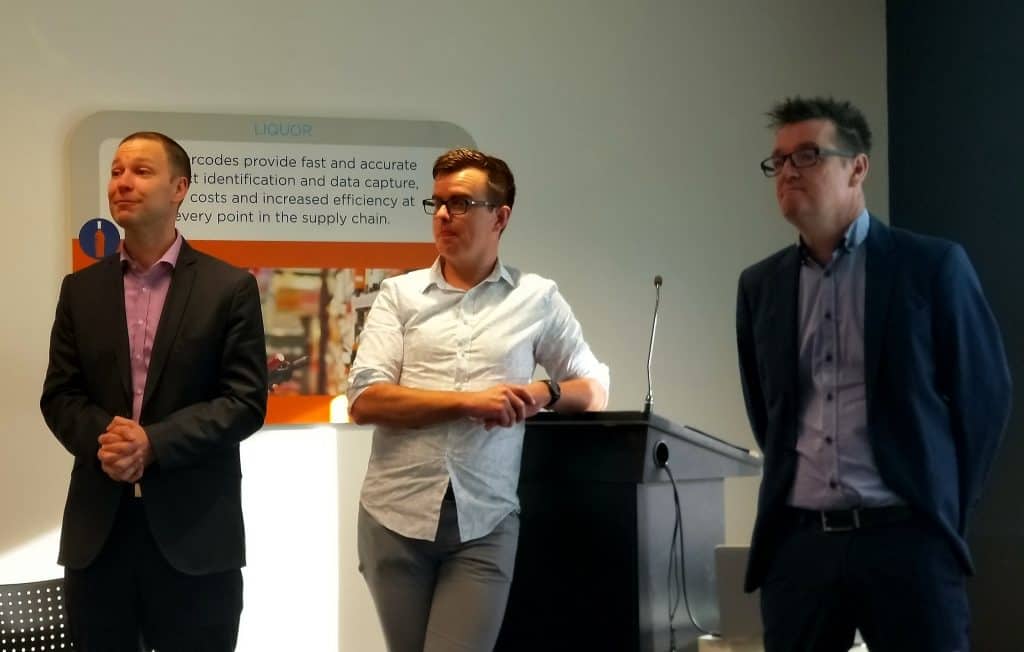
Mark Stipic, Antony Malmo and Michael Plowright

Last week a small seminar was held in the Melbourne suburb of Mulgrave. That seminar was no more than 90 minutes and provided advice from three experts in OHS-related topics related to workplace bullying. These were the psychology of workplace bullying, the management and prevention of it and workers compensation for the resultant mental ill-health.

Subscribe to SafetyAtWorkBlog to continue reading.
Subscribe Help
Already a member? Log in here

Labour Hire licencing scheme to be rolled out in Victoria

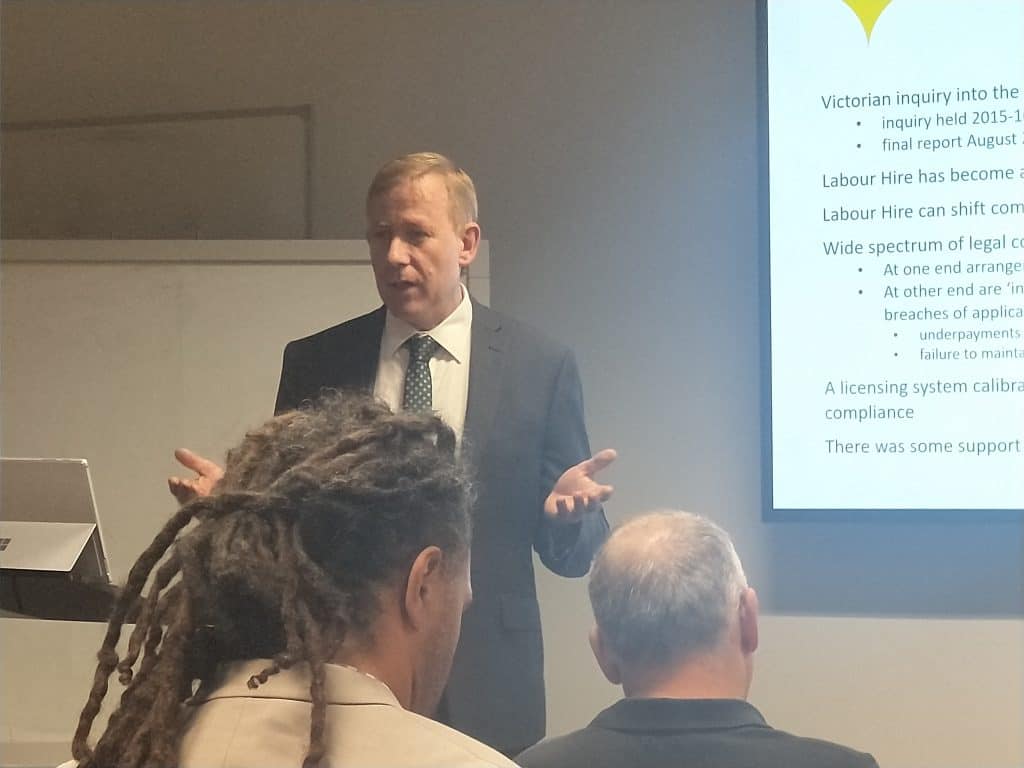
Labour Hire Authority Commissioner, Steve Dargavel,

Labour Hire is almost always seen in purely commercial terms of salaries, business costs, production rates, labour availability, migrant workers, and more. Occupational health and safety (OHS) is often seen as an add-on, a term that is included in a media story because it should be, not because the author has really thought about it or sees OHS as legitimate.

Australian States are beginning to introduce certification/regulations schemes for the Labour Hire industry as a result of the exposure of workplace abuses in this labour supply process. Not all States though. Queensland has one that has been running a year or so, Victoria’s is open for registration applications at the end of April 2019 and full operation before the end of 2019; South Australia began its system, but an election changed the political priorities and that scheme is in limbo. The other States are unclear on their preferences, but it is clear that there will be no national labour hire scheme.

Victoria’s Labour Hire Authority (LHA) Commissioner, Steve Dargavel, has just started his roadshow for explaining what the regulations are all about, how to apply, what it will mean and what it will cost. Importantly OHS and workers’ compensation are integral parts of the scheme and therefore part of what the LHA Inspectors will be looking at and enforcing.

Subscribe to SafetyAtWorkBlog to continue reading.
Subscribe Help
Already a member? Log in here

Family violence at work, looking at trees instead of forest

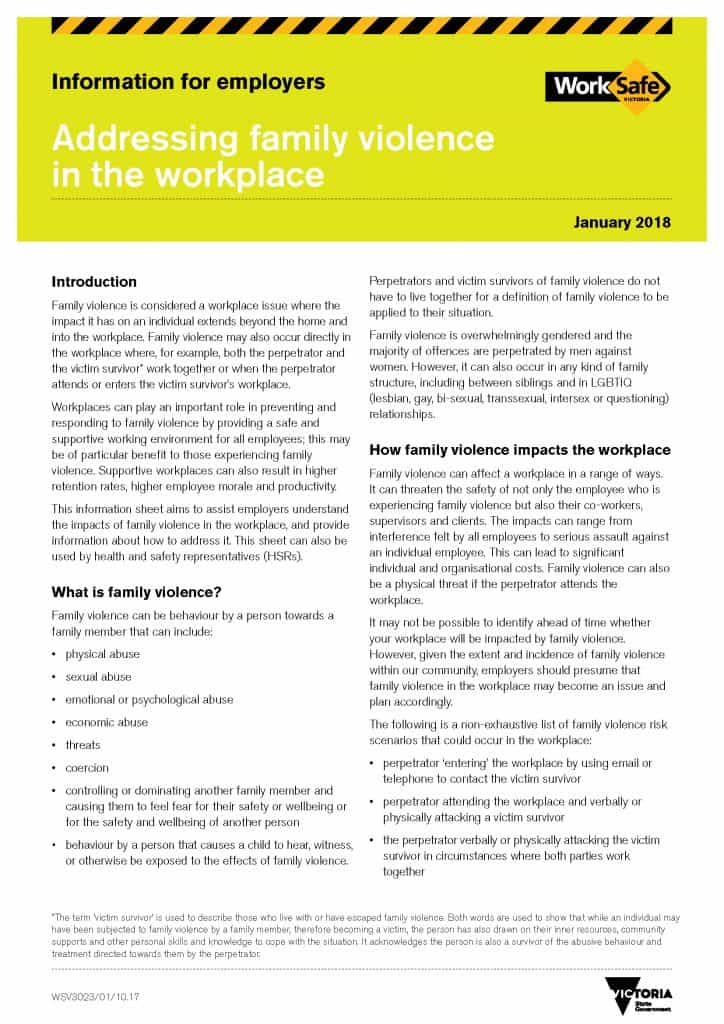
Victoria’s Minister for Workplace Safety, Jill Hennessy, has released a media statement about the occupational health and safety (OHS) context of family violence, referencing a WorkSafe Victoria guidance note from January 2018.

Hennessy is quoted saying:

“Employers have a legal obligation to provide a safe workplace for their employees – and that includes doing whatever they can to support workers experiencing family violence.”

But what level or type of support is expected from employers? Family violence is damaging and insidious but also a crime. It is also a subset, or maybe a special type, of workplace violence as is evident by WorkSafe’s reference to its broader violence publication at the end of the family violence guidance note. The publication, A guide for employers Preventing and responding to work-related violence, outlines the employers duty of care, which includes prevention.

Subscribe to SafetyAtWorkBlog to continue reading.
Subscribe Help
Already a member? Log in here

Steady as she goes in Victoria

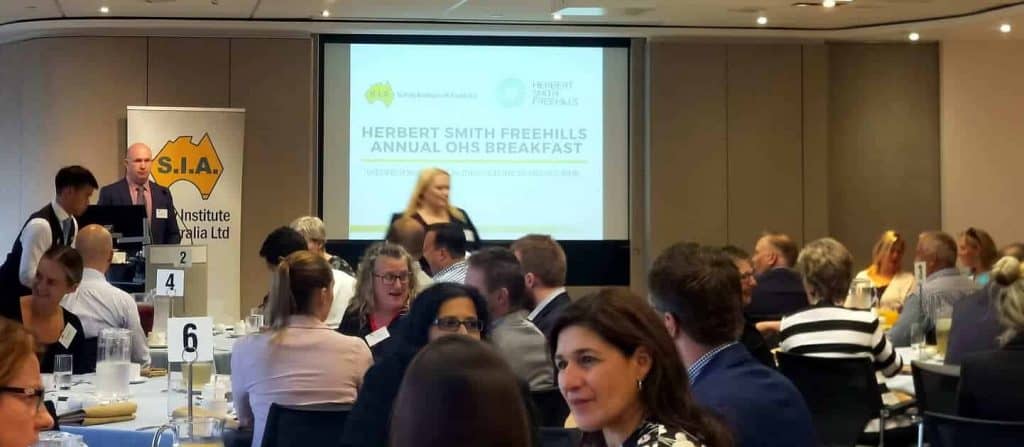
The annual Safety Institute of Australia (SIA) breakfast was held at the Melbourne offices of Herbert Smith Freehills (HSF). As has become a tradition, a spokesperson for WorkSafe Victoria was the feature presenter and this year that was the very recently appointed Executive Director of Health and Safety, Julie Nielsen. HSF’s Steve Bell also provided an update on OHS laws and national Work Health and Safety (WHS) changes.

Subscribe to SafetyAtWorkBlog to continue reading.
Subscribe Help
Already a member? Log in here
Concatenate Web Development
© Designed and developed by Concatenate Aust Pty Ltd