Grab the political OHS opportunity

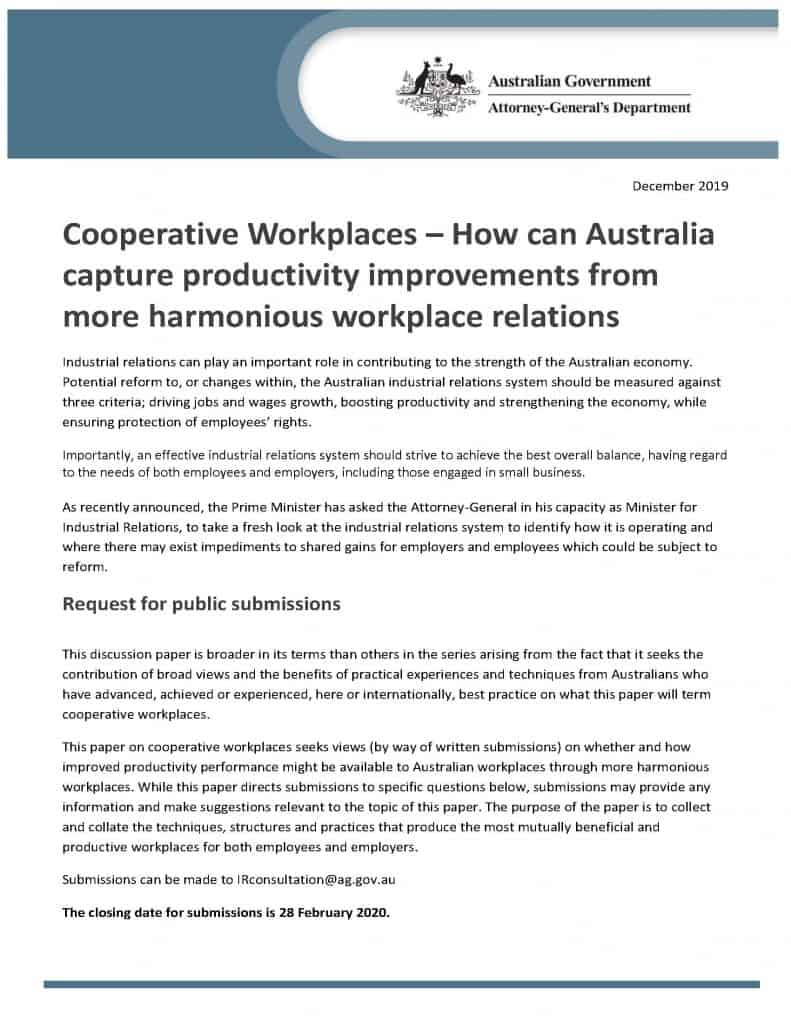
Yesterday, Australia’s Parliament opened for its Winter session. As per protocol, the Governor-General officially opened the process with a speech (page 13) about his government’s agenda. It is no surprise that it is heavy on economic reform but there was a few lines about lawlessness that are of interest.

The Governor-General’s words are aimed at the lawlessness of certain trade unions but we could impose occupational health and safety (OHS) on the statements as well. On the issue of Regulatory Reform and Industrial Relations, the Governor-General said the government:

“… will partner with businesses in identifying the barriers, blockages and bottlenecks to investment. Confidence to invest relies on productive and harmonious workplaces. This means tackling lawlessness in workplaces whenever and wherever it may occur…….

This work will be evidence based. It will protect the rights and entitlements of workers and identify a way forward that will benefit our economy and, most importantly, the workers who rely on it.”

Subscribe to SafetyAtWorkBlog to continue reading.
Subscribe Help
Already a member? Log in here

“They did not know what to say, so they stop saying anything at all”

Behind every call for Industrial Manslaughter laws in Australia over the last twenty years has been is a deeply grieving family. We often see relatives on the TV News, standing outside of Courts, or at memorial sites. SafetyAtWorkBlog fears for the mental health of these people who have usually been traumatised by the death and whose experiences in the immediate aftermath and the months afterwards often exacerbates that trauma.

But people have been killed at work for centuries and often the current pain and anger is so raw that we fail to remember those who have already gone through this process because their voices have often been used and discarded.

SafetyAtWorkBlog spoke with several bereaved relatives who have experienced the loss of a relative at work. The focus was on those whose relatives died over a decade ago, to gain a more measured and reflective perspective and in order to understand what may be in the future for all of us who have workers in our families. I responded more emotionally to these stories than I expected and have found it difficult to write about the issues I intended to address, so I have decided to let these interviews and stories stand pretty much by themselves.

The first of these responses is from Jan Carrick. Her 18-year-old son Anthony died in 1998 on his first day at work. One article written in 2003 about Anthony’s death and that of other young workers said this:

Continue reading ““They did not know what to say, so they stop saying anything at all””

“… merchants of doubt and experts in distorting the truth…”

The Weekly Times newspaper has provided strong coverage of the arguments about quad bike safety for many years, especially, through the work of Fiona Myers and Peter Hunt. The June 19, 2019 edition devoted its front page, page 4, an opinion piece and a cartoon to the objection by the quad bike manufacturers to Operator Protection Devices (OPDs). One of the benefits of long-term media coverage is that changed positions, or hypocrisy, can be shown and this is what Hunt did on 19 June.

Subscribe to SafetyAtWorkBlog to continue reading.
Subscribe Help
Already a member? Log in here

What is the problem that Industrial Manslaughter laws are intended to solve?

Marie Boland speaking on Day one

This week Melbourne Victoria hosted a conference about Work Health and Safety Prosecutions and Enforcement. The two-day conference, run by Criterion Conferences, focused on law and the application of that law. Occupational health and safety (OHS) was largely a subtext of the discussion, but it raised its head occasionally.

The audience of around 100 consisted of many OHS regulators and lawyers from most Australian States. This conference profile set the tone of this conference where a lot of legal knowledge and terminology was assumed even though, occasionally and not knowing the audience, a speaker trod old ground with Law 101.

Subscribe to SafetyAtWorkBlog to continue reading.
Subscribe Help
Already a member? Log in here

The potential of undocumented safety

SafeWorkSA’s CEO, Martyn Campbell, is fast becoming the highest profile occupational health and safety (OHS) regulator in Australia, partly because he has committed to communicating with stakeholders. Recently on the SafetyOnTap podcast Campbell, spoke about non-paper-based compliance. Given the current attention to safety clutter by David Provan and Greg Smith, his comments deserve some brief consideration.

Campbell was speaking about the importance of formalising OHS investigations through ICAM or root cause analysis and how proof of safety compliance comes through paperwork:

Subscribe to SafetyAtWorkBlog to continue reading.
Subscribe Help
Already a member? Log in here

Language, labels, thoughts and restraints

Carsten Busch is a committed voice for improvement in occupational health and safety (OHS) and our understanding of it. Recently he published a research paper entitled “Brave New World: Can Positive Developments in Safety Science and Practice also have Negative Sides?” (open access). The paper is of note for several reasons, not including the use Aldous Huxley’s 1932 novel “Brave New World” a book about a dystopia that many Australian high school students in the 1970s were required to read.

Dystopian novels suit the study of OHS as the structure often reflects a character with new experiences of an unfamiliar culture or an awakening or realisation of their place in the world. Brave New World fits the former and George Orwell’s 1984, the latter. OHS professionals often step into a workplace culture that is foreign to what they have understood to be the norm. They evaluate the new culture, find it wanting and suggest repairs, if they can. Over time some OHS professionals, often through an epiphany, realise that they have not achieved what they expected and either leave or turn on the OHS discipline. Some OHS professionals are able to blend both these experiences and perspectives.

Subscribe to SafetyAtWorkBlog to continue reading.
Subscribe Help
Already a member? Log in here

Tough but short-term

A toxic fire in an industrial district creates plumes of dangerous smoke billowing up into the air as seen from behind a near by warehouse building, 2019. Credit:Christopher Freeman

Melbourne, Australia has recently suffered several notable factory fires that resulted from unsafe storage of chemical wastes. These fires have resulted in toxic fumes across residential suburbs, environmental damage to local waterways and some injuries to workers. Victoria’s Minister for Workplace Safety, Jill Hennessy has responded by increasing penalties for breaching occupational health and safety (OHS) laws. This is a good short-term measure and indicates to the community that their government is doing something but is not a sustainable prevention strategy.

Subscribe to SafetyAtWorkBlog to continue reading.
Subscribe Help
Already a member? Log in here
Concatenate Web Development
© Designed and developed by Concatenate Aust Pty Ltd