Industrial Manslaughter campaign messages need scrutiny

Recently the State Secretary of the CFMEU Construction & General WA, Mike Buchan, wrote in Construction Weekly about the need for Industrial Manslaughter laws in Western Australia. There are several points made that deserve some assessment and clarification.

He starts by stating that current occupational health and safety (OHS) laws are inadequate. This may be the case, but as Nicole Rosie from WorkSafe NZ has, supposedly, said “you can’t regulate your way to safety”. What may be inadequate is people’s compliance with OHS laws, and there may be many reasons for this non-compliance – ignorance, illiteracy, lack of enforcement by government, complexity of laws and guidance, and/or a total disregard. According to Buchan, and the wider trade union movement, Industrial Manslaughter (IM) laws are supposed to fix this inadequacy.

Buchan writes that

“The penalties that are handed down, even when a builder is found guilty of negligence, have been a disgrace in the face of the extraordinary loss of life and the suffering of families left behind.”

Subscribe to SafetyAtWorkBlog to continue reading.
Subscribe Help
Already a member? Log in here

Asia, maturity, grief, zero and data-collecting mouthguards – the SafetyConnect conference

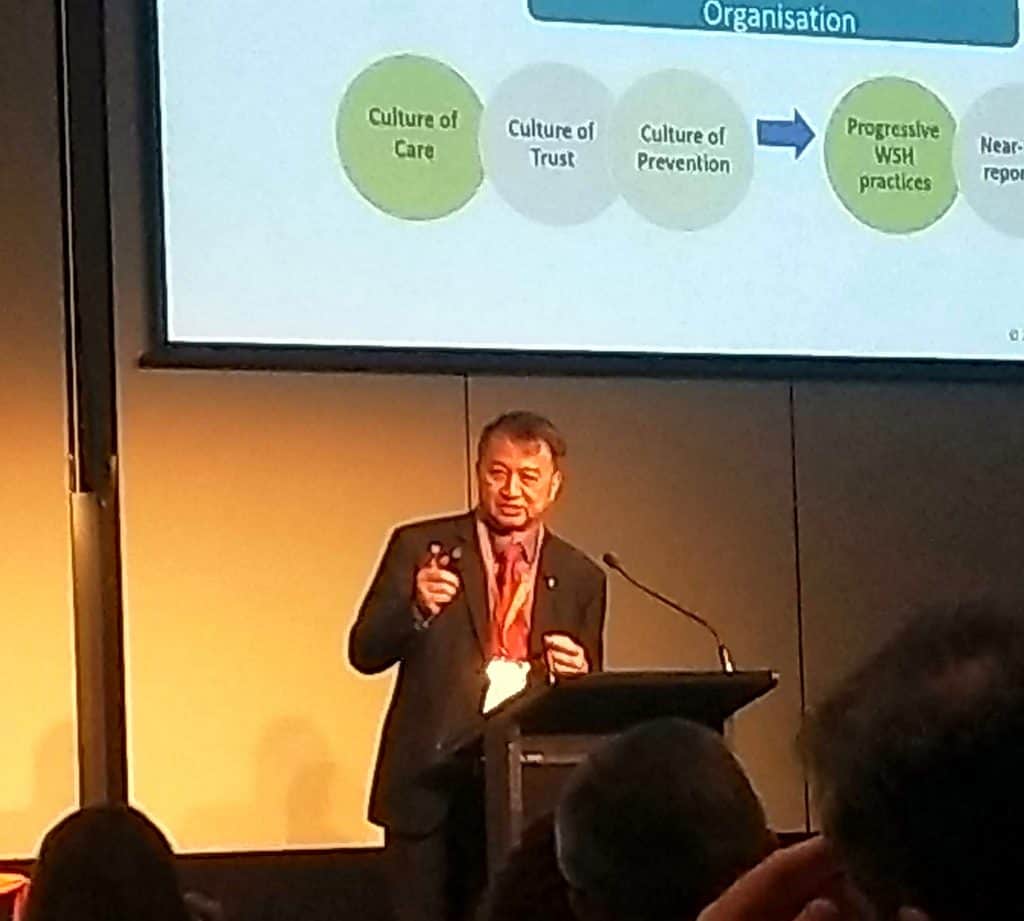
Zero Harm is hardly ever mentioned in Australia’s academic occupational health and safety (OHS) conferences, except maybe with a little snigger. But it was prominent at the NSCAV Foundation’s SafetyConnect conference in late August 2019. This was partly because this conference has more of a commercial bent compared to other conferences but also because several international speakers from Asia were able to clarify what was meant by the term.

This conference had an enviable number of prominent Asian OHS professionals and engineers. One of them Ho Siong Hin (pictured above) explained the application of Vision Zero by the Singaporean government and business community.

Subscribe to SafetyAtWorkBlog to continue reading.
Subscribe Help
Already a member? Log in here

New evidence of mental health effects on the relatives of deceased workers

Australian seems to be leading in the investigation of the (secondary) familial and social impacts of work-related death. New research from Lynda Matthews, Michael Quinlan and Philip Bohle to be publicly released soon focused on the mental health of bereaved families after a relative’s death. They found

“At a mean of 6.40 years post-death, 61 percent of participants had probable PTSD (Post Traumatic Stress Disorder), 44 percent had probable MDD (major depressive disorder), and 43 percent had probable PGD (prolonged grief disorder).”

Continue reading “New evidence of mental health effects on the relatives of deceased workers”

What do sex work and truck driving have in common? Non-work-related fatalities

It is widely acknowledged that work-related incidents are under-reported through worker or management choice. But there are institutional practices that mean that incidents in company vehicles are reported as traffic incidents even though the driver may be obliged to follow company safe driving procedures and the car has been purchased exclusively for work activities. But this situation is not just related to transport. Last week, Michaela Dunn, was murdered by a client while at work but her death will not be recorded as a work-related death.

Subscribe to SafetyAtWorkBlog to continue reading.
Subscribe Help
Already a member? Log in here

Time to ban synthetic stone

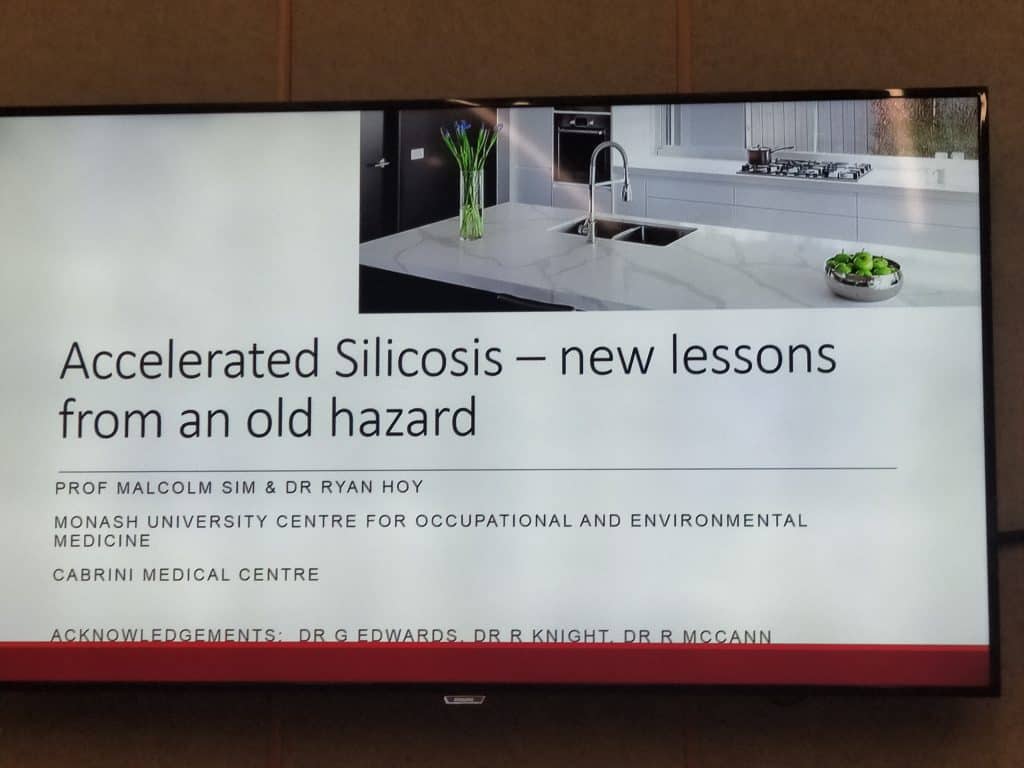
Professor Malcolm Sim of Monash University spoke at the 2019 National Work Health and Safety Colloquium on an issue that he never imagined he would be speaking of, at his age, silicosis.

As it is in several countries, the emergence of silicosis related to synthetic stone is gradually getting the attention of governments as more, and younger, workers are starting to die from this aggressive occupational disease. Professor Sim outlined the risk of handling this new type of stone by asking:

Subscribe to SafetyAtWorkBlog to continue reading.
Subscribe Help
Already a member? Log in here

Big potatoes, small potatoes, trust and transparency

The Australian Council of Superannuation Investors (ACSI) has released a research paper that discusses the reporting of workplace fatalities by major companies in their Environmental, Social and Governance (ESG) reports. There are many informational benefits in this report but perhaps the most important is that the report reinforces occupational health and safety (OHS) in ESG reports. The risk is that OHS is seen only in relation to the ESG criteria in Annual Reports.

Australia has experienced a gentle push for inclusion of OHS performance measurements in company and government department Annual Reports. SafetyAtWorkBlog has reported on this and some peer-reviewed research and recommendations over many years. The ACSI report progresses this but also illustrates the sluggish rate of change.

Subscribe to SafetyAtWorkBlog to continue reading.
Subscribe Help
Already a member? Log in here

What’s the fuss? Stay focused on safety

The debate about quad bike safety has gone global with the United States telling the World Trade Organisation that the imposition of operator protection devices (OPDs) on general quad bikes (those not used for recreation or sport) may be a trade barrier. To some this would appear silly, and the argument has little to do with worker safety, but this action by the US impedes progress on safety.

Recently the Victorian Coroner made findings into the quad bike-related death of 69-year-old farmer Gustaav Walta in September 2017. The finding is not yet publicly available but the story of Walta’s death sounds very familiar.

One evening around 6pm Walta advised his friend that he was putting the sheep away. His friend did not receive the regular phone call the next morning and drove to the property finding a quad bike that had rolled over and Walta’s body in an adjacent paddock. It was determined that Walta had died from severe chest injuries caused by the quad bike incident, that he had been ejected from the bike, the bike rolled over him and he then had tried walking to a neighbour’s property before he collapsed and died.

The chronology in the Findings is not very clear on Walta received his chest injuries but what is clear is that, like so many before, the quad bike had not been fitted with an OPD and that Walta had not been wearing a helmet.

Subscribe to SafetyAtWorkBlog to continue reading.
Subscribe Help
Already a member? Log in here
Concatenate Web Development
© Designed and developed by Concatenate Aust Pty Ltd