Red tape (again) and Obama’s support – Melbourne’s Workers’ Memorial Day 2014

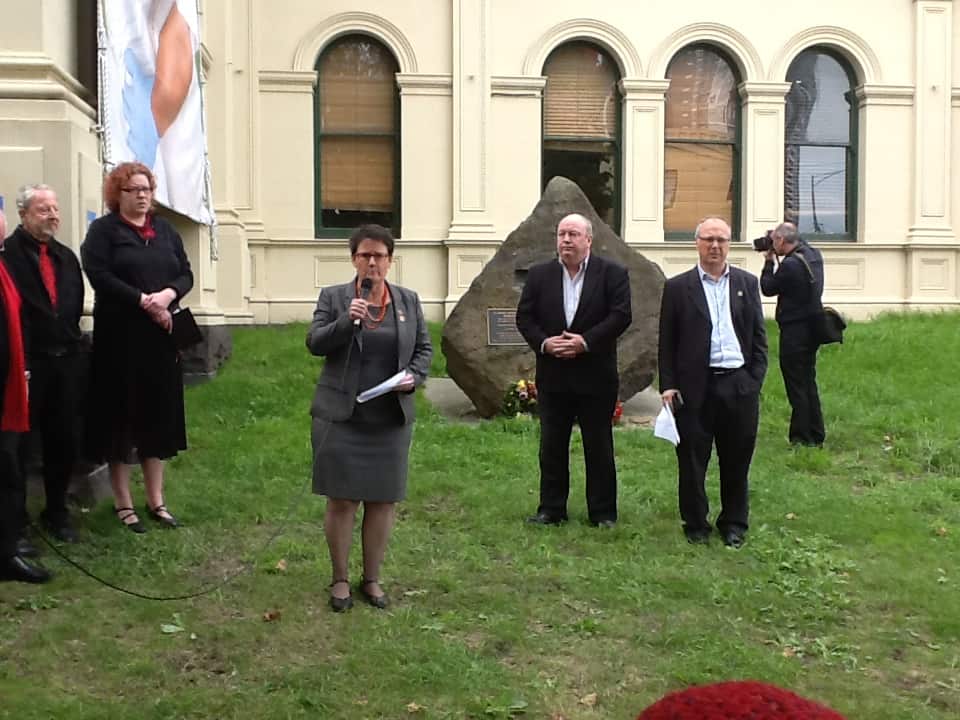
IWMD 2014 01A short time ago the International Workers Memorial Day commemoration in Melbourne, Victoria, concluded. The ceremony was less sombre than in previous years with, it seemed, fewer families and relatives of deceased workers.  Certainly there was no speech from a family member, nothing from workplace safety advocates other than the three trade union speakers, Meredith PeaceBrian Boyd and Michael Borowick (all pictured right), however there were tears for some in the crowd and wreaths were laid prior to a minute silence.

The politics was reduced this year as there were no noisy protests from the back of a tray truck and no march on Parliament afterward, however politics is never far from the surface of this type of event. Michael Borowick, Assistant Secretary of the Australian Council of Trade Unions  was the more effective of today’s three speakers.  Continue reading “Red tape (again) and Obama’s support – Melbourne’s Workers’ Memorial Day 2014”

OHS can be a force for social change, if anyone could be bothered

HesaMag should be obligatory reading for all OHS professionals, not just those in Europe. The editorial in the most recent edition (9 and not yet on line) is a great example of the value of this free magazine. It critically discusses the upcoming International Workers’ Memorial Day and its significance.

It asks for everyone to enact the commitment shown on each April 28 to every other day of the year. It says:

“Let’s not be taken in by the false sentiment on 28 April, but demand a clear and detailed accounting”

It asks why EU OHS legislation has been so slow to appear or be revised but equally, in Australia, questions should be asked about the status (failure in my opinion) of WHS harmonisaton, the lack of attention to the causes of workplace mental illness, the status of workplace bullying claims in the Fair Work Commission, the lack of attention to heavy vehicle OHS matters by the safety profession and the insidious encroachment of the perception of OHS as a failure of the individual rather than a failure in the system of work. Continue reading “OHS can be a force for social change, if anyone could be bothered”

Lessons from Royal Commission into Home Insulation Program

Australia’s Royal Commission into the Home Insulation Program (HIP) demands the attention of all occupational health and safety (OHS) professionals, primarily, because a job creation and economic stimulus program was so poorly planned at the highest level of government, that it seems to have established a culture that led to workplace deaths. However the Royal Commission is already revealing information that shows how OHS is misunderstood by decision-makers, a situation that still persists in many jurisdictions and will only change by watching the Royal Commission carefully and analysing this information through the perspective of workplace safety.

State of Knowledge

The Royal Commission has been investigating when the workplace deaths in New Zealand from using metal staples with foil insulation were known by the Australian Government.  In OHS-speak, it is trying to determine the state of knowledge on this workplace hazard in the decision-making process.  The deaths of four young Australian workers prove that the state of knowledge was inadequate however it is well established that Australia and New Zealand operate independently and that, although there are legislative similarities, it is rare for a death in one country to generate regulatory change in another.  (One could look to the quad bike safety issues for an additional example.)  The recent legislative changes in New Zealand may indicate that they listen to Australia more than vice versa.

Subscribe to SafetyAtWorkBlog to continue reading.
Subscribe Help
Already a member? Log in here

GlencoreXstrata’s annual report shows more than 26 deaths

Last week the Australian Financial Review (AFR) brought some focus on occupational health and safety (OHS) by reporting on the most recent annual report from GlencoreXstrata in its article “Mining’s not war, why 26 deaths?” (subscription required). The article is enlightening but as important is that a business newspaper has analysed an annual report in a workplace safety context.  Curiously, although OHS is often mentioned as part of its sustainability and risk management program, safety is not seen as a financial key performance indicator, and it should be.

AFR’s Matthew Stevens wrote:

“Everybody in mining talks about ‘zero harm’ being the ultimate ambition of their health and safety programs. But talking safe and living safe are two very different things.”

GlencoreXstrata’s 2013 annual report is worth a look to both verify the AFR’s quotes but also to see the corporate context in which fatality statements are stated.  The crux of the AFR article is this statement from the Chairman’s introduction:

“It is with deep sadness that I must report the loss of 26 lives at our combined operations during 2013. Any fatality is totally unacceptable and one of the Board’s main objectives is to bring about lasting improvements to our safety culture.” (page 76)

(A curious sidenote is that the interim Chairman is Dr Anthony Howard, formally of BP and brought to prominence by the Deepwater Horizon oil spill.) Continue reading “GlencoreXstrata’s annual report shows more than 26 deaths”

Coroner calls for fresh approach to OHS in small business

Ever since the UK Government reduced the occupational health and safety (OHS) obligations on small business, there have been concerns that a similar strategy could occur in Australia.  Of all the States in Australia, Victoria is the most likely to mirror the UK actions, particularly as its WorkSafe organisation continues with its restructuring and (ridiculous) rebranding, and Victoria’s conservative government continues to see OHS as a red tape issue for small business.  However a recent finding by the Queensland Coroner should be considered very seriously when thinking of OHS in small business.

In 2011 Adam Douglas Forster

” … came close to the rotating ball mill, then accidently (sic) became ensnared by the protruding bolts and was dragged underneath the ball mill which continued to rotate, thereby causing his fatal injuries.”

The inquest found

“There were no guards, barriers or other apparatus restricting access by any persons to the ball mill.” and

Forster “did not know how to turn the ball mill on or off”. Continue reading “Coroner calls for fresh approach to OHS in small business”

Workplace mental health deserves more attention

Mental health needs in the workplace has been an evolving area of study and application and has been followed by the SafetyAtWorkBlog since its inception.  Several recent statements and reports in Australia have shown that the subject continues to be discussed but not by those who can make the substantial social change, the Government, partly due to a lack of the type of evidence needed by Government to justify the change.

Mental Health is the core element of almost all the contemporary workplace hazards that are categorised as psychosocial.  This includes stress, bullying, fatigue, suicide, work/life balance, and many more.  Each of these categories are important but most reporting and a lot of the health promotion initiatives in the workplace focus on the manifestation of mental health instead of the source.

On February 21 2014 the chair of the

Subscribe to SafetyAtWorkBlog to continue reading.
Subscribe Help
Already a member? Log in here

Citi Research report provides insight into Australian corporate safety performance

On 29 January 2014 Australia’s Fairfax newspapers published an article called “Safety performances at Australia’s top companies is serious business” written by Adele Ferguson.  The article is based on an analysis by Citi Research of the safety performance of companies listed in Australia’s ASX100 share index.  Citi Research (Citi) has kindly provided SafetyAtWorkBlog with a copy of this report developed for its fund manager and superfund clients.  It is a terrific reference document providing a useful insight to the OHS performance of prominent Australian corporations.  It cannot be definitive but we know of nothing else like it in Australia.

In the Fairfax article Ferguson wrote:

“While safety is a complex issue largely due to the fact that safety records are difficult to measure and difficult to compare across companies and industries, it is an important area to explore. For starters, it is a good proxy for the way a company deals with staff and manages risk more generally.”

Safety does not have to be complex but the measurement of safety performance can be as, even though there is a (dreadfully outdated) Australian Standard for measuring OHS performance, companies tweak the existing measures and the principal measurement, the Lost Time Injury Frequency Rate (LTIFR), has been found to be a flawed indicator.  LTIFR is tolerated as a measurement simply because a better alternative has not been developed or widely accepted.

The Citi Research report lists LTIFRs for most of the 117 companies but it balances this with almost as many Total Recordable Injury Frequency Rates (TRIFR).  

Subscribe to SafetyAtWorkBlog to continue reading.
Subscribe Help
Already a member? Log in here
Concatenate Web Development
© Designed and developed by Concatenate Aust Pty Ltd