Small business can equal depression, stress and mental health problems

According to an article in  the Australian Financial Review on 16 February 2010 (only available online through subscription):

“The isolation of working at home or in a small shop or factory by themselves can wear down many in the small and medium  enterprise sector.  In the most severe cases, it can lead to depression and cause major problems for their family and business.”

Andrew Griffiths provides a quote that illustrates well the work/life conflict in the small business sector: Continue reading “Small business can equal depression, stress and mental health problems”

Vehicle crane safety alert

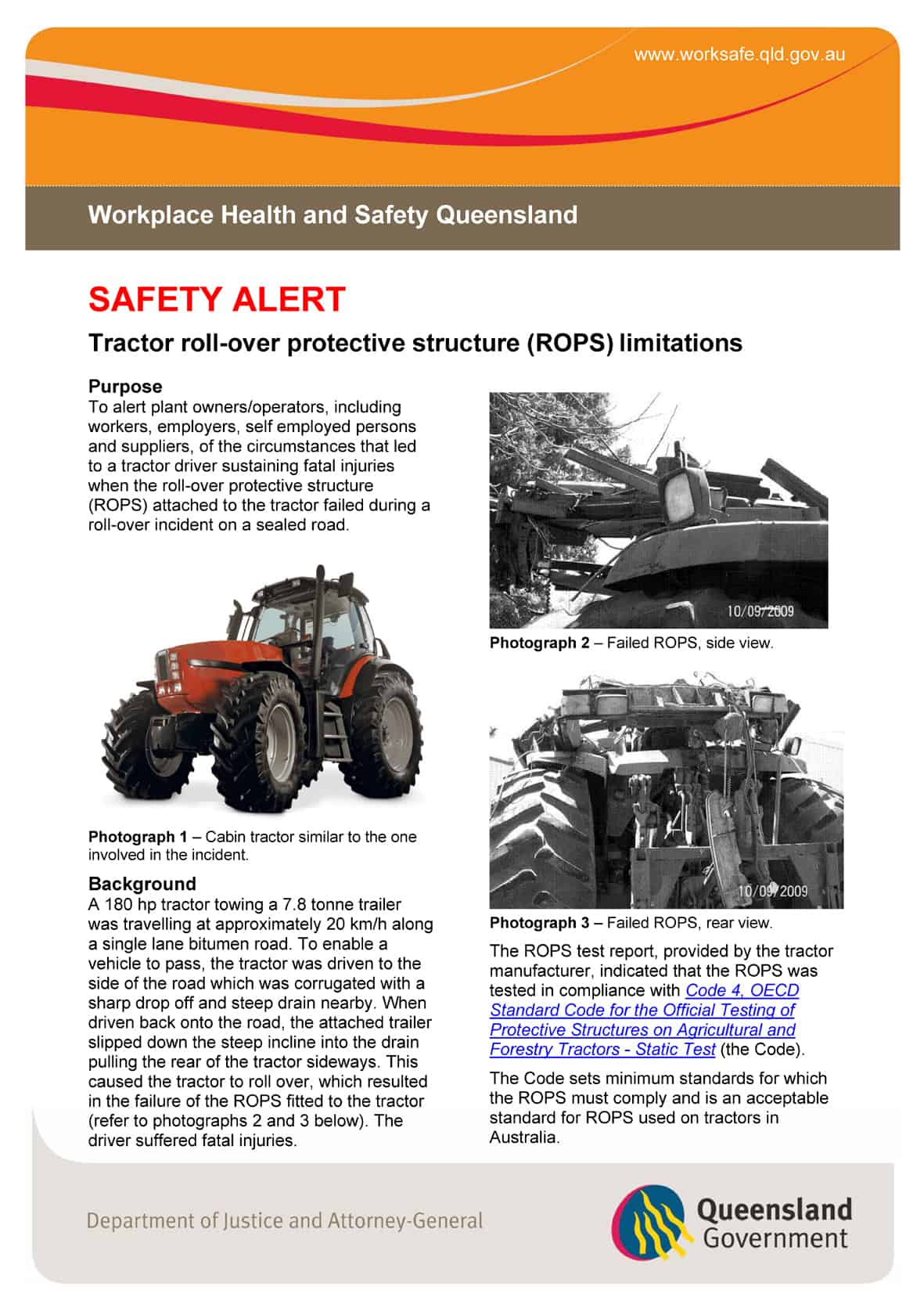
The Queensland Government has issued a safety alert of the purchasing and use of vehicle-based loading cranes (VLC).  The alert has originated from two deaths where the operator of the cranes were struck by the booms.

The safety advice offered by the government is sound – follow manufacturer’s instructions, provide suitable training – but it focusses on the lower order of control methods without asking the hard question – whether the design of such a crane is unsafe?

From the information in the alert it seems peculiar that such a crane should be on sale at all.   Continue reading “Vehicle crane safety alert”

Okay, I don’t smell but am I safe?

King Gee recently released a range of work clothing that is manufactured using a technique that reduces the wearer’s body odour.   A sample was sent to SafetyAtWorkBlog unrequested.   For those tradespeople with a body odour issue, the clothing may be a godsend, maybe more so for the people they have to work with.   The new clothing has received at least one media mention.

The issue that has stopped me from wearing the sample shirt is that the “odour-killing” properties are due to a process of:

“…. engineering molecules at the nanoscale …[that] transforms the very fibers of the fabric to provide unsurpassed odour elimination.”

Nanotechnology is a recent technology that is being applied widely but without a detailed consideration of the possible health effects to the user, the environment and to those who manufacture nano-materials. Continue reading “Okay, I don’t smell but am I safe?”

Australia’s Comcare issues safety alert on quad bikes

On 22 January 2010 Comcare issued a safety alert concerning the use of quad bikes (available on the Comcare website from 25 January 2010):

“Employers who own and operate quad bikes should be aware of the hazards and potential safety risks.

Following some recent accidents while operating quad bikes, a draft Code of Practice is currently being developed by the Federal Chamber of Automotive Industries and Distributors [FCAI] relating to the ‘Use of All Terrain Vehicles in the Workplace’.

Heads of Workplace Safety Authorities (HWSA) has also formed a working party comprising of OHS Regulators and industry representatives to look at strategies to improve quad bike safety. Continue reading “Australia’s Comcare issues safety alert on quad bikes”

Move your way to better health

Further to the recent posting on cardiovascular disease research, Dr David Dunstan participated in an online media briefing on 12 January 2010. (Video and audio interviews have begun to appear on line)

It is often difficult to identify control measures for workplace hazards from the raw research data.  Dr Dunstan, this morning elaborated on the possible workplace control measures that employers can design into workplaces in order to reduce the CVD risk from prolonged sedentary work.   Continue reading “Move your way to better health”

Sit down, get to work, get sick

Sitting for longer than four hours while watching television is likely to increase one’s risk of suffering a cardio-vascular disease (CVD), according to a new study reported in “Circulation: Journal of the American Heart Association”  in January 2010.

David Dunstan

The research was headed by Dr David Dunstan, Head of the Physical Activity Laboratory in the Division of Metabolism and Obesity at the Baker IDI Heart and Diabetes Institute in Australia.  The study is Australian but can easily be transposed to other countries. (Several audio reports are now available online, one from NPR)

The significance for safety professionals comes not from the published report itself but the accompanying media release where Dr Dunstan speculates on the broader social issues behind his findings:

“What has happened is that a lot of the normal activities of daily living that involved standing up and moving the muscles in the body have been converted to sitting…  Technological, social, and economic changes mean that people don’t move their muscles as much as they used to – consequently the levels of energy expenditure as people go about their lives continue to shrink.   For many people, on a daily basis they simply shift from one chair to another – from the chair in the car to the chair in the office to the chair in front of the television.” Continue reading “Sit down, get to work, get sick”

Nightclub fires and evacuations

Mainstream press around the world reported on the fire in a Russian nightclub over the weekend in which 100 people were killed.  One report says the nightclub owner has been arrested quotes the Russian President Dmitry Medvedev as saying

“All that has happened can only be described as a crime….I think this is absolutely clear….You have noted that a criminal investigation has been launched.  This is not a premeditated crime, but that does not reduce the gravity of the consequences. A huge number of people were killed.”

The fire reportedly started when stage pyrotechnics set fire to the ceiling.

Some readers, particularly in the United States would see distinct similarities with the  February 20 2003 in which 100 people were killed and over 200 injured.  A fire, also started by stage pyrotechnics, occurred in the Station nightclub on Rhode Island.  That whole event was captured on video.  The band’s tour manager who started the pyrotechnics, Daniel Biechele, was charged with 100 counts of involuntary manslaughter, pleaded guilty and served 4 years of a 15 year jail sentence.

The nightclub owners did not contest their charges and received similar sentences to Biechele.  Civil penalties added up to around $US175 million.

Given that the Station fire was six years ago, it is hard to understand why any nightclub would even consider using such stage pyrotechnics.

Other nightclub fires should not be forgotten although they received less coverage in the Western media.  Those with which SafetyAtWorkBlog is familiar include the 2002 fires in the Caracas nightclub, La Guajira where 47 people died, mainly from smoke inhalation.  Rumours had it that the nightclub had exceeded its allowable client limit.  Investigations showed that fire exits were not clear and the fire extinguishers were inoperative.

Although there are several incidents going back to the 1970s one that received a huge amount of attention was the December  30 2004 fire in the Republica Cromagnon nightclub in Buenos Aires. (The Wikipedia entry for this incident has a very good list of similar incidents)

The Republica Cromagnon nightclub had several of its doors shut with wire or padlocks.  The nightclub had 4,000 patrons in a premises licensed for 1,100.  Initial reports said that 715 people were injured and over 190 died from a fire that was started by a flare.

The incident generate three days of rioting and street protests of thousands of people, many were relatives of the dead.

In this case, not only were the club’s owners jailed on murder charges but city building inspectors and police officers were charged with manslaughter and corruption.  The inspectors allowed the nightclub to operate with inadequate safety standards.  The police accepted bribes from the owners and did not report the overcrowding or use of flares.

In November 2005, the mayor Buenos Aires, Anibal Ibarra, was suspended from office after the legislature voted to impeach him over issues related to the Republica Cromagnon fire.

Managing safety in nightclubs is a complex business as the industry overlaps many jurisdictional areas from workplace safety to building design to security to emergency response.  As the world moves towards the main season of celebrations with Christmas, New Year and others it is worth considering some of the more useful OHS guidelines for nightclub operation, even though such measures should have been considered well before now.

Going from the violations related to the Rhode Island fire by OSHA it would be expected for a nightclub owner to

  • Remove any highly flammable materials from the interior of the structure
  • Make sure that exit doors are visible at all times
  • have a written emergency action plan
  • have a written fire prevention plan
  • nominate and train staff to assist in a safe and orderly evacuation of other employees
  • review fire hazards with employees.

Seattle has a nightclub patron safety handout.

One guide from Virginia specifically references the Station nightclub fire.

The Health and Safety Executive has a guide to assessing risks in nightclubs as well as general OHS advice for the hospitality and leisure industries.

WorkSafe Victoria has a guide on crowd control which may also be useful

Many local jurisdictions have guidelines, or the industry itself has developed guidelines, to assist in the management of nightclub crowds.  SafetyAtWorkBlog urges owners and staff to undertake reviews prior to peak times.

Kevin Jones

Concatenate Web Development
© Designed and developed by Concatenate Aust Pty Ltd