Industrial Manslaughter or Category 1. Which prevents harm more effectively?

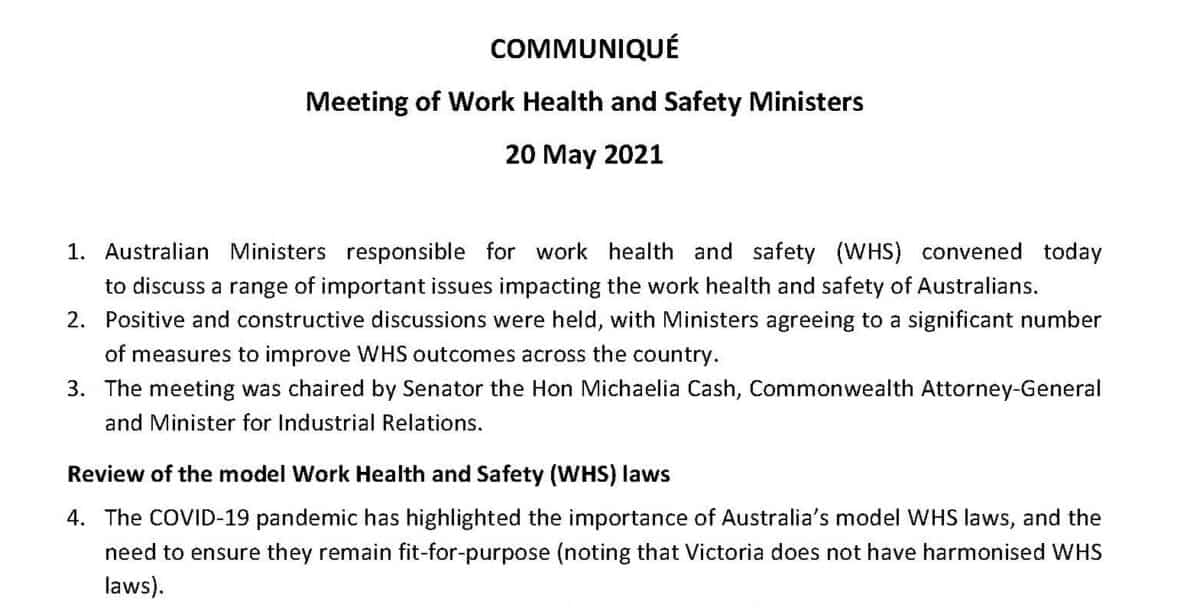
The Communique issued after the May 20, 2021 meeting of the Work Health and Safety (WHS) Ministers says that Australia is not likely to apply an Industrial Manslaughter law nationally:

“While the Northern Territory, Queensland, Western Australia, the Australian Capital Territory and Victoria provided their support for an industrial manslaughter offence, the recommendation did not receive the required majority.”

Some people think that this is no real failure as the Communique also includes “defacto ‘industrial manslaughter’ laws”. Here is the quote that supports that position:

Subscribe to SafetyAtWorkBlog to continue reading.
Subscribe Help
Already a member? Log in here

Psychological harm gets new regulations and funding access

The State of Victoria had a big week on mental health, with the Labor Government allocating billions of dollars to the improvement of the mental health of its citizens. Much of the justification for the spend (and the imposition of a mental health levy on large companies) is in response to the recent Royal Commission into Mental Health Systems. Workplace health and safety was on the agenda in that Royal Commission. Hence, it is worth looking at how, or if, this recent Budget helps employers improve the psychological health of their workers in anticipation of new regulations on this hazard promised by Victoria’s Minister for Workplace Safety, Ingrid Stitt.

Subscribe to SafetyAtWorkBlog to continue reading.
Subscribe Help
Already a member? Log in here

Industrial Manslaughter presents an empty hook

New South Wales’ Opposition Minister for Industrial Relations, Adam Searle, spoke recently in support of the introduction of Industrial Manslaughter (IM) laws. In Parliament on May 5 2021, he said

“… legislation is required to enable the prosecution of industrial manslaughter and to fundamentally change the approach across industry in order to raise the standard and embed a culture of workplace safety of a much higher and more stringent nature. We need a culture that supports workplace safety in our State, not a culture, as I indicated before, that allows and encourages the cutting of corners and the fostering of unsafe workplaces…..

page 43, Hansard,

Legislation can achieve many things but not by itself, and that reality often makes such penalties like Industrial Manslaughter little more than symbolic.

Subscribe to SafetyAtWorkBlog to continue reading.
Subscribe Help
Already a member? Log in here

“reasonably practicable” reduces workers to a cash value

Legal interpretations dominate occupational health and safety (OHS). Understandably, if OHS is only determined by laws, but if the safety of workers is a moral imperative to you, the law is less significant. This latter perspective is rarely voiced, and one of the most important elements of OHS law is compliance “as far as is reasonably practicable” (ASFAIRP). ASFAIRP makes business sense but not necessarily safety sense, especially when one is dealing with the recent phenomenon of work-related mental health.

Some of the most powerful discussions on ASFAIRP and its place in providing safe and healthy workplaces occurred over a decade ago. However, the issue still resonates, and its perspective deserves continuous consideration.

Subscribe to SafetyAtWorkBlog to continue reading.
Subscribe Help
Already a member? Log in here

New workplace mental health info but no new strategy

On May 20, 2021, Australia’s Work Health and Safety (WHS) Ministers to discuss a range of occupational health and safety (OHS) matters. One matter will be the inclusion of a specific requirement on employers that, according to the Australian Council of Trade Unions (ACTU):

“…. would finally require employers to identify and address risks to mental health, in the same way, they are required to with risks to physical health.”

What the ACTU fails to make clear is why this regulatory change is required when the duty to provide a physically and psychologically safe and healthy workplace already exists in the current OHS/WHS laws in Australia.

The ACTU does, however, with the help of the Australia Institute and Centre for Future Work, provide more data on work-related mental health. The union movement is one of the few voices that acknowledge the structural elements of OHS but fails to consider any options other than regulation and, with a federal conservative government in power, it is unlikely to receive an attentive audience.

Subscribe to SafetyAtWorkBlog to continue reading.
Subscribe Help
Already a member? Log in here

Resilience = the enemy of the Duty of Care

Last year Professor Michael Quinlan and Dr Elsa Underhill wrote about how precarious work arrangements had contributed to the spread and prevalence of COVI19 in Australia and its workplaces. Soon Australia’s Treasurer, Josh Frydenburg, will announce his 2021-22 Budget strategy. It is forecast to include big government spending and in many different areas of Australian industry, but the economy and Australians’ health may be better served by addressing the precarious employment structures on which more and more businesses rely and about which the Government seems disinterested.

In the latest edition of Griffith Review (no. 72), Angela Smith looked at how embedded precarious work is in Australia’s economic rebound. She also looked at how the wellbeing and wellness industries compound the health and safety risks of this type of work in this time of COVID19.

Subscribe to SafetyAtWorkBlog to continue reading.
Subscribe Help
Already a member? Log in here

“Hmm, do tell me more” – safety leadership

Recently the Australian Institute of Health and Safety (AIHS) conducted a lunchtime online seminar on leadership. The speakers were prominent Australian women – Naomi Kemp, Diane Smith-Gander, Kirstin Ferguson and Queensland Minister Grace Grace. Although the seminar was hosted as part of the Women in Safety and Health group, these events are open to everyone. As work-related sexual harassment has shown, men are as involved in the process of safety and harm prevention as are women.

One of the biggest weaknesses of any safety management system, safety culture or safety leadership, comes from hypocrisy. Leaders state the importance of occupational health and safety (OHS) to the business then make decisions where OHS and worker welfare is dismissed or minimised, or rationalised dubiously to “as far as is reasonably practicable”.

Smith-Gander spoke about how executives should embed OHS into all the Board and executive decisions beyond the obligatory and often poor quality “Safety Moments” at the start of a meeting.

Subscribe to SafetyAtWorkBlog to continue reading.
Subscribe Help
Already a member? Log in here
Concatenate Web Development
© Designed and developed by Concatenate Aust Pty Ltd